Nucleósidos
Se han encontrado 3569 productos de "Nucleósidos"
7-Deaza-2'-deoxy-7-iodoadenosine
CAS:7-Deaza-2'-deoxy-7-iodoadenosine (7DADI) is a modified nucleoside that has antiviral and anticancer properties. It is synthesized by the reaction of 2'-deoxyadenosine with iodine in the presence of an activator such as sodium hypochlorite. 7DADI binds to ribonucleosides, forming a phosphoramidate bond at the 3' position, which leads to inhibition of viral RNA synthesis and DNA replication. This drug also inhibits the growth of cancer cells by inhibiting DNA synthesis and protein synthesis. 7DADI is novel because it is not found in nature or produced by any other organism.
Fórmula:C11H13IN4O3Pureza:Min. 98 Area-%Peso molecular:376.16 g/mol3’-O-Levulinyl-2’-deoxyadenosine
CAS:3’-O-Levulinyl-2’-deoxyadenosine is a nucleoside and a prodrug for the anticancer drug 2’,3’-dideoxyadenosine. 3’-O-Levulinyl-2’-deoxyadenosine is an activator of deoxyribonucleic acid (DNA) synthesis and also inhibits DNA repair. In mammals, 3’-O-levulinyl-2’deoxyadenosine is converted to 2’,3′ dideoxyadenosine monophosphate (ddAMP), which can be phosphorylated to ddATP in cells. 3′ -O -levulinyl -2′ -deoxyadenosine has been shown to inhibit the growth of cancer cells in vitro and in vivo.
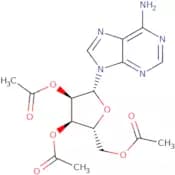
Pureza:Min. 95%2',3',5'-Tri-O-acetyladenosine
CAS:2',3',5'-Tri-O-acetyladenosine is a chemically protected form of adenosine with potential for use as an intermediate in nucleoside synthesis and nucleic acid chemistry. The hydroxyl (–OH) groups at the 2′, 3′, and 5′ positions of the ribose are protected by acetyl groups (–COCH₃), which can prevent unwanted chemical reactions during chemical synthesis.
Fórmula:C16H19N5O7Pureza:Min. 95%Forma y color:PowderPeso molecular:393.35 g/molRef: 3D-NT04548
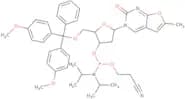
Producto descatalogadoFurano-dt cep
CAS:Furano-dt cep is a novel antiviral drug that has been shown to inhibit the production of viral nucleic acid and to activate the immune system. Furano-dt cep is a phosphoramidite compound that is synthesized from ribonucleosides and deoxyribonucleosides, which are modified with 2,2-dithiobis(propionitrile). Furano-dt cep binds to the 5'-terminal phosphate group on the DNA strand, preventing RNA synthesis. Furano-dt cep also inhibits tumor growth by causing cell death through apoptosis.
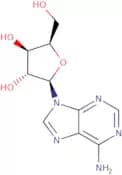
Fórmula:C42H49N4O8PPureza:Min. 95%Peso molecular:768.8 g/mol9-(β-D-Xylofuranosyl)adenine
CAS:9-(β-D-Xylofuranosyl)adenine is a nucleoside analog that inhibits the activity of adenine nucleotide. It has been shown to be effective against a wide range of viruses and bacteria, including HIV, herpes simplex virus, influenza A virus, and Mycobacterium tuberculosis. The chemical structure of 9-(β-D-Xylofuranosyl)adenine resembles that of adenosine and this similarity confers inhibitory properties on it. 9-(β-D-Xylofuranosyl)adenine is an analog of adenosine. The steric interactions between the intramolecular hydrogen bonds in 9-(β-D-Xylofuranosyl)adenine are weaker than those in adenosine, which allows it to bind more easily with the enzyme responsible for the conversion of adenosine to inosinic acid. This inhibition prevents the formation of ATP from AMP, leading
Fórmula:C10H13N5O4Pureza:Min. 95%Forma y color:PowderPeso molecular:267.24 g/molRef: 3D-FX144729
Producto descatalogado2'-Deoxyinosine
CAS:2'-Deoxyinosine is an antimicrobial peptide that has been shown to have potent activity against Gram-positive bacteria, including Staphylococcus aureus. 2'-Deoxyinosine binds to the 3′-hydroxyl group of nucleic acid, preventing DNA replication and transcription. This binding also prevents ribosomal RNA from binding to the ribosome, inhibiting protein synthesis. 2'-Deoxyinosine has been detected using a highly sensitive optical sensor and can be used as a model system for studying the interaction between dsDNA duplexes and other biomolecules. The pharmacokinetic properties of this molecule have been determined in rats by measuring its concentration in serum over time after injection. These data were then used to determine the amount of 2'-deoxyinosine that was needed to inhibit bacterial growth in water samples.
Fórmula:C10H12N4O4Pureza:Min. 98 Area-%Forma y color:White PowderPeso molecular:252.23 g/molRef: 3D-ND05750
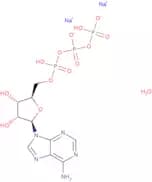
Producto descatalogadoAdenosine 5'-triphosphate disodium salt hydrate
CAS:Adenosine 5'-triphosphate disodium salt hydrate (ATP 2Na) is a nucleoside triphosphate acting as the essential part of energy storage and metabolism in vivo. It plays a crucial role in many biological processes including neurotransmission, signal transduction, muscle contraction and cardiac function, often described as the "molecular unit of currency" for intracellular energy transfer.
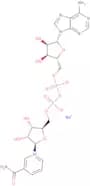
Fórmula:C10H14N5Na2O13P3·xH2OPureza:Min. 97 Area-%Forma y color:White PowderPeso molecular:551.14 g/molβ-Nicotinamide adenine dinucleotide sodium dihydrate
CAS:Coenzyme and regenerating electron donor in catabolic processes
Fórmula:C21H26N7NaO14P2•(H2O)2Pureza:Min. 95%Forma y color:White PowderPeso molecular:721.44 g/molRef: 3D-NN44827
Producto descatalogadoStavudine 5'-triphosphate sodium salt - 100 mM aqueous solution
Stavudine 5'-triphosphate sodium salt is a modified nucleoside analog with antiviral and anticancer properties. It is a phosphoramidate of stavudine, which has been modified by the replacement of the L-cysteine moiety with a 2-thiophenecarboxamide group. The novel chemical structure of stavudine 5'-triphosphate sodium salt leads to higher solubility in water than other analogues and improved pharmacokinetics. Stavudine 5'-triphosphate sodium salt is an activator for the synthesis of DNA, RNA, and protein. It also inhibits viral replication by interfering with viral DNA polymerase and ribonucleotide reductase, which are essential enzymes for viral replication.Fórmula:C10H17N2O13P3·xNaPureza:Min. 95 Area-%Forma y color:Clear LiquidPeso molecular:466.17 g/mol5-Bromo-2'-deoxyuridine
CAS:5-Bromo-2'-deoxyuridine (5-BrDU) is a nitrate reductase inhibitor that prevents the reduction of nitrate to nitrite by inhibiting the enzyme nitrate reductase. It is a genotoxic agent that has been shown to cause DNA damage and cell death in vitro. 5-BrDU has been shown to induce preconditioning in vivo, reducing neuronal injury after ischemia. This drug also binds to NMDA receptors and may be useful as a model system for studying neurodegenerative diseases such as Alzheimer's disease. 5-BrDU has been shown to inhibit the polymerase chain reaction in wild-type strains of bacteria, but not in strains with a mutation in their DNA gyrase genes.
Fórmula:C9H11BrN2O5Pureza:Min. 99 Area-%Forma y color:White Off-White PowderPeso molecular:307.1 g/molRef: 3D-NB06315
Producto descatalogadoN2-Isobutyryl-N-trityl-morpholino guanine
CAS:N2-Isobutyryl-N-trityl-morpholino guanine is a synthetic nucleoside analogue. It has been shown to be an activator of ribonucleotide reductase, and it is a potential anticancer agent. N2-Isobutyryl-N-trityl-morpholino guanine has also been shown to inhibit the replication of DNA and RNA viruses. This compound is being studied for its possible use in the treatment of HIV infection, as well as other viral infections that affect the central nervous system.
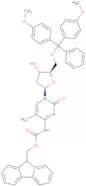
Pureza:Min. 95%2'-Deoxy-5’-O-DMT-N4-Fmoc-5-methylcytidine
CAS:2'-Deoxy-5'O-DMT-N4-Fmoc-5-methylcytidine is a modified nucleoside that is used to synthesize antiviral ribonucleosides and deoxyribonucleosides. It can be used to synthesize novel anticancer drugs, which are effective against tumor cells.
Pureza:Min. 95%7-Deaza-2'-deoxy-7-iodoguanosine
CAS:The phosphoramidite 7-Deaza-2'-deoxy-7-iodoguanosine is a modified nucleotide that is used in the synthesis of DNA. This compound has antiviral and anticancer properties, as it inhibits viral replication by preventing the synthesis of viral RNA or DNA. It also prevents the production of cancer cells by inhibiting ribonucleotide reductase, an enzyme that reduces ribonucleotides to deoxyribonucleotides for DNA synthesis. The purity of this product is high and the novel nature of this product makes it a valuable reagent for research.
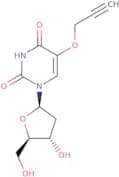
Fórmula:C11H13IN4O4Pureza:Min. 97 Area-%Peso molecular:392.16 g/mol2'-Deoxy-5-propargyloxyuridine
CAS:2'-Deoxy-5-propargyloxyuridine is a synthetic compound that inhibits the herpes simplex virus by inhibiting thymidylate synthase, an enzyme in the synthesis of DNA. It is used to study the growth rate of herpes virus and has been shown to inhibit murine leukemia L1210 and human l1210 cells at concentrations of 10-20 μg/mL. 2'-Deoxy-5-propargyloxyuridine has also been shown to have inhibitory activities against other viruses, such as polio virus and influenza virus. 2'-Deoxy-5-propargyloxyuridine inhibits biosynthesis by binding to enzymes involved in the synthesis of nucleic acids. The inhibitory dose for this compound is not yet known, but it has been shown to have an inhibitory effect on cell culture when preincubated with cells before infection with herpes simplex virus.
Fórmula:C12H14N2O6Pureza:Min. 95%Forma y color:PowderPeso molecular:282.26 g/molRef: 3D-ND08234
Producto descatalogado5-Ethynyl-2'-O-methyluridine triphosphate
5-Ethynyl-2'-O-methyluridine triphosphate is a novel nucleoside that contains a methyl group at the 5 position of the uracil ring. It is an antiviral agent for use in the treatment of HIV, herpes simplex virus, cytomegalovirus, and influenza virus infections. 5-Ethynyl-2'-O-methyluridine triphosphate is also used as a precursor to synthesize DNA and RNA. This compound has been shown to have anticancer properties against breast cancer cells.
Pureza:Min. 95%5’(R)-C-Methyluridine
CAS:5’(R)-C-Methyluridine is a synthetic nucleoside that is an antiviral agent. It inhibits the enzyme RNA polymerase and thereby prevents the production of viral RNA. The compound can be used as a potential anticancer drug because it inhibits the synthesis of DNA in tumor cells. 5’(R)-C-Methyluridine has been shown to inhibit the growth of some bacterial species, such as Mycobacterium tuberculosis, but not other bacteria, such as Escherichia coli.
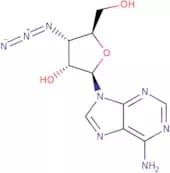
Pureza:Min. 95%3'-Azido-3'-deoxyadenosine
CAS:3'-Azido-3'-deoxyadenosine is an initiator that can be used in oligoribonucleotide synthesis. It is stable, nonhydrolyzable and does not require any protecting groups for its use. 3'-Azido-3'-deoxyadenosine is efficient at initiating the synthesis of ribosomal RNA and has been shown to be a good substrate for biochemical studies. This compound is functionalized with a ribose group, which can be linked to other substances. The linkage of this compound to other substances allows it to be used as a building block for the production of oligoribonucleotides.
Fórmula:C10H12N8O3Pureza:Min. 95%Forma y color:PowderPeso molecular:292.25 g/molRef: 3D-FA144620
Producto descatalogado5-(Carboxymethyl)uridine
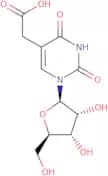
CAS:5-(Carboxymethyl)uridine is an uridine compound that has been shown to inhibit protein synthesis in cultured cells. It binds to the ribosome and inhibits protein synthesis by inhibiting the formation of peptide bonds. 5-Carboxymethyl-uridine has been shown to be effective against two strains of bacteria, Escherichia coli and Staphylococcus aureus, in cell culture experiments. The inhibition of bacterial protein synthesis was shown to be dose-dependent for both strains. The mechanism of action is believed to be due to its binding to the ribosome and inhibiting the formation of peptide bonds.
Fórmula:C11H14N2O8Pureza:Min. 95 Area-%Forma y color:White Off-White PowderPeso molecular:302.24 g/molRef: 3D-NC159474
Producto descatalogado9-(2’-Deoxy-2’-fluoro-arabinofuranosyl)adenine 5’-triphosphate triethyl ammonium salt
Ai Product Descriptions 50 Creative
Pureza:Min. 95%Morpholino C monomer
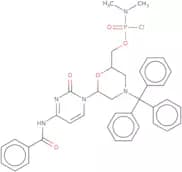
CAS:Morpholino C monomer is a nucleoside amidite used to prepare morpholino oligomers
Fórmula:C37H37ClN5O5PPureza:Min. 98 Area-%Forma y color:White PowderPeso molecular:698.15 g/molRef: 3D-PM137473
Producto descatalogado