Nucleósidos
Los nucleósidos son building blocks fundamentales de los ácidos nucleicos, compuestos por una base nitrogenada unida a una molécula de azúcar. En esta sección, puede encontrar una amplia variedad de nucleósidos esenciales para la investigación en biología molecular, bioquímica y farmacología. Estos compuestos juegan roles cruciales en la síntesis de ADN y ARN, y son vitales en varios procesos metabólicos. Los nucleósidos se utilizan para estudiar material genético, desarrollar terapias antivirales y anticancerígenas, y comprender los mecanismos celulares. En CymitQuimica, proporcionamos nucleósidos de alta calidad para apoyar sus necesidades de investigación y desarrollo, asegurando pureza y fiabilidad para sus aplicaciones experimentales.
Se han encontrado 3569 productos de "Nucleósidos"
Ordenar por
Pureza (%)
0
100
|
0
|
50
|
90
|
95
|
100
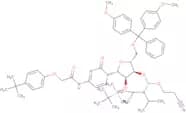
2'-O-tert-Butyldimethylsilyl-N4-(tert-butylphenoxyacetyl)-5'-O-DMT-cytidine 3'-CE phosphoramidite
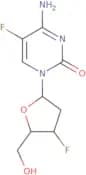
CAS:2'-O-tert-Butyldimethylsilyl-N4-(tert-butylphenoxyacetyl)-5'-O-DMT-cytidine 3'-CE phosphoramidite is a DNA synthesis reagent that is used in the preparation of oligonucleotides, in particular for the synthesis of 2'-deoxyribonucleosides. It has been shown to be an activator and to have anticancer, antiviral, and antimalarial properties. This compound is synthesized by reacting 5'-O-DMT cytidine with 2',3' epoxypropyltrichlorophosphite. The product is purified by silica gel column chromatography and recrystallization from ethanol followed by vacuum drying. CAS No. 149989-66-2Fórmula:C57H76N5O10PSiPureza:Min. 95%Peso molecular:1,050.3 g/mol2',3'-Dideoxy-3',5-difluorocytidine
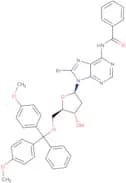
CAS:<p>2',3'-Dideoxy-3',5-difluorocytidine (ddF) is a nucleotide analogue that inhibits the viral polymerase. It binds to the enzyme and prevents it from synthesizing DNA, which is needed for viral replication. ddF has been shown to be effective against different types of cancer cells, including breast and prostate cancers. This drug also has antiviral properties and is used as an antiviral agent in AIDS therapy. ddF may also be used as a precursor in the synthesis of other nucleosides or nucleotides.</p>Pureza:Min. 95%5'-O-DMT-8-Bromo-N6-(benzoyl)-2′-deoxyadenosine
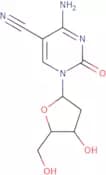
CAS:Bromo substituted deoxyadenosineFórmula:C38H34BrN5O6Peso molecular:736.61 g/mol5-Cyano-2'-deoxycytidine
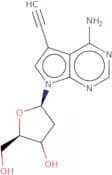
CAS:Nucleobase functionalised deoxynucleosideFórmula:C10H12N4O4Pureza:Min. 95%Peso molecular:252.23 g/mol7-Deaza-2'-deoxy-7-ethynyladenosine
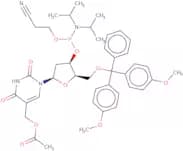
CAS:<p>7-Deaza-2'-deoxy-7-ethynyladenosine is a fluorescent analog of adenosine that has been synthesized to be used as an antimicrobial agent. This compound has shown to be effective against both Gram-positive and Gram-negative bacteria, including methicillin resistant Staphylococcus aureus and Escherichia coli. 7DDAE is also able to inhibit the growth of fungus and yeast, such as Candida albicans. This drug has been shown to have no cytotoxic effects on mammalian cells at concentrations up to 50 μM. 7DDAE has been found to be very photostable in solution, which means it does not degrade when exposed to light.</p>Fórmula:C13H14N4O3Pureza:Min. 95%Forma y color:PowderPeso molecular:274.28 g/mol2'-Deoxy-5'-O-DMT-5-acetoxymethyluridine 3'-CE phosphoramidite
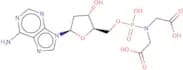
CAS:2'-Deoxy-5'-O-DMT-5-acetoxymethyluridine 3'-CE phosphoramidite is a novel nucleoside analogue with anticancer activity. It is synthesized from 2'-deoxy-5'-O-DMT-5-acetoxymethyluridine and 3'-chloroethyl phosphate. The compound has been shown to inhibit DNA, RNA, and protein synthesis in vitro, as well as to induce apoptosis in human cancer cell lines. 2'-Deoxy-5'-O-DMT-5-acetoxymethyluridine 3'-CE phosphoramidite is a modified nucleoside that can be used in the production of oligonucleotides for use in gene therapy.Fórmula:C42H51N4O10PPureza:Min. 95%Peso molecular:802.85 g/molIDA-dAMP
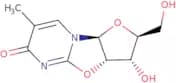
An iminodiacetic acid phophoramidite. This acts as a pyrophosphate mimic so behaves as a leaving group in the enzymatic polymerisation of deoxyribonucleic acids.Fórmula:C14H19N6PO9Peso molecular:446.31 g/mol2,2'-Anhydro-L-thymidine
CAS:2,2'-Anhydro-L-thymidine is an antiviral, anticancer agent and a synthetic nucleoside. It is a monophosphate that was first synthesized in 1967 and has been used as a potential antiviral agent. 2,2'-Anhydro-L-thymidine has been shown to be effective against the herpes simplex virus type 1 (HSV1). However, it does not inhibit viral nucleic acid synthesis or viral protein synthesis. It also does not inhibit the growth of tumor cells in culture.Fórmula:C10H12N2O5Pureza:Min. 95%Forma y color:PowderPeso molecular:240.21 g/molCytidine 5'-diphosphoglycerol disodium salt
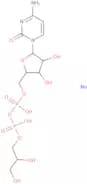
CAS:Cytidine 5'-diphosphoglycerol disodium salt is a modified nucleotide that belongs to the group of phosphoramidites. It is a cytidine derivative with a 2-hydroxymethylene bridge, which makes it resistant to degradation by cytidine deaminase and therefore enhances its anticancer activity. Cytidine 5'-diphosphoglycerol disodium salt has been shown to inhibit the growth of cancer cells in vitro and in vivo models, as well as inhibit viral replication. Cytidine 5'-diphosphoglycerol disodium salt is stable at high temperatures and can be used for activation of DNA synthesis in vitro. This product has not been tested on animals or humans and should not be taken internally.Fórmula:C12H19N3Na2O13P2Pureza:Min. 95%Peso molecular:521.22 g/mol7-Deaza-2'-deoxyguanosine-5'-triphosphate sodium salt - 10mM aqueous solution
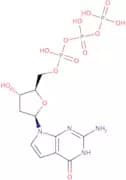
CAS:<p>7-Deaza-2'-deoxyguanosine-5'-triphosphate sodium salt is a cytosolic small molecule that inhibits the activity of telomerase, an enzyme involved in the replication of chromosomes. It also has inhibitory effects on kinase domains and may be used to treat cancer. 7-Deaza-2'-deoxyguanosine-5'-triphosphate sodium salt binds to human mitochondrial DNA and inhibits gene transcription by hybridizing with it. This results in the inhibition of dopamine production, which can be helpful for treating Parkinson's disease. 7-Deaza-2'-deoxyguanosine-5'-triphosphate sodium salt is structurally similar to 2'-deoxyadenosine 5'-triphosphate (dATP) and can be incorporated into DNA by phosphorylation to form a covalent bond that disrupts the dATP/ATP ratio. This causes cellular energy production to decrease and</p>Fórmula:C11H17N4O13P3·xNaPureza:Min. 95%Peso molecular:506.19 g/molThymidine 3'-monophosphate sodium salt
CAS:Thymidine 3'-monophosphate sodium salt (TMP) is a nucleoside that is involved in the synthesis of DNA. TMP has been shown to have minimal carcinogenic effects on the liver, with no effect on the rate of DNA synthesis or cell proliferation in vivo. It has been shown to be hepatotoxic and genotoxic in animal studies and can cause DNA strand breaks and chromosomal aberrations in liver cells. TMP also causes a specific adduct, crotonaldehyde, which is considered to be an indicator of hepatic injury. The detection method for this adduct uses gas chromatography-mass spectrometry, which identifies the presence of TMP by detecting its unique mass spectrum.Fórmula:C10H15N2O8P•xNaPureza:Min. 95%Forma y color:Powder2',3'-Dehydro-5'-O-tritylthymidine
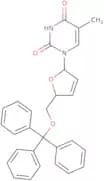
CAS:<p>2',3'-Dehydro-5'-O-tritylthymidine is an anticancer compound, which is a novel nucleoside phosphoramidite. It is synthesized from thymidine in two steps: first, the 2',3'-dideoxyribose phosphate moiety is prepared by reacting 2',3'-dideoxyribose with chloroacetic acid in the presence of triethylamine, followed by reaction with trityl chloride to form the 5' position of the thymidine. 2',3'-Dehydro-5'-O-tritylthymidine has been shown to inhibit DNA synthesis and antiviral activity.</p>Fórmula:C29H26N2O4Pureza:Min. 95%Peso molecular:466.54 g/molGuanosine-2'(&3')-monophosphate disodium (mixed isomers)
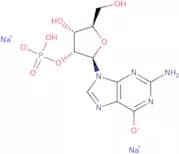
CAS:Guanosine-2'(&3')-monophosphate disodium salt (mixed isomers) is a synthetic nucleoside with antiviral and anticancer properties. It has been shown to activate the transcription of DNA in vitro by binding to the promoter region, resulting in higher levels of RNA synthesis. Guanosine-2'(&3')-monophosphate disodium salt (mixed isomers) has been shown to inhibit the replication of viruses, such as herpes simplex virus type 1 (HSV-1), and it may have potential use in cancer therapy. The drug is also used as a precursor for other antiviral drugs and antibiotics. Guanosine-2'(&3')-monophosphate disodium salt (mixed isomers) is available in high purity, high quality, and at low cost.Fórmula:C10H14N5O8P•2NaPureza:Min. 95%Forma y color:White PowderPeso molecular:407.18 g/molN6-Benzoyl-2'-deoxy-5'-O-DMT-adenosine 3'-thiophosphoramidite
<p>N6-Benzoyl-2'-deoxy-5'-O-DMT-adenosine 3'-thiophosphoramidite is a modified phosphoramidite that can be used to synthesize DNA oligomers. The nucleoside is an antiviral and antitumor agent. It is also used to inhibit the replication of RNA by inhibiting the activity of DNA polymerase. N6-Benzoyl-2'-deoxy-5'-O-DMT-adenosine 3'-thiophosphoramidite has novel properties that have not been seen in any other nucleosides. This product is for research use only, not for diagnostics or therapeutic purposes.</p>Fórmula:C51H51N6O7PS2Pureza:Min. 95%Peso molecular:955.09 g/mol2'-Deoxy-5-fluorouridine-5'-triphosphate sodium salt - 100 mM solution in water
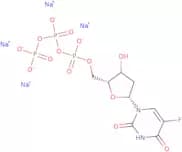
CAS:<p>2'-Deoxy-5-fluorouridine-5'-triphosphate sodium salt - 100 mM solution in water is a nucleotide analog that inhibits the synthesis of RNA. It is used for the treatment of cancer. This agent binds to DNA and prevents the formation of RNA by inhibiting the enzyme ribonucleotide reductase. 2'-Deoxy-5-fluorouridine-5'-triphosphate sodium salt - 100 mM solution in water also has a perchloric acid component, which may be responsible for its haematopoietic effects.</p>Fórmula:C9H14FN2O14P3·xNaPureza:Min. 95%Forma y color:PowderPeso molecular:486.13 g/molLauroyl coenzyme A potassium salt
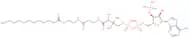
CAS:<p>Lauroyl coenzyme A potassium salt is a potent inhibitor of fatty acid synthase. It has the ability to inhibit the enzyme activity of fatty acid synthase in vitro, which belongs to the class of irreversible inhibitors. Lauroyl coenzyme A potassium salt inhibits the synthesis of fatty acids by inhibiting the enzyme activity of fatty acid synthase. This inhibitor also reversibly inhibits other enzymes with a similar mechanism, such as acetyl-coenzyme A carboxylase and phosphatidate phosphohydrolase. The reaction mechanism can be understood through titration calorimetry studies, demonstrating that lauroyl coenzyme A potassium salt binds to the active site of these enzymes and blocks access to substrates. The binding affinity is higher for wild type strains than for mutant strains, which may be due to differences in protein structure or other factors. Lauroyl coenzyme A potassium salt has been shown to have no effect on wild-type strains but inhibits polymer</p>Fórmula:C33H55N7O17P3SK3Pureza:Min. 95%Forma y color:PowderPeso molecular:1,064.11 g/molOctanoyl coenzyme A lithium salt hydrate
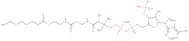
CAS:Octanoyl coenzyme A lithium salt hydrate (OCCA) is a metabolite of octanoic acid, which is formed by the oxidation of fatty acids. OCCA has been shown to have relevance in the metabolism of fatty acids, as it can be conjugated with other molecules and transported into cells. This compound has been detected in human liver tissues and was found to be metabolized by primary rat hepatocytes in vitro. The metabolic pathway of OCCA is not yet fully understood, but it has been investigated in vivo studies.Fórmula:C29H50N7O17P3S·xLi·yH2OPureza:Min. 95%Peso molecular:893.73 g/mol2'-Amino-2'-deoxycytidine-5'-triphosphate
CAS:2'-Amino-2'-deoxycytidine-5'-triphosphate is an inhibitor of viral RNA polymerase. It is a nucleoside analogue that mimics the natural substrate for the enzyme, 2'-deoxycytidine-5'-triphosphate. This compound binds to the active site of viral RNA polymerases and blocks their ability to synthesize RNA. The compound has been shown to inhibit the replication of norovirus and HIV in cell culture. 2'-Amino-2'-deoxycytidine-5'-triphosphate binds to metal ions in the active site of the enzyme, which prevents its binding with the template strand and prevents elongation of RNA synthesis.Fórmula:C9H17N4O13P3Pureza:Min. 95%Peso molecular:482.17 g/molTrebler phosphoramidite
CAS:<p>Please enquire for more information about Trebler phosphoramidite including the price, delivery time and more detailed product information at the technical inquiry form on this page</p>Fórmula:C86H101N2O14PPeso molecular:1,417.7 g/molN4-Benzoyl-3',5'-O-(1,1,3,3-tetraisopropyl-1,3-disiloxanediyl)cytidine
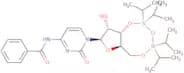
CAS:N4-Benzoyl-3',5'-O-(1,1,3,3-tetraisopropyl-1,3-disiloxanediyl)cytidine is a boron trifluoride etherate catalyst that catalyzes the synthesis of cytidine from uridine. This catalyst is stable and can be used for many reactions. It yields a trifluoromethanesulfonate as a byproduct. The trifluoromethanesulfonate can be converted to a boronic acid or ester by treatment with base or acid respectively. The etherate can also be converted to an alcohol using hydrogen chloride gas and methanol. N4-Benzoyl-3',5'-O-(1,1,3,3-tetraisopropyl-1,3-disiloxanediyl)cytidine has been shown to catalyze the isomerFórmula:C28H43N3O7Si2Pureza:Min. 95%Forma y color:PowderPeso molecular:589.83 g/mol