Nucleósidos
Se han encontrado 3569 productos de "Nucleósidos"
8-Bromoadenosine 3',5'-cyclic monophosphate sodium salt
CAS:Membrane-permeable brominated cAMP analog and activator of cAMP-dependent protein kinase A (PKA). In stem cell research, the compound enhanced the induction of pluripotency and efficiency of cellular reprogramming of human neonatal fibroblasts that were transduced with different transcription factors.Fórmula:C10H10BrN5O6P·NaPureza:Min. 95%Forma y color:White PowderPeso molecular:430.08 g/mol2'-O-Acetyl-3'-azido-3'-deoxy-5'-O-(p-toluoyl)-6-azauridine
2'-O-Acetyl-3'-azido-3'-deoxy-5'-O-(p-toluoyl)-6-azauridine is a novel, modified nucleoside. It has antiviral activity and can be used as a building block for the synthesis of oligonucleotide analogues. 2'-O-Acetyl-3'-azido-3'-deoxy-5'-O-(p-toluoyl)-6-azauridine is a monophosphate that is phosphorylated to form an active ribonucleoside. It can be used in high purity as a building block for the synthesis of oligonucleotide analogues. This compound has been shown to have anticancer effects and DNA binding activities.Pureza:Min. 95%N3-Methylcytidine
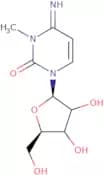
CAS:N3-Methylcytidine is a synthetic analog of uridine. It is used for the treatment of syncytial virus infection, which is a group of diseases caused by viruses that have an RNA genome and replicate by forming syncytia—large groups of infected cells. N3-Methylcytidine inhibits the synthesis of proteins in cells and inhibits the growth of bacteria. This drug has been shown to inhibit actin polymerization and prevents cell spreading. N3-Methylcytidine also binds to RNA polymerase II and blocks its interaction with DNA, inhibiting protein synthesis at the ribosome level. N3-Methylcytidine is metabolized in vivo into methylated cytidine, which can be detected in urine samples using chemical biology methods or fluorescence resonance energy transfer (FRET) analysis. Synonyms: N3-methyluridine; 3-methyluridineFórmula:C10H15N3O5Pureza:Min. 95%Forma y color:White PowderPeso molecular:257.24 g/mol3'-Deoxy-N-dimethylformamidine- 5'-O-DMT-guanosine-2'-O-succinoyl-long chain alkylamino-CPG
3'-Deoxy-N-dimethylformamidine-5'-O-DMT-guanosine-2'-O-succinoyl-long chain alkylamino-CPG is an anticancer, antiviral, and modified nucleoside. It is a novel monophosphate nucleoside that can be used in the synthesis of DNA or RNA. 3'-Deoxy-N-dimethylformamidine is a synthetic phosphoramidite that is activated with triethylamine and reacts with 5'--DMT--guanosine to yield a novel nucleoside. The compound has high purity and high quality.Pureza:Min. 95%5-O-[[[(1S)-1-Methyl-2-(1-methylethoxy)-2-oxoethyl]amino]-phenoxyphosphinyl]-cytidine
CAS:5-O-[[[(1S)-1-Methyl-2-(1-methylethoxy)-2-oxoethyl]amino]-phenoxyphosphinyl]-cytidine is a modified nucleoside analog that inhibits the synthesis of DNA and RNA. It has been shown to have antiviral, anticancer, and antiinflammatory activities. 5-O-[[[(1S)-1-Methyl-2-(1-methylethoxy)-2-oxoethyl]amino]-phenoxyphosphinyl]-cytidine is a ribonucleoside that can be used as a building block for the production of deoxyribonucleosides (i.e., as an activator). This product also has high purity and quality, as well as being novel in structure.Fórmula:C21H29N4O9PPureza:Min. 95%Forma y color:White to off-white solid.Peso molecular:512.45 g/mol5'-O-DMT-2'-O-methyl-N6-phenoxyacetyladenosine 3'-CE phosphoramidite
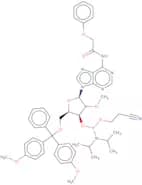
5'-O-DMT-2'-O-methyl-N6-phenoxyacetyladenosine 3'-CE phosphoramidite is a monophosphate, which is a phosphate group that is attached to the 5' carbon on the ribose ring of RNA. This monophosphate has been modified with a 2'-O-methyl group at the 6 position of the adenosine moiety. It has also been modified with a phenoxyacetyl group at the 2 position of the adenosine moiety. The phosphoramidite backbone is an ester bond between phosphorus and nitrogen atoms, and it can be used to make DNA or RNA in vitro. This compound has anticancer properties and antiviral activities against HIV, HSV, and HBV. 5'-O-DMT-2'-O-methyl-N6-phenoxyacetyladenosine 3'-CE phosphoramidite has novel properties that have notFórmula:C49H56N7O9PPureza:Min. 95%Forma y color:White PowderPeso molecular:918.01 g/mol1-(5-O-Acetyl-2,3-dideoxy-ß-L-glycero-pent-2-enofuranosyl)-5-fluorouracil
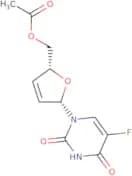
CAS:1-(5-O-Acetyl-2,3-dideoxy-ß-L-glycero-pent-2-enofuranosyl)-5-fluorouracil is a modified nucleoside analog with structural alterations that enhance its biological properties and stability. The compound features 5-fluorouracil as the nucleobase, a fluorinated pyrimidine often used in chemotherapy due to its ability to interfere with DNA replication. The sugar component is 2,3-dideoxy-β-L-glycero-pent-2-enofuranose and has a specific glycerol and enol configuration, which alters its interactions with enzymes involved in nucleic acid metabolism. The compound includes a 5-O-acetyl protecting group at the 5'-position, which shields the hydroxyl group during synthesis.
Fórmula:C11H11FN2O5Pureza:Min. 95%Peso molecular:270.21 g/mol8-Benzyloxy-9-(β-D-xylofuranosyl)guanine
8-Benzyloxy-9-(beta-D-xylofuranosyl)guanine (8BXG) is a novel nucleoside analog that inhibits the growth of cancer cells. It binds to the ribonucleotide reductase enzyme and inhibits the synthesis of DNA, thus preventing cell proliferation. 8BXG has been shown to inhibit viral replication in vitro with high potency. This compound is a monophosphate, which can be phosphorylated by adenosine kinase to form its active form. 8BXG is also an activator of ribonucleotide reductase in vitro, leading to increased anticancer activity.Pureza:Min. 95%2’-O-Acetyl-3,5-bis-O-(2,4-dichlorobenzyl)adenosine
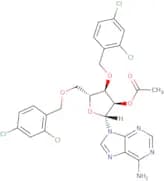
CAS:2’-O-Acetyl-3,5-bis-O-(2,4-dichlorobenzyl)adenosine (OAAD) is a novel nucleoside that has been modified to be phosphorylated by the enzyme ribonucleotide kinase. It is an antiviral and anticancer agent that affects the synthesis of DNA. OAAD inhibits viral replication in vitro and in vivo by inhibiting DNA synthesis.Fórmula:C26H23Cl4N5O5Pureza:Min. 95%Peso molecular:627.3 g/molAdenosine 3',5'-diphosphate disodium salt
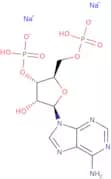
CAS:Adenosine 3',5'-diphosphate disodium salt is a nucleotide that is found in all cells and is involved in the regulation of many physiological processes, including energy metabolism and blood flow. It has inhibitory effects on platelets and calcium ion channels. Adenosine 3',5'-diphosphate disodium salt also inhibits the synthesis of prostaglandins by blocking the conversion of arachidonic acid to prostaglandin H2, which leads to an anti-inflammatory effect. Adenosine 3',5'-diphosphate disodium salt has been shown to be effective in treating primary pulmonary hypertension and bowel disease. The reaction solution can be used for polymerase chain reactions, multivariate logistic regression, or other applications.Fórmula:C10H15N5O10P2·2NaPureza:Min. 96 Area-%Forma y color:White Beige PowderPeso molecular:473.18 g/molN4-Acetyl-2'-O-tert-butyldimethylsilyl-5'-O-DMT-5-methylcytidine 3'-CE phosphoramidite
N4-Acetyl-2'-O-tert-butyldimethylsilyl-5'-O-DMT-5-methylcytidine 3'-CE phosphoramidite is a novel monophosphate nucleotide that can be used for the synthesis of DNA and RNA. It has antiviral, anticancer, and activating properties. N4-Acetyl-2'-O-tert-butyldimethylsilyl-5'-O-DMT-5-methylcytidine 3'-CE phosphoramidite is synthesized by modifying cytosine with an acetyl group at the 4th position in the ribose ring, a tertiary butyldimethylsilyl group at the 2nd position on the 5' carbon atom, and a DMT group at the 5' position on the 5' carbon atom. The CAS number for this compound is 868312050.Pureza:Min. 95%1-Methyl-2'-O-methylinosine
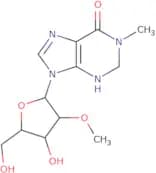
CAS:1-Methyl-2'-O-methylinosine is a nucleoside that is naturally found in RNA. It is the methylated form of inosine, which is a nonessential amino acid and purine nucleotide. 1-Methyl-2'-O-methylinosine's chemical name is β--D--ribofuranosyl-(1'→2')--N--(6-fluoro-3-indoxyl)glycinamide monohydrochloride. This nucleoside has been researched for its potential use as an indexing tool for phylogenetic research of DNA and RNA. 1-Methyl-2'-O-methylinosine has also been shown to be structurally similar to other nucleic acids and has been classified as a nucleoside.Fórmula:C12H16N4O5Pureza:Min. 95%Peso molecular:296.28 g/molE-5-(2-Carbomethoxyvinyl)-2'-deoxyuridine
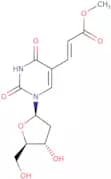
CAS:E-5-(2-Carbomethoxyvinyl)-2'-deoxyuridine is a nucleoside that is a modified form of uridine. It is a nucleotide analog that inhibits the synthesis of DNA and RNA and can be used to treat cancer. E-5-(2-Carbomethoxyvinyl)-2'-deoxyuridine is an activator that activates the phosphoramidites in the synthesis of DNA and RNA. This drug can also be used as antiviral therapy for herpes simplex virus type 1, influenza virus, and HIV. E-5-(2-Carbomethoxyvinyl)-2'-deoxyuridine has been shown to have anti-inflammatory properties by inhibiting prostaglandin synthesis.Fórmula:C13H16N2O7Pureza:Min. 95%Forma y color:White to off-white solid.Peso molecular:312.28 g/mol2'-Deoxy-5'-O-DMT-inosine 3'-CE phosphoramidite
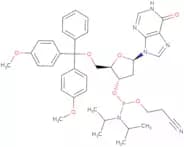
CAS:2'-Deoxy-5'-O-DMT-inosine 3'-CE phosphoramidite is a novel, modified nucleoside monophosphate. It is an activator of antiviral and anticancer activities. It is synthesized by the condensation of 5-bromo-2'-deoxyuridine with 2-chloroethyl chloroformate followed by reaction with ethylenediaminetetraacetic acid (EDTA) and sodium cyanoborohydride in aqueous solution. The product was purified by silica gel column chromatography.Fórmula:C40H47N6O7PPureza:Min. 98 Area-%Forma y color:White PowderPeso molecular:754.83 g/mol2’,3’-Bis-O-tert-butyldimethylsilyl-5’-deoxy-4’,5’-Didehydrouridine
CAS:2’,3’-Bis-O-tert-butyldimethylsilyl-5’-deoxy-4’,5’-Didehydrouridine is a phosphoramidite that is used in the synthesis of DNA, RNA and nucleotide analogues. It has antiviral and antitumor properties and can be used for the treatment of leukemia. 2’,3’-Bis-O-tert-butyldimethylsilyl-5’-deoxyuridine is an activator for ribonucleotides and deoxyribonucleotides. It also has anticancer properties due to its ability to inhibit DNA replication, which may lead to apoptosis or cell death.Pureza:Min. 95%2'-Deoxy-2'-fluoroguanosine
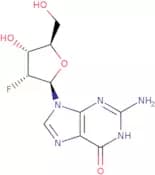
CAS:2'-Deoxy-2'-fluoroguanosine is a modified nucleoside analog where the base is guanine, the sugar is deoxyribose, and a fluoro group is attached to the 2' position of the sugar ring. This modification potnetially enhances the stability and nuclease resistance of the nucleoside, making it a useful tool in molecular biology and drug development.
Fórmula:C10H12FN5O4Pureza:Min. 98 Area-%Forma y color:White PowderPeso molecular:285.23 g/mol2’,3’-Bis-O-tert-butyldimethylsilyl-5’-O-DMT-uridine
CAS:2’,3’-Bis-O-tert-butyldimethylsilyl-5’-O-DMT-uridine is a high purity, novel nucleoside that has antiviral properties. It is a phosphoramidite monophosphate that is synthesized by reacting 5’-O-DMT uridine with bis(2,2,2-trichloroethyl)dimethylsilane and 2,6,8,-trioxabicyclo[3.3.1]nonane in the presence of triethylamine. This product can be used as an activator for DNA synthesis or to synthesize deoxyribonucleosides.Pureza:Min. 95%N4-Benzoyl-2’,3’-di-O-tert-butyldimethylsilyl-5’-O-DMT-N4-methylcytidine
N4-Benzoyl-2’,3’-di-O-tert-butyldimethylsilyl-5’-O-DMT-N4-methylcytidine is a modified nucleoside that is used as an antiviral agent. It inhibits the activity of reverse transcriptase, which is an enzyme that catalyzes the conversion of RNA into DNA. This nucleoside inhibits viral replication and prevents the production of new viruses in cells infected by HIV. N4-Benzoyl-2’,3’-di-O -tert -butyldimethylsilyl -5’ -O -DMT -N4 methylcytidine also inhibits DNA synthesis by inhibiting the activity of DNA polymerases. This drug has been shown to be effective against cancer cells and may have anticancer properties.Pureza:Min. 95%Adenosine 5′-phosphosulfate triethylammonium salt
Adenosine 5′-phosphosulfate triethylammonium salt serves as a donor of sulfate groups in biochemical processes, such as in the synthesis of sulfate esters. The triethylammonium salt form improves the solubility and stability of the compound, making it useful in laboratory applications involving enzymatic assays and the synthesis of sulfated biomolecules.
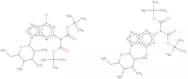
Fórmula:C10H14N5O10PS·xC6H15NPureza:Min. 98.0 Area-%Forma y color:PowderPeso molecular:427.29 g/molN2-Diboc-7/9-(2,3,4,6-tetra-O-acetyl-D-mannopyranosyl)-6-chloro-2-aminopurine
N2-Diboc-7/9-(2,3,4,6-tetra-O-acetyl-D-mannopyranosyl)-6-chloro-2-aminopurine is a nucleoside that is modified with a chlorine group. The modification of the nucleoside may enhance its anticancer activity. N2-Diboc-7/9-(2,3,4,6-tetra-O-acetyl-D-mannopyranosyl)-6-chloro-2 aminopurine has been shown to inhibit the growth of virus and cancer cells by inhibiting DNA synthesis. It has also been shown to induce apoptosis in human leukemia cells.Fórmula:C21H30ClN5O9Pureza:Min. 95%Forma y color:White to beige solid.Peso molecular:531.94 g/mol




![5-O-[[[(1S)-1-Methyl-2-(1-methylethoxy)-2-oxoethyl]amino]-phenoxyphosphinyl]-cytidine](/_next/image/?url=https%3A%2Fstatic.cymitquimica.com%2Fproducts%2F3D%2Fthumb-webp%2FNM46513.webp&w=3840&q=75)