Nucleósidos
Los nucleósidos son building blocks fundamentales de los ácidos nucleicos, compuestos por una base nitrogenada unida a una molécula de azúcar. En esta sección, puede encontrar una amplia variedad de nucleósidos esenciales para la investigación en biología molecular, bioquímica y farmacología. Estos compuestos juegan roles cruciales en la síntesis de ADN y ARN, y son vitales en varios procesos metabólicos. Los nucleósidos se utilizan para estudiar material genético, desarrollar terapias antivirales y anticancerígenas, y comprender los mecanismos celulares. En CymitQuimica, proporcionamos nucleósidos de alta calidad para apoyar sus necesidades de investigación y desarrollo, asegurando pureza y fiabilidad para sus aplicaciones experimentales.
Se han encontrado 3569 productos de "Nucleósidos"
Ordenar por
Pureza (%)
0
100
|
0
|
50
|
90
|
95
|
100
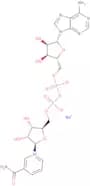
β-Nicotinamide adenine dinucleotide sodium dihydrate
CAS:<p>Coenzyme and regenerating electron donor in catabolic processes</p>Fórmula:C21H26N7NaO14P2•(H2O)2Pureza:Min. 95%Forma y color:White PowderPeso molecular:721.44 g/mol2',3',5'-Tri-O-acetyl-6-azauridine
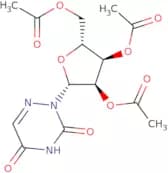
CAS:<p>2',3',5'-Tri-O-acetyl-6-azauridine is a nucleoside analog for research purposes. The replacement of a carbon atom with a nitrogen atom on the uracil base affects how the molecule interacts with cellular processes. It has the potential to interfere with normal metabolic processes within cells, particularly those related to RNA synthesis. Due to its ability to disrupt cell growth, it could be studied for any potential antiviral or antitumor properties.</p>Fórmula:C14H17N3O9Pureza:Min. 95%Forma y color:PowderPeso molecular:371.3 g/molN4-Benzoyl-2'-deoxy-a-cytidine
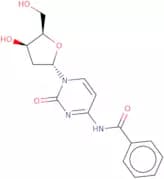
CAS:<p>N4-Benzoyl-2'-deoxy-a-cytidine is a novel, modified nucleoside that has shown anticancer and antiviral activity. It is synthesized by the enzymatic oxidation of 2'-deoxyadenosine with benzoyl chloride and sodium bicarbonate. N4-Benzoyl-2'-deoxy-a-cytidine has been shown to activate transcription, increase DNA synthesis, and inhibit virus replication. It also inhibits bacterial growth, but does not appear to have any effect on mammalian cells.</p>Fórmula:C16H17N3O5Pureza:Min. 95%Forma y color:PowderPeso molecular:331.32 g/molb-Nicotinamide mononucleotide
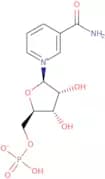
CAS:<p>b-Nicotinamide mononucleotide, or NMN, is a precursor to nicotinamide adenine dinucleotide (NAD+), a coenzyme found in all living cells that is essential for various metabolic processes. NAD+ is involved in critical functions such as DNA repair, gene expression, and cellular stress responses.</p>Fórmula:C11H15N2O8PPureza:Min. 95 Area-%Forma y color:PowderPeso molecular:334.22 g/mol3-Methyl-2-nitropyridine
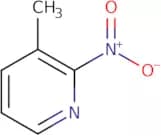
CAS:<p>3-Methyl-2-nitropyridine is a high yield byproduct of formamide, which can be activated to form an intermediate for the synthesis of nucleosides. The kinetics and labeling of this intermediate were studied using a transfer experiment. 3-Methyl-2-nitropyridine is acidic, with a pKa value of 3.6, and is reactive towards nucleophiles. It is also catalytic, yielding methyl groups and dioxane as products when heated at temperatures between 180°C and 220°C. In addition, it undergoes nucleophilic substitutions at methoxy groups.</p>Fórmula:C6H6N2O2Pureza:Min. 95%Forma y color:PowderPeso molecular:138.12 g/molN4-Benzoyl-2'-deoxycytidine
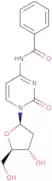
CAS:N4-Benzoyl-2'-deoxycytidine is a fluorescent nucleoside that has been used to study the molecular interactions between sugar residues and the phosphate groups of nucleic acids. It is used as a reagent for glycosidation, which involves the formation of a glycosidic linkage between an alcohol group in a saccharide or oligosaccharide and the hydroxyl group in an aromatic acid. N4-Benzoyl-2'-deoxycytidine has also been synthesized by solid-phase techniques. This synthetic method is based on phosphoramidite chemistry and uses an automated DNA synthesizer to produce oligonucleotides with specific sequences. The synthesis of this nucleoside relies on the use of fluorescent dyes such as fluorescein, rhodamine, and coumarin to monitor progress during synthesis.Fórmula:C16H17N3O5Pureza:Min. 95%Forma y color:White PowderPeso molecular:331.33 g/molInosine 5'-triphosphate lithium salt
<p>Inosine 5'-triphosphate lithium salt is a nucleoside that is used as an activator for DNA polymerase in the synthesis of deoxyribonucleotides. It has been shown to have anticancer properties and can be used to treat leukemia, lymphoma, and ovarian cancer. Inosine 5'-triphosphate lithium salt has also been shown to inhibit the growth of bacteria by inhibiting RNA synthesis.</p>Fórmula:C10H15N4O14P3FPureza:Min. 95%Peso molecular:527.16 g/molN2-Isobutyryl-3',5'-O-(1,1,3,3-tetraisopropyl-1,3-disiloxanediyl)guanosine
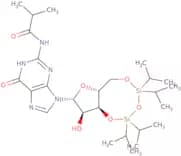
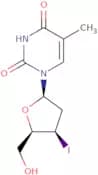
CAS:<p>N2-Isobutyryl-3',5'-O-(1,1,3,3-tetraisopropyl-1,3-disiloxane-diyl)guanosine is a nucleoside that is activated by phosphorylation. It has been shown to be an inhibitor of cancer cell growth and proliferation in vitro. This compound was also found to inhibit the expression of two oncogenes (c-MYC and c-Ki67) and induce the expression of the tumor suppressor gene p53. This nucleoside is synthesized from 2'-deoxyadenosine monophosphate (2'-DAMP) with a modified DNA synthesis protocol.</p>Fórmula:C26H45N5O7Si2Pureza:Min. 95 Area-%Forma y color:White Off-White PowderPeso molecular:595.84 g/mol3'-Deoxy-3'-iodothymidine
CAS:<p>3'-Deoxy-3'-iodothymidine is a nucleoside that is found in DNA. It has a constant of -1.5 and can be protonated to form the anion. The molecule has a reactive radical anion, which is stabilized by electron delocalization with the aromatic rings. 3'-Deoxy-3'-iodothymidine has been studied for use as a medicine for cancer treatment, but it also has applications in biology and chemistry. This compound can be used in conductometry and electron spectroscopy, as well as other chemical experiments that require ionic compounds or radiation.</p>Fórmula:C10H13IN2O4Pureza:Min. 95%Forma y color:PowderPeso molecular:352.13 g/mol2’-Amino-2’-deoxy-β-D-arabinouridine
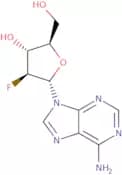
CAS:<p>2’-Amino-2’-deoxy-β-D-arabinouridine is a modified nucleoside based on uridine, in which the 2'-hydroxyl group of the sugar has been replaced with an amino group, and the sugar itself is arabinose (a stereoisomer of ribose). This compound is of possible interest in nucleic acid chemistry and antisense or RNA-interference research.</p>Fórmula:C9H13N3O5Pureza:Min. 95%Forma y color:solid.Peso molecular:243.22 g/mol9-(2'-Deoxy- 2'- fluoro- a- D- arabinofuranosyl) -9H- purin- 6- amine
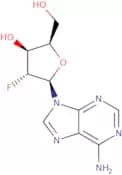
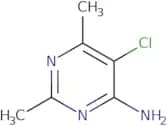
CAS:<p>9-(2'-Deoxy- 2'- fluoro- a- D- arabinofuranosyl) -9H- purin- 6- amine is an antiviral and anticancer agent. It can be used as a monophosphate or as a phosphoramidite for the synthesis of DNA, RNA, and modified nucleosides. The chemical name is 9-(2'-deoxy-2'-fluoro-a-D-arabinofuranosyl)-9H-purin-6-amine. It has the CAS number 20187-82-0. This drug was synthesized in 1976 by Koehler and colleagues at Bayer.<br>The molecular weight is 268.46 g/mol, with a melting point of 190°C, boiling point of 320°C and density of 1.408 g/mL at 20°C. It is soluble in water, methanol, ethanol, chloroform and acetic acid</p>Fórmula:C10H12FN5O3Pureza:Min. 95%Forma y color:SolidPeso molecular:269.23 g/mol4-Amino-5-chloro-2,6-dimethylpyrimidine
CAS:<p>4-Amino-5-chloro-2,6-dimethylpyrimidine is a supramolecular complex that is characterized by the coordination geometry of its metal ion and the donor atoms. It has been proposed as a potential drug for the treatment of bacterial infections, such as tuberculosis. The 4-Amino-5-chloro-2,6,dimethylpyrimidine is structurally similar to nucleobases and may be able to form hydrogen bonds with water molecules. This molecule also has a high melting point and is not soluble in water. It can be protonated at different pH values and forms complexes with hydroxyl groups found in nucleic acids.</p>Fórmula:C6H8ClN3Pureza:Min. 95%Forma y color:PowderPeso molecular:157.6 g/mol(2R,3R,4S,5R)-2-(4-Aminothieno[3,4-d]pyrimidin-7-yl)-5-(hydroxymethyl)tetrahydrofuran-3,4-diol
CAS:<p>(2R,3R,4S,5R)-2-(4-Aminothieno[3,4-d]pyrimidin-7-yl)-5-(hydroxymethyl)tetrahydrofuran-3,4-diol is a nucleoside analog for research purposes</p>Fórmula:C11H13N3O4SPureza:Min. 95%Forma y color:PowderPeso molecular:283.3 g/mol2'-O-Propargylcytidine
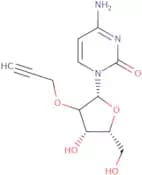
CAS:<p>2'-O-Propargylcytidine is a novel nucleoside that has been modified from cytidine. It is designed to inhibit the activity of RNA polymerase and to be used in anticancer therapy. The synthesis of 2'-O-propargylcytidine has been achieved by modifying the nucleotide with propargylic chloride, which is then reacted with sodium cyanide. The resulting product is purified by column chromatography and recrystallization.<br>2'-O-Propargylcytidine is a phosphoramidite that can be used for DNA synthesis or as a monophosphate in RNA synthesis. This high purity product has a CAS number of 206552-85-4 and it can be used as an activator for ribonucleosides, such as adenosine, guanosine, uridine, cytidine, and thymidine.</p>Fórmula:C12H15N3O5Pureza:Min. 95%Forma y color:PowderPeso molecular:281.26 g/mol2'-Deoxyisocytidine
CAS:<p>2'-deoxyisocytidine is a nucleoside that is used in biochemical research. It can be synthesized by two methods: solid-phase synthesis and depyrimidination. 2'-deoxyisocytidine has been shown to be more efficient than other fluorescent nucleosides when used with the excimer laser technique. The stability of this compound has also been shown to be greater than other fluorescein-based compounds, which makes it an appropriate substitute when using phosphoramidite chemistry.</p>Fórmula:C9H13N3O4Pureza:Min. 95%Forma y color:PowderPeso molecular:227.22 g/molQueuine hydrochloride
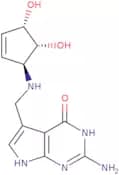
CAS:<p>Queuine is a modified nucleoside found in tRNA. It is synthesized from guanosine by the enzyme queuine tRNA-ribosyltransferase, which converts guanosine to queuosine. Queuine hydrochloride is a synthetic form of queuine that can be used for research purposes to examine the anticodon loop and other structural features of the molecule. The prokaryotic and eukaryotic organisms studied showed different levels of synthesis of queuine, with bacteria synthesizing more than mammals. Bacteria were found to have a greater affinity for queuine than eukaryotes, which may be due to modification of the trna anticodon loop or to differences in ribosomal proteins.</p>Fórmula:C12H15N5O3·HClPureza:(%) Min. 90%Forma y color:Light (Or Pale) Beige To Light (Or Pale) Purple SolidPeso molecular:313.74 g/molN2-Isobutyryl-2'-O-methylguanosine
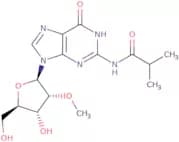
CAS:<p>N2-Isobutyryl-2'-O-methylguanosine (IBOG) is a modified nucleoside that can be used as an activator for DNA synthesis. IBOG is a high purity, high quality chemical with CAS No. 63264-29-9 and has antiviral and anticancer properties.</p>Fórmula:C15H21N5O6Pureza:Min. 95%Forma y color:White To Yellow SolidPeso molecular:367.36 g/mol2'-O-tert-Butyldimethylsilyl-N2-isobutyryl-5'-O-MMT-guanosine 3'-CE phosphoramidite
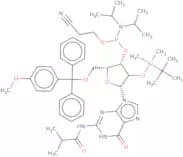
<p>2'-O-tert-Butyldimethylsilyl-N2-isobutyryl-5'-O-MMT-guanosine 3'-CE phosphoramidite is a novel modified ribonucleoside that has been synthesized to mimic the natural nucleotide. It has been shown to activate DNA synthesis, inhibit cancer cell division and proliferation, and inhibit viral replication. 2'-O-tert-Butyldimethylsilyl-N2-isobutyryl-5'-O-MMTguanosine 3'-CE phosphoramidite is a monophosphate nucleotide with an anticancer activity. It has also showed antiviral effects against HIV and Hepatitis B virus. This novel modified ribonucleoside is highly pure and can be used for the synthesis of high quality DNA, RNA, or phosphoramidites.</p>Fórmula:C49H66N7O8PSiPureza:Min. 95%Peso molecular:940.17 g/mol9-(2-Deoxy- 2- fluoro- b- D- xylofuranosyl) -9H- purin- 6- amine
CAS:<p>9-(2-Deoxy- 2-fluoro- b-D-xylofuranosyl) -9H- purin- 6- amine is an activator that has been shown to have anti cancer, antiviral, and antifungal properties. It is a novel monophosphate nucleoside that is synthesized from deoxyribonucleosides. 9-(2-Deoxy-2 fluoro b D xylofuranosyl) -9H purin 6 amine has demonstrated activity against HIV and cytomegalovirus. It also has anticancer properties by inhibiting DNA synthesis and the production of tumor necrosis factor. 9-(2-Deoxy 2 fluoro b D xylofuranosyl) -9H purin 6 amine can be phosphorylated to form a nucleotide or used as a synthon for the preparation of new nucleosides. This product is available in high purity and quality</p>Fórmula:C10H12FN5O3Pureza:Min. 95%Peso molecular:269.23 g/mol




![(2R,3R,4S,5R)-2-(4-Aminothieno[3,4-d]pyrimidin-7-yl)-5-(hydroxymethyl)tetrahydrofuran-3,4-diol](/_next/image/?url=https%3A%2Fstatic.cymitquimica.com%2Fproducts%2F3D%2Fthumb-webp%2FFA165910.webp&w=3840&q=75)