Nucleósidos
Se han encontrado 3569 productos de "Nucleósidos"
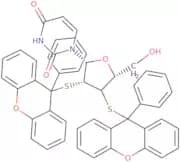
2',3'-Di(9-phenylxanthen-9-yl)dithiouridine
CAS:2',3'-Di(9-phenylxanthen-9-yl)dithiouridine is a synthetic nucleoside that has antiviral, anticancer and antitumor properties. It is an activator of the enzyme ribonucleotide reductase, which converts ribonucleotides to deoxyribonucleotides. 2',3'-Di(9-phenylxanthen-9-yl)dithiouridine is used as a monophosphate or diphosphate for the treatment of cancer and HIV/AIDS. This drug has shown high purity and quality and can be synthesized in high yield.Fórmula:C47H36N2O6S2Pureza:Min. 95%Peso molecular:788.93 g/molN6-Benzoyl-2'-deoxy-5'-O-DMT-adenosine 3'-succinyl CPG 2000 Å
N6-Benzoyl-2'-deoxy-5'-O-DMT-adenosine 3'-succinyl CPG 2000 Å, a novel nucleoside analog, is an antiviral agent that inhibits the synthesis of viral DNA. It also induces apoptosis and cell cycle arrest in cancer cells. N6-Benzoyl-2'-deoxy-5'-O-DMT-adenosine 3'-succinyl CPG 2000 Å is synthesized by the coupling of deoxyribonucleotide phosphoramidite monomers onto a carrier support with a molecular weight of 2000Å. This product is available as white solid, and it has purity greater than 99%.Pureza:Min. 95%Adenosine 3',5'-cyclic monophosphothioate Rp-isomer triethylammonium salt
CAS:Adenosine 3',5'-cyclic monophosphothioate Rp-isomer triethylammonium salt is a neurotrophic factor that can be used in the treatment of neurological disorders. It has been shown to activate various biological processes, such as neurotransmitter release and neurite outgrowth. Adenosine 3',5'-cyclic monophosphothioate Rp-isomer triethylammonium salt also has been shown to have an effect on body mass index (BMI) and colony stimulating factor (CSF). It stimulates the production of IGF-I, which is involved in the regulation of metabolic processes and has a positive effect on cell proliferation. Adenosine 3',5'-cyclic monophosphothioate Rp-isomer triethylammonium salt also has been shown to stimulate signal pathways that are involved in apoptosis and neuronal differentiation.Fórmula:C10H11N5O5PS·C6H16NPureza:Min. 95%Peso molecular:446.46 g/molStavudine 5'-triphosphate triethyammonium salt
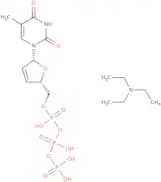
CAS:Stavudine 5'-triphosphate triethyammonium salt is a novel, modified nucleoside that has antiviral and anticancer properties. It is synthesized as a phosphoramidite and used in the synthesis of ribonucleotides, which are incorporated into RNA. Stavudine 5'-triphosphate triethyammonium salt inhibits viral DNA replication by inhibiting the activity of reverse transcriptase, an enzyme that copies the DNA sequence to create a complementary RNA sequence. In vitro studies have shown that stavudine 5'-triphosphate triethyammonium salt inhibits cell proliferation in human cancer cells.Pureza:Min. 95%Pyrazolo[1,5-a]pyrimidine-2-carboxylic acid
CAS:Pyrazolo[1,5-a]pyrimidine-2-carboxylic acid is a high purity chemical substance. It is an antiviral and anticancer agent, which has been shown to inhibit the replication of DNA in vitro. Pyrazolo[1,5-a]pyrimidine-2-carboxylic acid can be used for the synthesis of ribonucleosides, deoxyribonucleosides, nucleoside phosphoramidites, diphosphate and triphosphate. This novel chemical substance is also a potential inhibitor of DNA polymerase and RNA polymerase.Fórmula:C7H5N3O2Pureza:Min. 95%Peso molecular:163.13 g/mol5'-O-DMT-2'-O-(2-methylacetamido)-5-methyluridine
5'-O-DMT-2'-O-(2-methylacetamido)-5-methyluridine is a monophosphate of deoxyribonucleosides. It is an antiviral and anticancer agent that inhibits the synthesis of RNA in cells, which can lead to the death of the cell. The novel chemical structure of 5'-O-DMT-2'-O-(2-methylacetamido)-5-methyluridine makes it a useful drug for treatment against viral infections and cancer.Pureza:Min. 95%Cytidine-5'-phosphate-3'-(6-aminohexyl)phosphate-biotin triethylammonium salt - 1 mM aqueous solution (10 mM Tris-HCl)
Cytidine-5'-phosphate-3'-(6-aminohexyl)phosphate-biotin triethylammonium salt - 1 mM aqueous solution (10 mM Tris-HCl) is a nucleoside phosphate activator with antiviral effects. It has been successfully synthesized and shown to be an effective anticancer agent. Cytidine-5'-phosphate-3'-(6-aminohexyl)phosphate-biotin triethylammonium salt - 1 mM aqueous solution (10 mM Tris-HCl) is modified from cytidine, which contains the amino acid L-alanine in place of D-alanine. This modification increases the stability and bioavailability of this molecule. Cytidine, or cytidylate, is a nucleoside phosphate that is widely used in biochemistry as an activator for other nucleosides or as a substrate for enzymesFórmula:C25H42N6O13P2S1Pureza:Min. 95%Forma y color:Colorless PowderPeso molecular:728.65 g/mol5'-o-Methyl-dt cep
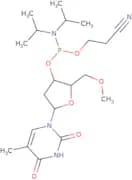
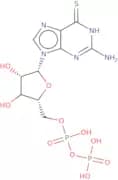
CAS:5'-o-Methyl-dt cep is a modified phosphoramidite that has been synthesized to provide a novel, highly active anticancer and antiviral agent. It is used as an activator for the synthesis of DNA or RNA in the nucleoside or deoxyribonucleoside pathway. 5'-o-Methyl-dt cep could be used in the treatment of HIV, Hepatitis C, and other viral infections.Fórmula:C20H33N4O6PPureza:Min. 95%Peso molecular:456.5 g/mol6-Thioguanosine-5'-O-diphosphate sodium salt - 10mM aqueous solution
CAS:6-Thioguanosine-5'-O-diphosphate sodium salt is a nucleotide derivative of guanosine that binds to the regulatory site of ATP synthase in the chloroplast. It is an allosteric inhibitor that has been shown to inhibit the synthesis of proteins and chlorophyll, as well as ATP synthesis in plastids of plants. 6-Thioguanosine-5'-O-diphosphate sodium salt has been shown to be effective at inhibiting protein synthesis in mammalian cells, which may be due to its ability to bind to the metabotropic glutamate receptor. The molecule was also found to bind with high affinity to a ternary complex that includes glutamine, glutamate, and ammonia.Fórmula:C10H15N5O10P2SxNaPureza:Min. 95%Forma y color:PowderPeso molecular:459.27 g/molN6-Benzoyl-3'-O-tert-butyldimethylsilyl-adenosine 2'-CE phosphoramidite
N6-Benzoyl-3'-O-tert-butyldimethylsilyl-adenosine 2'-CE phosphoramidite is a novel nucleoside that has been synthesized and characterized. It is an antiviral agent and has been demonstrated to have anticancer properties. N6-Benzoyl-3'-O-tert-butyldimethylsilyl-adenosine 2'-CE phosphoramidite is a phosphoramidite and is used in DNA synthesis as a replacement for diphosphate, which can be toxic when it reacts with ribonucleotides or deoxyribonucleotides. This novel nucleoside also inhibits the enzyme DNA polymerase, which is required for viral replication.Fórmula:C53H66N7O8PSiPureza:Min. 95%Peso molecular:988.19 g/molN-(tert-butylphenoxyacetyl)-5'-O-DMT-2'-O-methylguanosine 3'-CE phosphoramidite
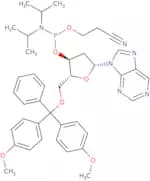
N-(tert-butylphenoxyacetyl)-5'-O-DMT-2'-O-methylguanosine 3'-CE phosphoramidite is a novel nucleoside analogue with antiviral and anticancer activity. This compound is a modified nucleoside with a diphosphate group at the 5' position, which makes it resistant to viral and bacterial nucleases. N-(tert-butylphenoxyacetyl)-5'-O-DMT-2'-O-methylguanosine 3'-CE phosphoramidite also inhibits DNA synthesis and can induce apoptosis in cancer cells. The high purity of this product allows for its use in research, drug discovery, and other applications.Fórmula:C53H64N7O10PPureza:Min. 95%Peso molecular:990.09 g/mol2'-Deoxy-5'-O-DMT-nebularine 3'-CE phosphoramidite
CAS:2'-Deoxy-5'-O-DMT-nebularine 3'-CE phosphoramidite is an anticancer agent that is used in the treatment of leukemia. It inhibits DNA and RNA synthesis, leading to cell death by inhibiting the production of proteins vital for cell division. 2'-Deoxy-5'-O-DMT-nebularine 3'-CE phosphoramidite has been shown to be effective against leukemia cells that are resistant to other anticancer drugs such as 5FU. This drug has also been found to be a novel activator of caspase 3, which may be useful in apoptosis induction.Fórmula:C40H47N6O6PPureza:Min. 95%Peso molecular:738.81 g/mol2,6-Diamino-9-(2'[2-methylacetamido]-b-D-ribofuranosyl)purine
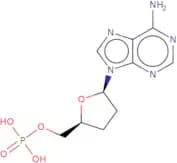
2,6-Diamino-9-(2'[2-methylacetamido]-b-D-ribofuranosyl)purine is an antiviral drug that is an analogue of adenosine. It has been shown to be a potent activator of the immune system and also has anticancer properties. 2,6-Diamino-9-(2'[2-methylacetamido]-b-D-ribofuranosyl)purine is synthesized from 2',3'-dideoxyadenosine and 2,6 diaminopurine riboside by the use of activated phosphoramidites in a modified nucleoside synthesizer. The CAS number for this compound is 70717-54-8.Pureza:Min. 95%2',3'-Dideoxyadenosine-5'-monophosphate
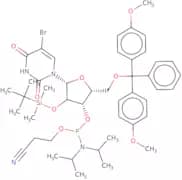
CAS:2',3'-Dideoxyadenosine-5'-monophosphate (ddAMP) is an adenosine analog that is a substrate for the enzyme dideoxyribonucleoside kinase. It is activated by phosphorylation to the 5' ends of DNA molecules and inhibits viral replication. ddAMP has been shown to be effective in treating human immunodeficiency virus (HIV) infection, at least in part, by inhibiting the production of p24 antigen levels and reducing the number of CD4+ lymphocytes. The mechanism of action may involve binding to HIV-1 RNA, which prevents it from interacting with cellular dsDNA and inhibits its transcription into DNA.Fórmula:C10H14N5O5PPureza:Min. 95%Peso molecular:315.22 g/mol5-Bromo-2'-O-tert-butylbutyldimethylsilyl-5'-O-DMT-uridine 3'-CE phosphoramidite
5-Bromo-2'-O-tert-butylbutyldimethylsilyl-5'-O-DMT-uridine 3'-CE phosphoramidite is a novel phosphoramidite that can be used in the synthesis of ribonucleosides. Ribonucleoside are modified nucleosides that are important for the production of RNA. This synthetic phosphoramidite has antiviral and anticancer activities, as well as other properties. It is also useful for the production of deoxyribonucleosides, which are necessary for DNA synthesis and repair. 5-Bromo-2'-O-tert-butylbutyldimethylsilyl-5'-O-DMT-uridine 3'-CE phosphoramidite is a high purity, high quality compound that can be used to synthesize nucleic acids.Fórmula:C45H60BrN4O9PSiPureza:Min. 95%Peso molecular:939.97 g/mol8-Allyloxy-N2-isobutyryl-2-deoxyguanosine
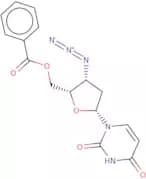
CAS:8-Allyloxy-N2-isobutyryl-2-deoxyguanosine is an anticancer drug that has been modified to be resistant to degradation by nucleases. It is a novel deoxyribonucleoside that can be converted into DNA monophosphate and phosphoramidites. 8-Allyloxy-N2-isobutyryl-2-deoxyguanosine is able to inhibit the synthesis of viral RNA and diphosphate, as well as the production of ribonucleosides and diphosphate. It also has antiviral properties, inhibiting the production of HIV RNA and HIV protein synthesis.Fórmula:C17H23N5O6Pureza:Min. 95%Peso molecular:393.40 g/mol3'-Azido-5'-O-benzoyl-2',3'-dideoxyuridine
3'-Azido-5'-O-benzoyl-2',3'-dideoxyuridine is a novel nucleoside that is synthesized by reacting 3'-azido-5'-deoxyuridine with 5-(benzoyl)salicylic acid. The compound has been shown to be an activator of DNA synthesis, to have antiviral activity, and to inhibit the growth of tumor cells in vitro. 3'-Azido-5'-O-benzoyl-2',3'-dideoxyuridine is a nucleoside analogue that may be useful in anticancer therapy.
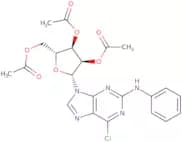
Fórmula:C16H15N5O5Pureza:Min. 95%Peso molecular:357.32 g/mol6-Chloro-N-phenyl-9-(2,3,5-tri-O-acetyl-b-D-ribofuranosyl)-9H-purin-2-amine
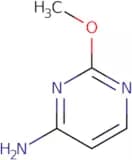
CAS:6-Chloro-N-phenyl-9-(2,3,5-tri-O-acetyl-b-D-ribofuranosyl)-9H-purin-2-amine is a monophosphate nucleoside analog. It is an antiviral agent that inhibits the synthesis of DNA and RNA. 6CNP has been shown to be cytotoxic against cancer cells in vitro, as well as in vivo. This compound also shows anticancer activity by inhibiting the production of ribonucleosides and deoxyribonucleosides.Fórmula:C22H22ClN5O7Pureza:Min. 95%Peso molecular:503.89 g/mol4-Amino-2-methoxypyrimidine
CAS:4-Amino-2-methoxypyrimidine is a fluorescent compound that is used for the detection of hydrogen bonds, and as a precursor in the synthesis of other compounds. 4-Amino-2-methoxypyrimidine has been shown to be able to absorb ultraviolet radiation, which leads to its fluorescence. The compound can also form hydrogen bonds with other molecules and it has been shown to react with n-hexane. 4-Amino-2-methoxypyrimidine reacts with orthophosphate, producing singlet oxygen and transferring a proton. It also reacts with solvents such as water or ethanol, giving off light.Fórmula:C5H7N3OPureza:Min. 95%Peso molecular:125.13 g/mol2',3'-Di-O-acetyl-5'-deoxy-5-fluoro-N-[(2-methylbutoxy)carbonyl]cytidine
CAS:2',3'-Di-O-acetyl-5'-deoxy-5-fluoro-N-[(2-methylbutoxy)carbonyl]cytidine is an activator, anticancer, monophosphate nucleoside that is synthesized from 2'-deoxycytidine and 5'-fluorouracil. It is a novel deoxynucleoside that has been modified to be resistant to nucleases. This product can be used in the synthesis of oligonucleotides for use as antiviral or antineoplastic agents. 2',3'-Di-O-acetyl-5'-deoxy-5-fluoro-N-[(2-methylbutoxy)carbonyl]cytidine is also known by its CAS number 1341231-51-3.Fórmula:C19H26FN3O8Pureza:Min. 95%Peso molecular:443.42 g/mol2'-Deosy-O6-diphenylcarbamoyl-5'-O-DMT-N2-isobutyrylguanine
2'-Deoxy-2'-O-diphenylcarbamoyl-5'-O-DMT-N2-isobutyrylguanine (2'-DPCG) is a novel antiviral and anticancer agent. It has been shown to inhibit the replication of both DNA and RNA viruses. 2'-DPCG is synthesized in a high yield and purified to near homogeneity. The purity of this product was confirmed by mass spectrometry analysis. The CAS number for this product is 1227071-12-0.Pureza:Min. 95%N4-Benzoyl-3'-O-tert-butyldimethylsilyl-5'-O-DMT-cytidine
N4-Benzoyl-3'-O-tert-butyldimethylsilyl-5'-O-DMT-cytidine is a nucleoside with anticancer, antiviral, and antiretroviral properties. It is synthesized by reacting cytidine with benzoyl chloride in the presence of tert-butyldimethylsilyl chloride. N4-Benzoyl-3'-O-tert-butyldimethylsilyl-5'-O-DMTcytidine has shown to be a novel and potent inhibitor of the human immunodeficiency virus type 1 (HIV1) reverse transcriptase. It also inhibits DNA synthesis and has been shown to inhibit tumor cell growth in vitro.Fórmula:C43H49N3O8SiPureza:Min. 95%Peso molecular:763.95 g/mol2'-Deoxycytidine-3'-monophosphate ammonium salt
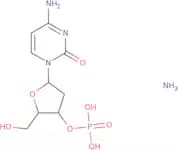
CAS:2'-Deoxycytidine-3'-monophosphate ammonium salt is a synthetic compound that is used in the production of phosphite fertilizers. It is also used to detect the presence of phosphorus and sulfur in elements, as well as to synthesize alkylene compounds. In addition, 2'-Deoxycytidine-3'-monophosphate ammonium salt can be used in the synthesis of ribozymes and deoxyadenosyl compounds.Fórmula:C9H14N3O7P·2NH3Pureza:Min. 95%Peso molecular:341.26 g/mol6-Iodo-uridine
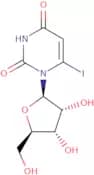
CAS:6-Iodo-uridine is an antiviral drug that is used to treat tuberculosis, influenza, and hepatitis. It has a propionyl group in place of the hydroxyl group on the pyrimidine ring. This substitution stabilizes the molecule and prevents it from being broken down by enzymes in the body. 6-Iodo-uridine can be synthesized from uridine through a cross-coupling reaction with formaldehyde and propionaldehyde. 6-Iodo-uridine can also be synthesized by coupling orotic acid 5′ monophosphate decarboxylase with formaldehyde.
Fórmula:C9H11IN2O6Pureza:Min. 95%Peso molecular:370.1 g/mol2’,3’-Dideoxy-5-fluorocytidine
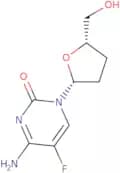
CAS:2’,3’-Dideoxy-5-fluorocytidine is a nucleoside analog that inhibits the growth of tumor cells in animals. It has been shown to inhibit the replication of hepatitis B virus and HIV without affecting normal cell division. 2′,3′-Dideoxy-5-fluorocytidine also has potent antitumor activity against human hematopoietic cells and induces apoptosis.
Fórmula:C9H12FN3O3Pureza:Min. 95%Peso molecular:229.21 g/mol5-Ethyl-3',5'-bis-(p-chlorobenzoyl)-2'-deoxyuridine
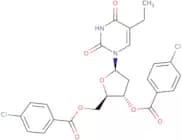
CAS:5-Ethyl-3',5'-bis-(p-chlorobenzoyl)-2'-deoxyuridine is a phosphoramidite nucleoside analog that inhibits viral replication. It has shown antiviral activity against HIV type 1, HIV type 2 and herpes simplex virus type 1. 5-Ethyl-3',5'-bis-(p-chlorobenzoyl)-2'-deoxyuridine is an analogue of the natural nucleoside uridine and is used in the synthesis of modified DNA and RNA molecules. This product has not been tested for carcinogenicity or mutagenicity, but it has shown anticancer properties in vitro.Fórmula:C25H22Cl2N2O7Pureza:Min. 95%Peso molecular:533.36 g/mol1,5-Anhydro-4,6-O-benzylidene-2,3-dideoxy-2-[uracil-1-yl]-D-glucitol
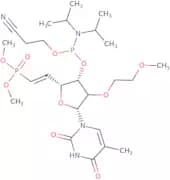
CAS:1,5-Anhydro-4,6-O-benzylidene-2,3-dideoxy-2-[uracil-1-yl]-D-glucitol is a synthetic nucleoside that is used as an antiviral agent. This compound is a potent inhibitor of human immunodeficiency virus (HIV) reverse transcriptase and has been shown to be active against influenza A virus. 1,5-Anhydro-4,6-O-benzylidene-2,3-dideoxy-2-[uracil]-D glucitol is also an anticancer agent that inhibits DNA synthesis in cancer cells. As a modified nucleoside with a sugar group at the 5' position, this compound inhibits the incorporation of uridine into DNA by competitively inhibiting ribonucleotide reductase.Fórmula:C17H18N2O5Pureza:Min. 95%Peso molecular:330.34 g/mol1-(5',6'-Dideoxy-6'-dimethylphosphono-2'-O-(2-methoxyethyl)-5-methyl-b-D-ribo-hex-5(E)-enofuranosyl)uracil 3'-CE phosphoroamidite
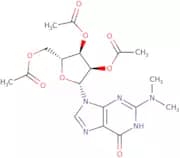
1-(5',6'-Dideoxy-6'-dimethylphosphono-2'-O-(2-methoxyethyl)-5-methyl-b-D-ribo-hex-5(E)-enofuranosyl)uracil 3'-CE phosphoroamidite is a novel nucleoside analogue that has antiviral activity. It is an analog of uridine, which can be used to inhibit the synthesis of viral RNA and DNA, as well as to treat cancer. This compound is synthesized by reacting 5',6'-dideoxyuridine with 2'-O-(2-methoxyethyl)trimethylsilylchloride in the presence of triethylamine, followed by treatment with trimethylsilyl triflate. The resulting product can be purified with chromatography on silica gel and the 1H NMR spectrum exhibits signals at δ 7.06 (d, J = 8 Hz) andFórmula:C25H42N4O10P2Pureza:Min. 95%Peso molecular:620.57 g/mol2',3',5'-Tri-O-acetyl-2N,2N-dimethylguanosine
CAS:2',3',5'-Tri-O-acetyl-2N,2N-dimethylguanosine (TAMG) is a novel nucleoside that is synthesized from 2',3',5'-tri-O-acetyl-1,3,5-trioxohexanecarboxylic acid. TAMG has been shown to inhibit HIV and Hepatitis B virus replication by inhibiting the synthesis of viral DNA and RNA. The antiviral properties of TAMG are due to its incorporation into the growing DNA chain and blocking the polymerization process. TAMG also has anticancer activity and can be used as a chemotherapeutic agent against various types of cancer cells.Fórmula:C18H23N5O8Pureza:Min. 95%Peso molecular:437.4 g/mol2'-Deoxy-5'-O-DMT-5-(3-methacryloyl)uridine 3'-CE phosphoramidite
CAS:2'-Deoxy-5'-O-DMT-5-(3-methacryloyl)uridine 3'-CE phosphoramidite is a synthetic nucleoside analogue. It is an antiviral and anticancer agent that inhibits viral DNA synthesis by inhibiting the enzyme DNA polymerase. The compound also induces apoptosis in cancer cells by inhibiting RNA synthesis. 2'-Deoxy-5'-O-DMT-5-(3-methacryloyl)uridine 3'-CE phosphoramidite has been shown to be cytotoxic to human breast cancer cells, and is currently being studied as a potential treatment for prostate cancer.Fórmula:C43H51N4O10PPureza:Min. 95%Peso molecular:814.88 g/mol2'-Deoxyadenosine-5'-triphosphate dilithium salt
2'-Deoxyadenosine-5'-triphosphate dilithium salt is a modified nucleoside that is used in the synthesis of DNA. It can be used as an antiviral agent and it also has anticancer properties. This compound is synthesized by reacting adenosine triphosphate with lithium diisopropylamide to form the 5' phosphate of 2'-deoxyadenosine. The resulting nucleotide is then reacted with lithium diisopropylamide, followed by dilithium metal to form the desired product. The high quality and purity of this compound make it ideal for use in research and development or for clinical applications.Fórmula:C10H13N5O12P3·2LiPureza:Min. 95%Peso molecular:502.04 g/mol2',3'-Dideoxyinosine-5'-monophosphate triethylammonium salt
2',3'-Dideoxyinosine-5'-monophosphate triethylammonium salt is a synthetic nucleoside that is used to inhibit the production of viral DNA. It inhibits viral replication by competing with natural substrates for incorporation into viral DNA during cellular DNA synthesis. 2',3'-Dideoxyinosine-5'-monophosphate triethylammonium salt also has antiviral and anticancer activity. This product is not for human use, but for research purposes only.Pureza:Min. 95%N4-Acetyl-2'-deoxy-5'-O-DMT-cytidine 3'-succinyl CPG 500 Å
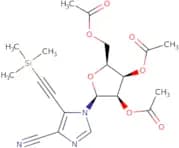
N4-Acetyl-2'-deoxy-5'-O-DMT-cytidine 3'-succinyl CPG 500 Å is a novel modified nucleoside that has been shown to inhibit the replication of HIV and other viruses. N4-Acetyl-2'-deoxy-5'-O-DMT-cytidine 3'-succinyl CPG 500 Å is an activator for DNA synthesis. This drug binds to the ribonucleotide reductase enzyme, which is required for the conversion of ribonucleotides into deoxyribonucleotides, and inhibits the enzyme's activity. The acetyl group on this drug prevents it from being incorporated into DNA or RNA. This drug can be used as an antiviral or anticancer agent.Pureza:Min. 95%Forma y color:Powder5-(2-(Trimethylsilyl)-1-ethynyl)-1-(2',3',5'-tri-O-acetyl-b-D-ribofuranosyl)imidazo-4-carbonitrile
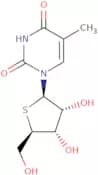
CAS:Ribonucleosides are a class of nucleoside analogues that have been used as antiviral and anticancer agents. Ribonucleosides are synthesized in a two-step process. The first step is the conversion of an appropriate ribose or deoxyribose to the corresponding monophosphate. The second step is the coupling of the monophosphate with an appropriate nucleotide. 5-(2-(Trimethylsilyl)-1-ethynyl)-1-(2',3',5'-tri-O-acetyl-b-D-ribofuranosyl)imidazo-4-carbonitrile is a novel nucleoside analogue, which has been shown to be active against cancer cells and to inhibit viral replication by interacting with DNA polymerase and other enzymes involved in DNA synthesis.Pureza:Min. 95%5-Methyl-4'-thiouridine
CAS:5-Methyl-4'-thiouridine is a novel, synthetic nucleoside that has antiviral and anticancer activities. It is an activator of ribonucleotide reductase and a substrate for diphosphate reductase. 5-Methyl-4'-thiouridine (also known as 5-methyluridine) is used in the synthesis of DNA, RNA, and phosphoramidites. The CAS number for this compound is 6741-71-5.Pureza:Min. 95%1,N6-Ethenoadenosine-5'-monophosphate sodium salt
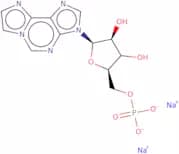
CAS:1,N6-Ethenoadenosine-5'-monophosphate sodium salt is a synthetic nucleoside analog. It serves as an antiviral and anticancer agent by inhibiting viral DNA polymerase and tumor cell proliferation. This drug has been shown to be effective in animal models of cancer. 1,N6-Ethenoadenosine-5'-monophosphate sodium salt also inhibits the enzyme ribonucleotide reductase, which is needed for deoxyribonucleotide synthesis. 1,N6-Ethenoadenosine-5'-monophosphate sodium salt is chemically related to adenosine monophosphate (AMP). However, it is not active against AMP phosphohydrolases that are found in bacteria and some protozoa.Fórmula:C12H14N5O7PPureza:Min. 95%Peso molecular:371.24 g/mol2'-Deoxy-5'-O-DMT-N2-isobutyrylguanosine 3'-Rp-oxazaphospholidine
2'-Deoxy-5'-O-DMT-N2-isobutyrylguanosine 3'-Rp-oxazaphospholidine is a novel nucleoside analog that is modified from 2'-deoxy-5'-O-dimethoxytritylguanosine 6'-Rp-oxazaphospholidine. It has antiviral and anticancer activities, as well as inhibiting DNA synthesis by competing with natural substrates for the enzyme DNA polymerase. It is synthesized from the corresponding phosphoramidites and can be used in high purity for chemical synthesis of oligonucleotides.Pureza:Min. 95%3',5'-Bis-O-(tert-butyldimethylsilyl)-2'-deoxyuridine
CAS:3',5'-Bis-O-(tert-butyldimethylsilyl)-2'-deoxyuridine is a synthetic nucleoside that is used in antiviral and anticancer research. It is an activator of the monophosphate form of DNA and RNA, leading to their synthesis. 3',5'-Bis-O-(tert-bulyldimethylsilyl)-2'-deoxyuridine has been shown to have antitumour activity against cancer cells.Fórmula:C21H40N2O5Si2Pureza:Min. 95%Peso molecular:456.72 g/mol2'-O-(tert-Butyldimethylsilyl)-3'-O-(phenoxythioncarbonyl)-5'-O-trityluridine
CAS:2'-O-(tert-Butyldimethylsilyl)-3'-O-(phenoxythioncarbonyl)-5'-O-trityluridine (TBS-PTU) is a modified nucleoside that has antiviral activity. TBS-PTU inhibits viral replication by interfering with the synthesis of viral RNA and DNA. The antiviral activity of TBS-PTU is increased in the presence of ribonucleotide reductase, an enzyme that converts ribonucleotides to deoxyribonucleotides. TBS-PTU is used as a building block for DNA synthesis and as a precursor to other modified nucleosides.Fórmula:C41H44N2O7SSiPureza:Min. 95%Peso molecular:736.95 g/molN6-Benzoyl-9-(2'-deoxy-2'-fluoro-b-D-arabinofuranosyl)adenine
CAS:N6-Benzoyl-9-(2'-deoxy-2'-fluoro-b-D-arabinofuranosyl)adenine is a novel nucleoside analogue that inhibits HIV, Herpes simplex virus type 1 and 2, Hepatitis C virus, and influenza A virus. It is structurally similar to adenosine but has a benzoyl group at the 6 position on the ribose moiety. N6-Benzoyl-9-(2'-deoxy-2'-fluoro-b-D-arabinofuranosyl)adenine is phosphoramidite, which means it can be synthesized by chemical means or enzymatically. It has high purity and quality with a CAS number of 1446113-65-0. This product also has antiviral activity against several viruses.Fórmula:C17H16FN5O4Pureza:Min. 95%Peso molecular:373.35 g/mol2'-O-tert-Butyldimethylsilyl-5'-O-DMT-5-methyluridine 3'-CE phosphoramidite
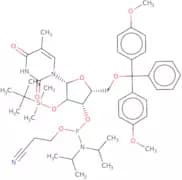
CAS:2'-O-tert-Butyldimethylsilyl-5'-O-DMT-5-methyluridine 3'-CE phosphoramidite is a novel DNA synthesis building block that contains a 5'-dimethoxytrityl group. This compound is an activator, which means it helps in the initiation of DNA synthesis. It is used to synthesize oligonucleotides with 5'-terminal deoxyribonucleoside monophosphates and 5'-terminal diphosphates. The 2'-O-tert-butyldimethylsilyl-5'-O-DMT-5-methyluridine 3'-ce phosphoramidite is an anticancer agent, antiviral agent, and an antifungal agent.
Fórmula:C46H63N4O9PSiPureza:Min. 95%Peso molecular:875.07 g/mol(2R,3R,4S,5R)-2-[6-Amino-2-(propylsulfanyl)-9H-purin-9-yl]-5-(hydroxymethyl)oxolane-3,4-diol
CAS:(2R,3R,4S,5R)-2-[6-Amino-2-(propylsulfanyl)-9H-purin-9-yl]-5-(hydroxymethyl)oxolane-3,4-diol is a novel nucleoside that has antiviral and anticancer properties. It is synthesized from deoxyribonucleosides and phosphoramidites by reacting with high purity acetic anhydride in the presence of triethylamine as catalyst. The compound is also known as (2R,3R,4S,5R)-2-[6-Amino-2-(propylsulfanyl)-9H-purin-9-yl]-5-(hydroxymethyl)oxolane-3,4-diol or 2'-deoxy[(2R,3R,4S,5R)-2-[6-(aminopropylsFórmula:C13H19N5O4SPureza:Min. 95%Peso molecular:341.39 g/mol5'-Deoxy-5-fluoro-5'-iodo-2',3'-O-isopropylidenecytidine
CAS:5'-Deoxy-5-fluoro-5'-iodo-2',3'-O-isopropylidenecytidine is a nucleoside with antiviral and anticancer activity. It is an activator of phosphoramidites, and is used in the production of DNA and RNA. 5'-Deoxy-5-fluoro-5'-iodo-2',3'-O-isopropylidenecytidine also has a high purity, which makes it suitable for use in the synthesis of oligonucleotides and ribonucleotides.Fórmula:C12H15FIN3O4Pureza:Min. 95%Peso molecular:411.17 g/molN6-Benzoyl-2'-deoxy-3'-O-DMT-adenosine
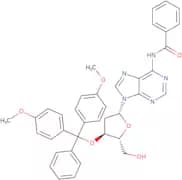
CAS:N6-Benzoyl-2'-deoxy-3'-O-DMT-adenosine is a novel nucleoside analog that is structurally related to the natural nucleotide adenosine. It is an activator of ribonucleotide reductase, which converts ribonucleosides to deoxyribonucleosides. This product has antiviral and anticancer properties. N6-Benzoyl-2'-deoxy-3'-O-DMT-adenosine can be used in research or as an intermediate for the manufacture of other pharmaceuticals.Pureza:Min. 95%N6-Benzoyl-3'-O-tert-butyldiphenylsilyl-2'-Deoxy-2'-fluoroadenosine
N6-Benzoyl-3'-O-tert-butyldiphenylsilyl-2'-Deoxy-2'-fluoroadenosine is a modified nucleoside that is an antiviral and anticancer agent. It inhibits the replication of DNA and RNA, and has shown to be effective in treating leukemia and other cancers. N6-Benzoyl-3'-O-tert-butyldiphenylsilyl-2'-Deoxy-2'-fluoroadenosine has also been used as a starting material for the synthesis of phosphoramidites, which are used in the production of DNA. This product is available at high purity with a modified structure.Fórmula:C34H38FN5O2SiPureza:Min. 95%Peso molecular:595.78 g/mol3',5'-Di-O-acetyl-5-chloro-2'-deoxyuridine
CAS:3',5'-Di-O-acetyl-5-chloro-2'-deoxyuridine (3,5'-diacetyl-2'-deoxyuridine) is a modified nucleoside with antiviral and anticancer properties. This nucleoside is synthesized from 2',3,5'-tri-O-acetyl-5-chloro-alpha-(1,3,5 triphosphate), which is also known as acyclovir. 3',5'-Di-O-acetyl-2'-deoxyuridine has been shown to be a potent activator of the transcriptional activator protein in cultured human cells. 3',5'-Di-O acetyl 2' deoxyuridine is also a novel phosphoramidite monomer that can be used in the synthesis of DNA and RNA. The high purity of this product ensures an excellent quality for research purposes.Fórmula:C13H15ClN2O7Pureza:Min. 95%Peso molecular:346.73 g/mol9-(5'-O-t-Butyldimethylsilyl-2',3'-O-isopropylidene-b-D-ribofuranosyl)-6-chloro-7-deazaguanine
CAS:9-(5'-O-t-Butyldimethylsilyl-2',3'-O-isopropylidene-b-D-ribofuranosyl)-6-chloro-7-deazaguanine is a novel nucleoside phosphoramidite. It is an analogue of the nucleoside 7-(4,4'-dimethoxytrityl)guanine and 9-(4,4'-dimethoxytrityl)guanine. This product has been shown to have anticancer activity and antiviral activity against HIV in vitro. 9-(5'-O-t-Butyldimethylsilyl-2',3'-O-isopropylidene b -D ribofuranosyl)-6 chloro -7 deazaguanine has also been shown to inhibit DNA synthesis in cells. The purity of this product is over 98%. It is a novel compound thatFórmula:C20H33ClN4O4SiPureza:Min. 95%Peso molecular:457.04 g/molN4-Benzoyl-2'-deoxy-5'-O-DMT-cytidine 3'-phosphonate triethylammonium salt
CAS:N4-Benzoyl-2'-deoxy-5'-O-DMT-cytidine 3'-phosphonate triethylammonium salt (BENZYT) is a novel nucleoside analogue that is phosphorylated to the monophosphate (BENZYTP). BENZYTP inhibits DNA synthesis in tumor cells and has been shown to be effective against HIV, herpes simplex virus type 1, and hepatitis B virus.Fórmula:C37H35N3O9P·C6H16NPureza:Min. 95%Peso molecular:798.86 g/molCyclic di-adenosine monophosphate sodium salt
CAS:Cyclic di-adenosine monophosphate sodium salt (c-di-AMP) is a cyclic nucleotide that is structurally similar to its natural counterpart, Adenosine 5'-triphosphate. It binds to the Toll-like receptor 4 (TLR4) and blocks the activation of TLR4 by lipopolysaccharide, thereby inhibiting the downstream inflammatory response. c-di-AMP also inhibits the production of proinflammatory cytokines such as TNFα, IL1β, and IL6 in vitro. c-di-AMP has shown anti-inflammatory properties in vivo and can be used for the treatment of infectious diseases.Fórmula:C20H24N10O12P2·xNaPureza:Min. 95%Peso molecular:658.41 g/molN4-Acetyl-2'-deoxy-5'-O-DMT-cytidine 3'-succinyl CPG 1400 Å
N4-Acetyl-2'-deoxy-5'-O-DMT-cytidine 3'-succinyl CPG 1400 Å is a novel antiviral agent that inhibits the synthesis of viral RNA. This compound has been shown to be effective against influenza A and B, human cytomegalovirus, and herpes simplex virus type 1. N4-Acetyl-2'-deoxy-5'-O-DMT-cytidine 3'-succinyl CPG 1400 Å also has anticancer activity in vitro and in vivo. It has been shown to inhibit the proliferation of tumor cells by interfering with DNA replication, RNA synthesis, and protein synthesis.
Pureza:Min. 95%


![Pyrazolo[1,5-a]pyrimidine-2-carboxylic acid](/_next/image/?url=https%3A%2Fstatic.cymitquimica.com%2Fproducts%2F3D%2Fthumb-webp%2FNP57366.webp&w=3840&q=75)




![2,6-Diamino-9-(2'[2-methylacetamido]-b-D-ribofuranosyl)purine](/_next/image/?url=https%3A%2Fstatic.cymitquimica.com%2Fproducts%2F3D%2Fthumb-webp%2FND167504.webp&w=3840&q=75)
![2',3'-Di-O-acetyl-5'-deoxy-5-fluoro-N-[(2-methylbutoxy)carbonyl]cytidine](/_next/image/?url=https%3A%2Fstatic.cymitquimica.com%2Fproducts%2F3D%2Fthumb-webp%2FND100109.webp&w=3840&q=75)


![1,5-Anhydro-4,6-O-benzylidene-2,3-dideoxy-2-[uracil-1-yl]-D-glucitol](/_next/image/?url=https%3A%2Fstatic.cymitquimica.com%2Fproducts%2F3D%2Fthumb-webp%2FNA04723.webp&w=3840&q=75)







![(2R,3R,4S,5R)-2-[6-Amino-2-(propylsulfanyl)-9H-purin-9-yl]-5-(hydroxymethyl)oxolane-3,4-diol](/_next/image/?url=https%3A%2Fstatic.cymitquimica.com%2Fproducts%2F3D%2Fthumb-webp%2FGBA52853.webp&w=3840&q=75)