Nucleósidos
Los nucleósidos son building blocks fundamentales de los ácidos nucleicos, compuestos por una base nitrogenada unida a una molécula de azúcar. En esta sección, puede encontrar una amplia variedad de nucleósidos esenciales para la investigación en biología molecular, bioquímica y farmacología. Estos compuestos juegan roles cruciales en la síntesis de ADN y ARN, y son vitales en varios procesos metabólicos. Los nucleósidos se utilizan para estudiar material genético, desarrollar terapias antivirales y anticancerígenas, y comprender los mecanismos celulares. En CymitQuimica, proporcionamos nucleósidos de alta calidad para apoyar sus necesidades de investigación y desarrollo, asegurando pureza y fiabilidad para sus aplicaciones experimentales.
Se han encontrado 3569 productos de "Nucleósidos"
Ordenar por
Pureza (%)
0
100
|
0
|
50
|
90
|
95
|
100
2'-O-Methylcytidine-5'-triphosphate sodium salt - 100mM aqueous solution
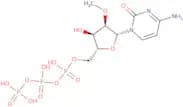
CAS:<p>2'-O-Methylcytidine-5'-triphosphate sodium salt is a synthetic, modified nucleoside analog. It can be used as an antiviral agent and anticancer drug to inhibit viral replication and tumor growth. 2'-O-Methylcytidine-5'-triphosphate sodium salt has the ability to activate cellular DNA synthesis. This compound also inhibits RNA polymerase activity in cancer cells, which inhibits the production of proteins vital for cell division. 2'-O-Methylcytidine-5'-triphosphate sodium salt can be used as a phosphoramidite building block for the synthesis of oligonucleotides with novel structures.</p>Fórmula:C10H18N3O14P3·xNaPureza:Min. 95%Forma y color:Clear LiquidPeso molecular:497.18 g/mol3'-O-Aminothymidine
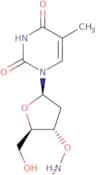
CAS:<p>3'-O-Aminothymidine is an isomer of thymidine, a nucleoside that is found in DNA and RNA. It has a neutral charge and belongs to the category of nucleosides. 3'-O-Aminothymidine is synthesized by the coupling of an amino group with a hydroxyl group. This reaction is efficient and can be used to produce dimers. 3'-O-Aminothymidine can also be used as a precursor for other nucleotides or as a synthetic intermediate in other chemical reactions.</p>Fórmula:C10H15N3O5Pureza:Min. 95%Forma y color:PowderPeso molecular:257.24 g/mol6-Chloro-7-deaza-9-(b-D-ribofuranosyl)purine
CAS:6-Chloro-7-deaza-9-(b-D-ribofuranosyl)purine is a novel nucleoside that has been shown to be an efficient activator of the transcription factor NFκB in vitro. 6-Chloro-7-deaza-9-(b-D-ribofuranosyl)purine is synthesized by phosphoramidite chemistry and purified by HPLC. It has been demonstrated to inhibit the replication of human immunodeficiency virus (HIV) in a dose dependent manner, which may be due to its ability to inhibit the synthesis of viral DNA and RNA. This product is highly pure and can be used for many purposes, including as a synthetic building block for DNA or as an antiviral drug.Fórmula:C11H12ClN3O4Pureza:Min. 95%Forma y color:White PowderPeso molecular:285.69 g/molN-Benzoyl-2'-deoxy-2'-fluoroadenosine, 3'-(hydrogen phosphonate)
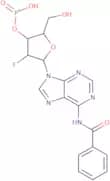
CAS:N-Benzoyl-2'-deoxy-2'-fluoroadenosine, 3'-(hydrogen phosphonate) is a novel nucleoside that inhibits the replication of virus by binding to viral RNA. It is synthesized by reacting 2'-deoxy-2'-fluoroadenosine with pentafluorophenyl phosphate in the presence of an activator such as dicyclohexylcarbodiimide or N-hydroxysuccinimide. The synthesis of N-benzoyl-2'-deoxy-2'-fluoroadenosine, 3'-(hydrogen phosphonate) can be accomplished using commercially available nucleosides and phosphoramidites.Pureza:Min. 95%N6-Benzoyl-5'-O-DMT-2'-O-propynyladenosine 3'-CE phosphoramidite
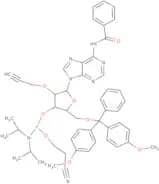
CAS:<p>N6-Benzoyl-5'-O-DMT-2'-O-propynyladenosine 3'-CE phosphoramidite is a modified nucleoside, which is an important building block for DNA and RNA synthesis. It is synthesized by the condensation of 6-benzoyladenosine with 2'-O-propynyladenosin. The stability of this compound has been demonstrated by its resistance to hydrolysis and oxidation, while it can also be activated with a variety of activators, including NaBH4 or NaCNBH3. This novel nucleotide has shown anticancer activity in vivo and antiviral activity against HIV.</p>Fórmula:C50H54N7O8PPureza:Min. 95%Peso molecular:911.98 g/mol6-Amino-1-(2'-deoxy-b-D-ribofuranosyl)-4-hydrazino-1H-pyrazolo[3,4-d]pyrimidine
6-Amino-1-(2'-deoxy-b-D-ribofuranosyl)-4-hydrazino-1H-pyrazolo[3,4-d]pyrimidine (6ADRP) is a synthetic nucleoside that is used as an activator of ribonucleosides and diphosphates in DNA synthesis. 6ADRP has antiviral activity against HIV and herpes simplex virus type 1. It binds to the viral DNA polymerase and prevents the addition of nucleotides to the growing DNA strand. 6ADRP is phosphorylated by T7 kinase to form the active metabolite, 6-amino-1-(2'-deoxy-[alpha]-D-ribofuranosyl)-5'-triphosphate (6ATP), which inhibits viral replication by preventing the formation of RNA primers.Pureza:Min. 95%2-Methylmercapto-4-oxo-6-aminopyrimidine monohydrate
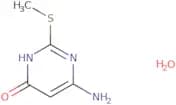
CAS:2-Methylmercapto-4-oxo-6-aminopyrimidine monohydrate is a chemical substance that is used as an anticancer and antiviral agent. It has been demonstrated to inhibit the proliferation of tumor cells in vitro and in vivo, and to deplete tumor cell lines of the enzyme ribonucleotide reductase, which is essential for DNA synthesis. The compound also inhibits the synthesis of viral nucleic acid. 2MMAP has a novel chemical structure that includes a methyl group attached to one nitrogen atom. This modification increases its affinity for DNA and RNA molecules by binding to the phosphate groups on these molecules.Fórmula:C5H7N3OS·H2OPureza:Min. 95%Forma y color:PowderPeso molecular:175.21 g/mol5’(R)-C-Methyladenosine
CAS:<p>5’(R)-C-Methyladenosine is a nucleoside that is used as an antiviral and anticancer agent. It has been shown to inhibit the replication of the human immunodeficiency virus type 1 (HIV-1) in a dose-dependent manner, with an IC50 value of about 0.4 μM for HIV-1 reverse transcriptase activity. In addition, 5’(R)-C-Methyladenosine has been shown to inhibit DNA synthesis and promote apoptosis in cancer cells by inhibiting transcription and translation. The compound also inhibits the growth of tumor cells in mice without affecting normal tissue growth.</p>Pureza:Min. 95%1-(2R,3R,4R,5R)-3-Hydroxy-5-(hydroxymethyl)-4-methoxytetra hydrofuran-2-yl)-5-methylpyrimidine-2,4(1H,3H)-dione
1-(2R,3R,4R,5R)-3-Hydroxy-5-(hydroxymethyl)-4-methoxytetra hydrofuran-2-yl)-5-methylpyrimidine-2,4(1H,3H)-dione is a nucleoside that is a novel anticancer drug. It has been shown to have potent antineoplastic activity in vitro and in vivo. This compound is an activator of the p53 tumor suppressor gene and may also act as a transcriptional inhibitor of NF-κB.Pureza:Min. 95%2'-Azido-2'-deoxyadenosine
CAS:<p>2'-Azido-2'-deoxyadenosine is a synthetic nucleoside analog of adenosine in which the 2'-hydroxyl group of the ribose sugar is replaced by an azido group (–N₃), and the 3'- and 5'-hydroxyl groups remain intact. This modification confers unique chemical properties, including the ability to participate in bioorthogonal "click" chemistry reactions, particularly azide-alkyne cycloadditions, making it useful for labeling and tracking nucleic acids in biochemical studies. Additionally, the azido substitution can influence enzymatic recognition and incorporation by polymerases, allowing its use in studying nucleic acid metabolism, drug design, and therapeutic nucleoside analog development.</p>Fórmula:C10H12N8O3Pureza:Min. 95%Forma y color:PowderPeso molecular:292.25 g/mol3'-O-Methylguanosine 5'-triphosphate lithium
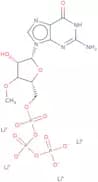
CAS:<p>3'-O-Methylguanosine 5'-triphosphate lithium is a nucleotide that has been synthesized and characterized. It is a biochemical regulatory molecule that is involved in the synthesis of DNA, RNA, and proteins. 3'-O-Methylguanosine 5'-triphosphate lithium binds to the guanine nucleotide binding protein G, which acts as an allosteric activator of the enzyme ribonucleotide reductase. The reconstituted enzyme system containing 3'-O-methylguanosine 5'-triphosphate lithium has demonstrated a high level of fidelity in the replication of dna templates.</p>Fórmula:C11H18N5O14P3•Li4Pureza:Min. 95%Forma y color:PowderPeso molecular:564.97 g/mol8-Hydroxyadenosine
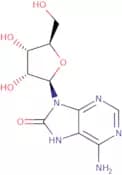
CAS:<p>8-Hydroxyadenosine (8-OHdG) is a purine nucleoside that is formed as a result of oxidative DNA damage. It is not an essential metabolite because it can be synthesized de novo. 8-OHdG has been shown to have potent anti-tumor activity in vitro and in vivo, which may be due to its ability to inhibit DNA replication. The biological effects of 8-OHdG are attributed to its ability to form hydrogen bonds with guanine residues in the double helix, and electrochemical detectors have been developed for its detection.</p>Fórmula:C10H13N5O5Pureza:Min. 98 Area-%Forma y color:PowderPeso molecular:283.25 g/mol2'-Azido-2'-deoxy-5'-O-DMT-uridine
CAS:2'-Azido-2'-deoxy-5'-O-DMT-uridine is a nucleoside that has been modified with an azido group at the 2' position. The azido group is used to modify DNA and RNA nucleosides, which are monophosphate, ribonucleosides, and deoxyribonucleosides. This drug may be used as an activator of DNA synthesis or as a antiviral agent. It has been shown to inhibit HIV replication in vitro.Pureza:Min. 95%5-Methoxycarbonylmethyluridine
CAS:<p>5-Methoxycarbonylmethyluridine is a nucleoside that is a precursor in the synthesis of other nucleotides. It has been shown to have potential as a biomarker for various diseases, such as metabolic disorders and hepatic steatosis. 5-Methoxycarbonylmethyluridine also inhibits the activity of methyltransferases, which are enzymes that catalyze the transfer of methyl groups from S-adenosylmethionine to substrates. It is also used as a model system for polymerase chain reaction in cancer research, because it has been shown to inhibit DNA replication by blocking the incorporation of uracil into DNA.<br>5-Methoxycarbonylmethyluridine has been found at high levels in fetal bovine serum and eukaryotic cells, but not in prokaryotes or cancerous tissues.</p>Fórmula:C12H16N2O8Pureza:Min. 95%Forma y color:PowderPeso molecular:316.26 g/mol2-Amino-9-(β-D-ribofuranosyl)purine
CAS:2-Amino-9-(β-D-ribofuranosyl)purine is a purine nucleoside consisting of the base 2-aminopurine linked via an N9-glycosidic bond to β-D-ribofuranose. As an analog of adenosine, it retains structural compatibility with nucleic acids but exhibits distinct biochemical properties, most notably intrinsic fluorescence. This makes it a valuable probe in molecular biology for studying nucleic acid structure, base pairing, and conformational changes, as its fluorescence is sensitive to local stacking interactions and environmental conditions.Fórmula:C10H13N5O4Pureza:Min. 95%Forma y color:White PowderPeso molecular:267.24 g/mol5'-Azido-5'-deoxyuridine
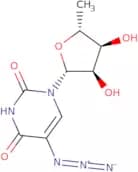
CAS:5'-Azido-5'-deoxyuridine is a synthetic nucleobase that is used in the synthesis of oligodeoxynucleotides. It has been shown to have an inhibitory effect on tumor cells, which may be due to its ability to interact with guanosine diphosphate (GDP) and prevent the formation of GTP. 5'-Azido-5'-deoxyuridine has also been shown to have an inhibitory effect on Mycobacterium tuberculosis and Mycobacterium avium complex, but does not affect other bacteria. 5'-Azido-5'-deoxyuridine interacts with RNA by binding to the phosphate group and inhibiting the synthesis of proteins and DNA.Pureza:Min. 95%2'-Deoxy-N6-DMF-5'-O-MMT-adenosine 3'-CE phosphoramidite
CAS:2'-Deoxy-N6-DMF-5'-O-MMT-adenosine 3'-CE phosphoramidite is a high purity, diphosphate nucleotide analog. It is an anticancer drug that inhibits DNA synthesis and can be used to treat cancer. The 2'-deoxy-N6-DMF moiety has been shown to inhibit the activity of DNA polymerase and other enzymes involved in DNA replication. This compound also has a novel mechanism of action that is not present in any other known anticancer drugs. CAS No. 195375-66-7.br>br>2'-Deoxy-N6-DMF 5'-O-MMT adenosine 3'-cephosphoramidite is often used as a building block for oligonucleotide synthesis because it is resistant to the removal of phosphate groups by alkaline phosphatases. The lack of phosphate groups makes this compound more stable than standard nucleotidesFórmula:C42H51N8O5PPureza:Min. 95%Peso molecular:778.9 g/mol5-Azacytidine
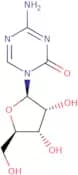
CAS:<p>An azanucleoside and epigenetic modulator that interferes with nucleic acid metabolism. The compound gets incorporated into RNA and inhibits ribonucleotide reductase subunit RRM2 in leukemia cell lines. Intracellularly, 5-azacytidine can get converted into 2′-deoxy-5-azacytidine (decitabine) and subsequently incorporated in DNA, where it irreversibly inhibits DNMT1 methyltransferase. In human epithelial cell lines, this compound decreases Src-activated expression of a histone chaperone CAF1 and inhibits cell motility and invasiveness.</p>Fórmula:C8H12N4O5Pureza:Min. 95%Forma y color:White Off-White PowderPeso molecular:244.21 g/mol2,4,6-Trichloro-5-methylpyrimidine
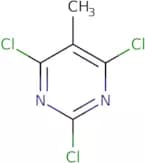
CAS:<p>2,4,6-Trichloro-5-methylpyrimidine is a nucleoside for use in research applications</p>Fórmula:C5H3Cl3N2Pureza:Min. 95%Forma y color:PowderPeso molecular:197.45 g/mol3'-O-Aminoacetoxy-2'-deoxyadenosine
amino functionalised nucleosideFórmula:C13H22N6O3Pureza:Min. 98 Area-%Forma y color:PowderPeso molecular:310.36 g/mol


![6-Amino-1-(2'-deoxy-b-D-ribofuranosyl)-4-hydrazino-1H-pyrazolo[3,4-d]pyrimidine](/_next/image/?url=https%3A%2Fstatic.cymitquimica.com%2Fproducts%2F3D%2Fthumb-webp%2FNA162940.webp&w=3840&q=75)