Nucleósidos
Los nucleósidos son building blocks fundamentales de los ácidos nucleicos, compuestos por una base nitrogenada unida a una molécula de azúcar. En esta sección, puede encontrar una amplia variedad de nucleósidos esenciales para la investigación en biología molecular, bioquímica y farmacología. Estos compuestos juegan roles cruciales en la síntesis de ADN y ARN, y son vitales en varios procesos metabólicos. Los nucleósidos se utilizan para estudiar material genético, desarrollar terapias antivirales y anticancerígenas, y comprender los mecanismos celulares. En CymitQuimica, proporcionamos nucleósidos de alta calidad para apoyar sus necesidades de investigación y desarrollo, asegurando pureza y fiabilidad para sus aplicaciones experimentales.
Se han encontrado 3569 productos de "Nucleósidos"
Ordenar por
Pureza (%)
0
100
|
0
|
50
|
90
|
95
|
100
3',5'-Di-O-(tert-butyldimethylsilyl)-2'-deoxyguanosine
CAS:3',5'-Di-O-(tert-butyldimethylsilyl)-2'-deoxyguanosine is a synthetic nucleoside with antiviral properties. It is a monophosphate that can be used to activate other nucleosides. This product has been shown to inhibit human immunodeficiency virus (HIV) reverse transcriptase in vitro and in vivo, as well as the replication of other viruses such as herpes simplex virus (HSV).Fórmula:C22H41N5O4Si2Pureza:Min. 95%Forma y color:PowderPeso molecular:495.76 g/mol2'-Deoxy-5'-O-MMT-inosine 3'-CE phosphoramidite
2'-Deoxy-5'-O-MMT-inosine 3'-CE phosphoramidite is a modified nucleoside that is used in the synthesis of DNA. It has been shown to inhibit the replication of HIV, herpes simplex virus type 1 and type 2, influenza A virus and vesicular stomatitis virus. The antiviral activity has been attributed to its ability to inhibit viral DNA polymerase, which prevents viral replication. This compound also inhibits human cytomegalovirus (CMV) DNA polymerase in vitro.Fórmula:C39H45N6O6PPureza:Min. 95%Peso molecular:724.8 g/mol3'-Amino-5'-O-p-anisoyl-3'-deoxy-D3-thymidine
Producto controlado3'-Amino-5'-O-p-anisoyl-3'-deoxy-D3-thymidine is a novel modified nucleoside that has antiviral and anticancer properties. It is an activator of the DNA polymerase, ribonucleotide reductase, and thymidine kinase enzymes. 3'-Amino-5'-O-p-anisoyl-3'-deoxy-D3-thymidine has been shown to inhibit the growth of human cancer cells in vitro and in vivo.Fórmula:C18H18N3O7D3Pureza:Min. 95%Peso molecular:394.39 g/mol6-Amino-1-(2'-deoxy-a-D-ribofuranosyl)-4-methoxy-1H- pyrazolo[3,4-d]pyrimidine
6-Amino-1-(2'-deoxy-a-D-ribofuranosyl)-4-methoxy-1H- pyrazolo[3,4-d]pyrimidine is a modified nucleoside that is an antiviral agent and anticancer drug. It inhibits viral replication by inhibiting the activity of DNA polymerase. 6-[Amino(2'-deoxyribofuranosyl)]-1-(2'-deoxyribofuranosyl)-4-methoxypyrazolo[3,4-d]pyrimidine has been shown to inhibit the growth of cancer cells without affecting healthy cells.Pureza:Min. 95%5-(Azidomethyl)-2’-deoxyuridine
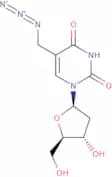
CAS:5-azidomethyl-2-deoxyuridine (AmdU) is a nucleoside that contains an azide group. The structure of the nucleoside is similar to thymidine, and it is incorporated into nascent DNA by cellular polymerases, similarly to EdU (NE08701). Unlike EdU that needs to be further modified with azides in the presence of copper catalyst, AmdU can also react in the absence of copper catalyst using spAAC Click Chemistry with strained cycloalkynes, such as cyclooctynes. This enables detection of nascent DNA in benign, copper free conditions.
Fórmula:C10H13N5O5Pureza:Min. 95%Forma y color:PowderPeso molecular:283.24 g/molIsocytidine
CAS:Isocytidine, also known as 2-amino-1-β-D-ribofuranosyl-4(1H)-pyrimidinone, have broad antitumor activity targeting indolent lymphoid malignancies.Fórmula:C9H13N3O5Pureza:Min. 95%Forma y color:PowderPeso molecular:243.22 g/mol8-Bromoguanosine 3',5'-cyclic monophosphate sodium salt
CAS:Activator of cGMP-dependent protein kinasesFórmula:C10H10BrN5NaO7PPureza:Min. 95%Forma y color:PowderPeso molecular:446.08 g/mol2,3'-Anhydro-5'-O-benzoyl-N4-benzoyl-2'-deoxycytidine
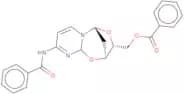
2,3'-Anhydro-5'-O-benzoyl-N4-benzoyl-2'-deoxycytidine is a novel nucleoside analog that has been shown to have anticancer, antiviral and antiretroviral activities. It binds to the ribonucleotide reductase enzyme and inhibits deoxyribonucleoside synthesis in cells. 2,3'-Anhydro-5'-O-benzoyl-N4-benzoyl-2'-deoxycytidine is also an activator of ribonucleotide reductase. This drug has been shown to be effective in treating leukemia, lymphoma, and breast cancer cells.Fórmula:C23H21N3O5Pureza:Min. 95%Peso molecular:419.44 g/mol6-Amino-4-hydrazino-2-(b-D-ribofuranosyl)-2H-pyrazolo[3,4-d]pyrimidine
6-Amino-4-hydrazino-2-(b-D-ribofuranosyl)-2H-pyrazolo[3,4-d]pyrimidine is a modified nucleoside which has been shown to be active against HIV and other viruses. It is a phosphoramidate of 2'-deoxyadenosine 5'-monophosphate with an amino group at the 2' position. This compound inhibits the replication of DNA by binding to the enzyme reverse transcriptase and prevents the synthesis of viral DNA. 6-Amino-4-hydrazino-2-(b-D-ribofuranosyl)-2H-pyrazolo[3,4-d]pyrimidine also has anticancer properties, as it inhibits cell proliferation in vitro and in vivo.Pureza:Min. 95%5'-O-p-Anisoyl-N4-benzoyl-3'-fluoro-2',3'-dideoxycytidine
5'-O-p-Anisoyl-N4-benzoyl-3'-fluoro-2',3'-dideoxycytidine is a deoxyribonucleoside that has antiviral, anticancer, and novel properties. It has a CAS No. of 49811-91-7 and a molecular weight of 290.5 g/mol. The chemical formula for 5'-0-p-anisoyl-N4-benzoyl-3'-fluoro-2',3'-dideoxycytidine is C12H14FN2O9. It is synthesized by reacting 2,6-(1H,1'H)-benzoxazinones with 3' -deoxycytidines in the presence of phosphoric acid and anhydrous zinc chloride in methanol at room temperature to form the 5'-0 p anisoyl derivative, which is then reacted withFórmula:C24H22FN3O6Pureza:Min. 95%Peso molecular:467.45 g/mol6-O-Methylinosine
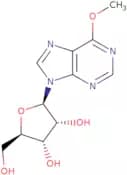
CAS:6-O-Methylinosine is a modified nucleoside that is used in the synthesis of recombinant proteins. It is synthesized from the reaction of methylphosphate and 6-O-methylguanosine. The phosphate group of the 6-O-methylguanosine molecule reacts with methylphosphate in an acid or neutral environment, while it reacts with phosphoric acid in a basic environment. This reaction can be monitored by measuring the amount of free phosphate groups present after the reaction. The rate of this reaction can be increased by increasing temperature and pH. 6-O-Methylinosine has been shown to have anticancer activity, which may be due to its ability to inhibit enzyme catalysis and modify DNA structure.Fórmula:C11H14N4O5Pureza:Min. 95%Forma y color:White PowderPeso molecular:282.25 g/mol5'-O-Benzoyl-2',3'-dideoxy-3'-fluorouridine
5'-O-Benzoyl-2',3'-dideoxy-3'-fluorouridine is a novel nucleoside that is synthesized from ribonucleosides. It is an inhibitor of the RNA polymerase enzyme, which prevents the transcription and replication of DNA. 5'-O-Benzoyl-2',3'-dideoxy-3'-fluorouridine also inhibits viral DNA synthesis by preventing viral RNA from being translated into DNA. This product has been shown to be active against a wide range of viruses, including influenza A virus, herpes simplex virus type 1, and vaccinia virus.Fórmula:C16H15FN2O5Pureza:Min. 95%Peso molecular:334.35 g/mol2’-Amino-2’-deoxy-5’-O-DMT-5-methyluridine
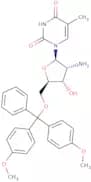
CAS:2’-Amino-2’-deoxy-5’-O-DMT-5-methyluridine is a novel nucleoside that has been modified to be phosphorylated on the 5' position. This modification provides the molecule with more stability in vivo and increases its anticancer potential. The synthesis of 2'-amino-2'-deoxy-5'-O-DMT-5 methyluridine is carried out by the conversion of 5'-O-(4,4'-dimethoxytrityl)-N,N-diisopropylphosphoramidite to 5'-O-(4,4'-dimethoxytrityl)-2',3',6'-triisopropylbenzoylphosphate. This compound can also inhibit viral replication by inhibiting dsRNA synthesis and is used to treat patients with chronic hepatitis B virus infection. The molecule has high purity and high quality.Pureza:Min. 95%EdU
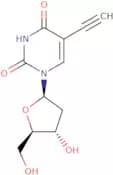
CAS:2'-Deoxy-5-ethynyluridine (5-EdU) is a modified thymidine analogue containing a terminal alkyne group, which is used for nucleotide labelling. 5-Edu is easily taken up by cells and incorporated by metabolic activation during DNA synthesis. By adding an azide conjugated to a fluorophore or a biotin moiety, a click reaction occurs from the labelled nucleotide linked by a triazole group. 5-Edu are employed in cell proliferation assays, to study DNA and RNA localisation, structure and dynamics, in the synthesis of aptamers with the click-SELEX method, and in other applications such as the preparation of oligonucleotide microarrays and nanoelectronic devices.Fórmula:C11H12N2O5Pureza:Min. 98 Area-%Forma y color:PowderPeso molecular:252.23 g/mol1-[(5E)-3-O-[(Bis-diisopropylamino)(2-cyanoethoxy) phosphino]-5,6-dideoxy-6-(diethoxyphosphinyl)-2-O-methyl-β-D- ribo-hex-5-enofu ranosyl]uracil
5-Deoxy-2'-O-methylcytidine is a phosphoramidite nucleoside that has antiviral, anticancer, and antifungal properties. It is used as an activator in the synthesis of oligonucleotides and as a reagent for the synthesis of other nucleotide analogues. 5-Deoxy-2'-O-methylcytidine has been shown to have a novel mechanism of action, which targets DNA polymerase alpha and inhibits replication. This drug also has antiangiogenic activity, which may be due to its ability to inhibit the production of VEGF.Pureza:Min. 95%2'-Deoxy-2'-fluoro-5'-O-trityluridine 3'-CE phosphoramidite
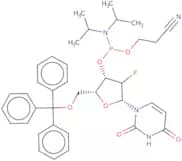
2'-Deoxy-2'-fluoro-5'-O-trityluridine 3'-CE phosphoramidite is a novel, modified nucleoside. It is a monophosphate and can be used as antiviral, activator or diphosphate. It has been shown to inhibit the growth of cancer cells in vitro. 2'-Deoxy-2'-fluoro-5'-O-trityluridine 3'-CE phosphoramidite also has activity against bacterial and viral pathogens and can be used for the synthesis of DNA, RNA, and other oligonucleotide compounds. This product is of high quality and purity with CAS No., Antiviral, Activator, diphosphate, Synthetic, Ribonuclesides, Deoxyribonucleosides.Fórmula:C37H42FN4O6PPureza:Min. 95%Peso molecular:688.74 g/mol2'-O-tert-Butyldimethylsilyladenosine
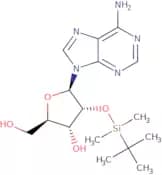
CAS:2'-O-tert-Butyldimethylsilyladenosine is a novel nucleoside. It is an anti-cancer and antiviral agent that is synthesized from ribonucleosides by the phosphoramidite method. 2'-O-tert-Butyldimethylsilyladenosine has been shown to be active against DNA polymerases, RNA polymerases, and enveloped viruses. This drug also inhibits cell proliferation in a variety of human tumor cells in vitro. 2'-O-tert-Butyldimethylsilyladenosine has been shown to exhibit anticancer activity by interfering with DNA synthesis and preventing the replication of damaged cells.Pureza:Min. 95%Guanylyl-3'-5'-cytidine ammonium salt
CAS:Guanylyl-3'-5'-cytidine ammonium salt is a nucleoside that is classified as a diphosphate. It has high quality and novel, anticancer and cytotoxic effects. Guanylyl-3'-5'-cytidine ammonium salt is synthesized from guanosine monophosphate (GMP) and cytidine monophosphate (CMP).Fórmula:C19H25N8O12P·NH3Pureza:Min. 95 Area-%Forma y color:PowderPeso molecular:605.46 g/mol2'-Deoxy-5'-O-DMT-N6-phenoxyacetyladenosine
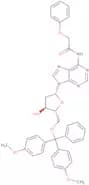
CAS:2'-Deoxy-5'-O-DMT-N6-phenoxyacetyladenosine is a novel phosphoramidite nucleoside that is an antiviral and anticancer agent. It can be used as a monophosphate or diphosphate. 2'-Deoxy-5'-O-DMT-N6-phenoxyacetyladenosine has been shown to inhibit the replication of DNA, RNA, and protein synthesis. This compound also has an activating effect on the immune system by inducing lymphocyte proliferation and increasing NK activity. It inhibits the growth of viruses such as HIV and influenza A virus. The purity of 2'-Deoxy-5'-O-DMT-N6-phenoxyacetyladenosine is high, with a CAS number of 11052282-2.Fórmula:C39H37N5O7Pureza:Min. 95%Forma y color:PowderPeso molecular:687.76 g/molN4-Benzoyl-3'-O-tert-butyldimethylsilyl-5'-O-DMT-N4-methylcytidine
N4-Benzoyl-3'-O-tert-butyldimethylsilyl-5'-O-DMT-N4-methylcytidine is a nucleoside that is chemically modified by the addition of a benzoyl group. It has antiviral, anticancer and antiretroviral activities. N4-Benzoyl-3'-O-tert-butyldimethylsilyl-5'-O-DMT-N4-methylcytidine inhibits viral DNA synthesis by inhibiting both viral DNA polymerase and reverse transcriptase, which are enzymes required for the production of viral DNA. It also inhibits cancer cell growth by forming covalent bonds with deoxyribonucleic acid (DNA) in the cancer cells and initiating apoptosis. This nucleoside has been shown to be active against HIV, Herpes Simplex Virus Type 1 (HSV1), and Human CytomegalovPureza:Min. 95%


![6-Amino-1-(2'-deoxy-a-D-ribofuranosyl)-4-methoxy-1H- pyrazolo[3,4-d]pyrimidine](/_next/image/?url=https%3A%2Fstatic.cymitquimica.com%2Fproducts%2F3D%2Fthumb-webp%2FNA162964.webp&w=3840&q=75)


![6-Amino-4-hydrazino-2-(b-D-ribofuranosyl)-2H-pyrazolo[3,4-d]pyrimidine](/_next/image/?url=https%3A%2Fstatic.cymitquimica.com%2Fproducts%2F3D%2Fthumb-webp%2FNA162981.webp&w=3840&q=75)


![1-[(5E)-3-O-[(Bis-diisopropylamino)(2-cyanoethoxy) phosphino]-5,6-dideoxy-6-(diethoxyphosphinyl)-2…](/_next/image/?url=https%3A%2Fstatic.cymitquimica.com%2Fproducts%2F3D%2Fthumb-webp%2FNB162929.webp&w=3840&q=75)