Metales
Los metales son elementos conocidos por sus propiedades características, como alta conductividad eléctrica y térmica, maleabilidad, ductilidad y brillo, lo que los hace esenciales en una amplia gama de aplicaciones industriales y de investigación. Estos elementos, incluyendo hierro, cobre, aluminio y oro, juegan roles críticos en sectores como la construcción, la electrónica, el transporte y la manufactura. En CymitQuimica, ofrecemos una diversa selección de metales de alta pureza diseñados para cumplir con los estrictos requisitos de las aplicaciones tanto de investigación como industriales. Nuestro catálogo incluye metales puros, aleaciones metálicas y compuestos metálicos, todos rigurosamente probados en cuanto a calidad y rendimiento. Al proporcionar metales de alta calidad, apoyamos a los investigadores y profesionales de la industria en la consecución de resultados precisos y eficientes en sus proyectos, facilitando avances en tecnología, ciencia de materiales e ingeniería.
Subcategorías de "Metales"
Se han encontrado 4493 productos de "Metales"
Ordenar por
Pureza (%)
0
100
|
0
|
50
|
90
|
95
|
100
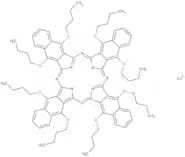
Copper(II) 5,9,14,18,23,27,32,36-octabutoxy-2,3-naphthalocyanine
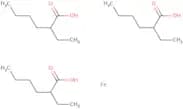
CAS:Copper(II) 5,9,14,18,23,27,32,36-octabutoxy-2,3-naphthalocyanine is a copper compound with a molecular formula of Cu(OCOCN)8. It has been shown to be a n-type semiconductor and can be used for applications in photovoltaic cells. Copper(II) 5,9,14,18,23,27,32,36-octabutoxy-2,3-naphthalocyanine has been shown to have high quantum efficiency and absorption in the near ultraviolet region. The density of this compound is 2.6 g/cm3 at room temperature.Fórmula:C80H88CuN8O8Pureza:Min. 95%Forma y color:PowderPeso molecular:1,353.15 g/molIron(III) 2-ethylhexanoate in 1,2,3,4-tetramethylbenzene
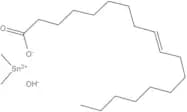
CAS:Iron(III) 2-ethylhexanoate is a ferric salt that is used as an acid catalyst for the synthesis of ethyl esters. It also acts as an oxidant and can be used in organic chemistry as a chemical reagent to produce ethyl esters from carboxylic acids. Iron(III) 2-ethylhexanoate reacts with iron oxide particles to form ferric hydroxide, which is then purified by calcium carbonate. This compound also has potential applications in nanotechnology, where it has been shown to be able to act as a catalyst for the synthesis of nanowires. The adsorption kinetics of this compound have been studied using various solvents and metal hydroxides, showing that the rate of adsorption depends on the type of solvent and metal hydroxide used. Iron(III) 2-ethylhexanoate is synthesized by reacting ethyl linoleate with iron oxide particles and calcium stearateFórmula:C24H45FeO6Pureza:Min. 95%Forma y color:Clear LiquidPeso molecular:485.47 g/molDIMETHYLHYDROXY(OLEATE)TIN, tech
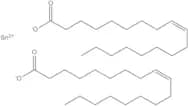
CAS:Fórmula:C20H40O3SnPureza:85%Forma y color:Yellow Amber LiquidPeso molecular:447.23TIN(II) OLEATE, tech
CAS:Fórmula:C36H66O4SnPureza:85%Forma y color:Straw To Amber LiquidPeso molecular:681.61BIS[BIS(TRIMETHYLSILYL)AMINO]TIN(II), 95%
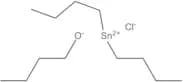
CAS:Fórmula:C12H36N2Si4SnPureza:95%Forma y color:Orange-Red LiquidPeso molecular:439.47DI-n-BUTYLBUTOXYCHLOROTIN, tech
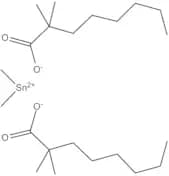
CAS:Fórmula:C12H27ClOSnPureza:95%Forma y color:Straw Amber LiquidPeso molecular:341.48DIMETHYLDINEODECANOATETIN, tech
CAS:Fórmula:C22H44O4SnPureza:95%Forma y color:Yellow Amber LiquidPeso molecular:491.26TETRAKIS(DIMETHYLAMINO)TIN
CAS:<p>ALD Material<br>Atomic layer deposition (ALD) is a chemically self-limiting deposition technique that is based on the sequential use of a gaseous chemical process. A thin film (as fine as -0.1 Å per cycle) results from repeating the deposition sequence as many times as needed to reach a certain thickness. The major characteristic of the films is the resulting conformality and the controlled deposition manner. Precursor selection is key in ALD processes, namely finding molecules which will have enough reactivity to produce the desired films yet are stable enough to be handled and safely delivered to the reaction chamber.<br>Tetrakis(dimethylamino)tin; Octamethylstannanetetraamine; Tin IV dimethylamide<br>Reacts with tris(aminoalkyl)amines, yielding azastannatranes<br></p>Fórmula:C8H24N4SnForma y color:Pale Yellow LiquidPeso molecular:294.99TETRAMETHYLTIN
CAS:<p>ALD Material<br>Atomic layer deposition (ALD) is a chemically self-limiting deposition technique that is based on the sequential use of a gaseous chemical process. A thin film (as fine as -0.1 Å per cycle) results from repeating the deposition sequence as many times as needed to reach a certain thickness. The major characteristic of the films is the resulting conformality and the controlled deposition manner. Precursor selection is key in ALD processes, namely finding molecules which will have enough reactivity to produce the desired films yet are stable enough to be handled and safely delivered to the reaction chamber.<br>Tetramethyltin; Tetramethylstannane<br>ΔHcomb: 903.5 kcal/molΔHform, gas, 27 °: -13.6 kcal/mol ΔHvap: 6.8 kcal/molSn-Me bond dissociation energy: 227 kJ/molEa, pyrolysis: 41.1 kcal/molVapor pressure, -21 °C: 10 mmVapor pressure, 20 °C: 90 mmAllows synthesis of even numbered alkanesConverts acid chlorides to methyl ketones with benzylchlorobis(triphenyl phosphine)palladiumForms aryl methyl ketones from aryl halides and CO in the presence of dicarbonylbis(triphenylphosphine)nickelFor CVD of tin oxide transparent conductive electrodes on glass for photovoltaics and sensorsPyrolyzed in vacuum to tin at 600-750 °CPyrolyzed oxidatively to SnO at 350-600 °CForms transparent conductive oxides for photovoltaics by Plasma-enhanced chemical vapor deposition (PECVD)Higher purity grade available, SNT7560.1<br></p>Fórmula:C4H12SnPureza:97%Forma y color:Colourless LiquidPeso molecular:178.83DI-n-BUTYLDILAURYLTIN, tech
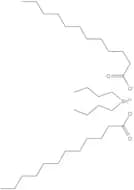
CAS:Fórmula:C32H64O4SnPureza:95%Forma y color:Straw To Pale Yellow LiquidPeso molecular:631.55i-Propylmagnesium bromide, 2.9M (35wt% ±1wt%) in 2-methyltetrahydrofuran
CAS:<p>i-Propylmagnesium bromide, 2.9M (35wt% ±1wt%) in 2-methyltetrahydrofuran</p>Fórmula:(CH3)2CHMgBrForma y color:liq.Peso molecular:147.30Benzylmagnesium chloride, 1-2 M in THF
CAS:<p>Benzylmagnesium chloride, 1-2 M in THF</p>Fórmula:C6H5CH2MgClForma y color:liq.Peso molecular:150.89Allylmagnesium bromide, 0.95-1.1 M in ether
CAS:<p>Allylmagnesium bromide, 0.95-1.1 M in ether</p>Fórmula:CH2CHCH2MgBrForma y color:liq.Peso molecular:145.28sec-Butylmagnesium chloride, lithium chloride complex 1.2M (15wt% ±1wt%) in tetrahydrofuran
CAS:<p>sec-Butylmagnesium chloride, lithium chloride complex 1.2M (15wt% ±1wt%) in tetrahydrofuran</p>Fórmula:CH3CH2CH(CH3)MgClLiClForma y color:dark brown liq.Peso molecular:159.26n-Butylmagnesium chloride, 1.5-3.0 M in THF
CAS:<p>n-Butylmagnesium chloride, 1.5-3.0 M in THF</p>Fórmula:C4H9MgClForma y color:liq.Peso molecular:116.87Ethylmagnesium chloride, 2M in ether
CAS:<p>Ethylmagnesium chloride, 2M in ether</p>Fórmula:C2H5MgClForma y color:liq.Peso molecular:88.83Methylmagnesium bromide, 3M in ether
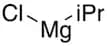
CAS:<p>Methylmagnesium bromide, 3M in ether</p>Fórmula:CH3MgBrForma y color:liq.Peso molecular:119.26i-Propylmagnesium chloride, 2-3M in ether
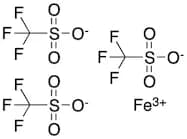
CAS:<p>i-Propylmagnesium chloride, 2-3M in ether</p>Fórmula:(CH3)2CHMgClForma y color:liq.Peso molecular:102.85Iron(III) trifluoromethanesulfonate
CAS:Producto controladoFórmula:C3F9FeO9S3Forma y color:NeatPeso molecular:503.05Chromium dioxide
CAS:Producto controlado<p>Applications Chromium dioxide (CAS# 12018-01-8) is a useful research chemical compound.<br></p>Fórmula:CrO2Forma y color:NeatPeso molecular:83.99


![BIS[BIS(TRIMETHYLSILYL)AMINO]TIN(II), 95%](/_next/image/?url=https%3A%2Fstatic.cymitquimica.com%2Fproducts%2F3H%2Fthumb-webp%2FSNB1025.webp&w=3840&q=75)