Metales
Los metales son elementos conocidos por sus propiedades características, como alta conductividad eléctrica y térmica, maleabilidad, ductilidad y brillo, lo que los hace esenciales en una amplia gama de aplicaciones industriales y de investigación. Estos elementos, incluyendo hierro, cobre, aluminio y oro, juegan roles críticos en sectores como la construcción, la electrónica, el transporte y la manufactura. En CymitQuimica, ofrecemos una diversa selección de metales de alta pureza diseñados para cumplir con los estrictos requisitos de las aplicaciones tanto de investigación como industriales. Nuestro catálogo incluye metales puros, aleaciones metálicas y compuestos metálicos, todos rigurosamente probados en cuanto a calidad y rendimiento. Al proporcionar metales de alta calidad, apoyamos a los investigadores y profesionales de la industria en la consecución de resultados precisos y eficientes en sus proyectos, facilitando avances en tecnología, ciencia de materiales e ingeniería.
Subcategorías de "Metales"
Se han encontrado 4493 productos de "Metales"
Ordenar por
Pureza (%)
0
100
|
0
|
50
|
90
|
95
|
100
Dichloro[rel-[N(S)]-N-[2-[(R)-phenylthio-κS]ethyl]-[1-pyrrolidineethanamine-κNN1,κN1](triphenylphosphine)ruthenium(II)
CAS:<p>Dichloro[rel-[N(S)]-N-[2-[(R)-phenylthio-κS]ethyl]-[1-pyrrolidineethanamine-κNN1,κN1](triphenylphosphine)ruthenium(II)</p>Fórmula:C32H37Cl2N2PRuSForma y color:pink pwdr.Peso molecular:684.67Bis(pentamethylcyclopentadienyl)magnesium, elec. gr. (99.999%-Mg) PURATREM
CAS:<p>Bis(pentamethylcyclopentadienyl)magnesium, elec. gr. (99.999%-Mg) PURATREM</p>Fórmula:(CH3)5C5MgPureza:(99.999%-Mg)Forma y color:white to yellow xtl.Peso molecular:294.77Bis(cyclopentadienyl)ruthenium, 99% (99.9%-Ru) (Ruthenocene)
CAS:<p>Bis(cyclopentadienyl)ruthenium, 99% (99.9%-Ru) (Ruthenocene)</p>Fórmula:(C5H5)2RuPureza:(99.9%-Ru)Forma y color:light yellow xtl.Peso molecular:231.26Tris(2,2,6,6-tetramethyl-3,5-heptanedionato)aluminum, 99% (99.9%-Al) [Al(TMHD)₃]
CAS:<p>Tris(2,2,6,6-tetramethyl-3,5-heptanedionato)aluminum, 99% (99.9%-Al) [Al(TMHD)3]</p>Fórmula:Al(C11H19O2)3Pureza:(99.9%-Al)Forma y color:white xtl.Peso molecular:576.80Diacetato{(S)-(-)-5,5'-bis[di(3,5-xylyl)phosphino]-4,4'-bi-1,3-benzodioxole}ruthenium(II) Ru(OAc)₂[(S)-dm-segphos®]
CAS:<p>Diacetato{(S)-(-)-5,5'-bis[di(3,5-xylyl)phosphino]-4,4'-bi-1,3-benzodioxole}ruthenium(II) Ru(OAc)2[(S)-dm-segphos®]</p>Fórmula:C50H50O8P2RuForma y color:yellow to brownish-red to dark green solidPeso molecular:941.95Zinc Bis(2-Ethylhexyl) Phosphorodithioate-d20
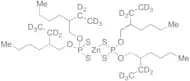
CAS:Producto controlado<p>Applications Isotope labelled Zinc Bis(2-Ethylhexyl) Phosphorodithioate is an analytical standard with antioxidant properties.<br>References Cermak, S. et al.: J. Am. Oil Chem. Soc., 91, 2101 (2014); Chemija. et al.: 25, 161 (2014);<br></p>Fórmula:C32D20H48O4P2S4ZnForma y color:NeatPeso molecular:792.62Zinc Bis(2-Ethylhexyl) Phosphorodithioate
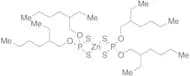
CAS:Producto controlado<p>Applications Zinc Bis(2-Ethylhexyl) Phosphorodithioate is an analytical standard with antioxidant properties.<br>References Cermak, S. et al.: J. Am. Oil Chem. Soc., 91, 2101 (2014); Chemija. et al.: 25, 161 (2014);<br></p>Fórmula:C32H68O4P2S4ZnForma y color:NeatPeso molecular:772.47Bis(N,N’-di-t-butylacetamidinato)ruthenium(II) dicarbonyl, 98% (99.99%-Ru) PURATREM
CAS:<p>Bis(N,N-di-t-butylacetamidinato)ruthenium(II) dicarbonyl, 98% (99.99%-Ru) PURATREM</p>Fórmula:C22H42N4O2RuPureza:98% (99.99%-Ru)Forma y color:beige to yellow solidPeso molecular:495.67Magnesium (N,N,N',N'-tetramethylethylenediamine)bis[BREW] (99.99+%-Mg) PURATREM
<p>Magnesium (N,N,N',N'-tetramethylethylenediamine)bis[BREW] (99.99+%-Mg) PURATREM</p>Fórmula:Mg(C6H16N2)CHyC(O)CHC(O)CHy(xyxPureza:(99.99+%-Mg)Forma y color:pale yellow liq.Zinc Salicylate Hydrate
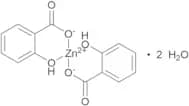
CAS:<p>Applications Zinc salicylate trihydrate (CAS# 16283-36-6) is a useful research chemical compound.<br></p>Fórmula:C14H10O6Zn·2H2OForma y color:NeatPeso molecular:375.665Bis(ethylcyclopentadienyl)ruthenium(II), 98% (99.9%-Ru), 44-0040, contained in high-temp 50 ml Swagelok® cylinder (96-1071) for CVD/ALD
CAS:<p>Bis(ethylcyclopentadienyl)ruthenium(II), 98% (99.9%-Ru), 44-0040, contained in high-temp 50 ml Swagelok® cylinder (96-1071) for CVD/ALD</p>Fórmula:(CH3CH2)C5H4RuPureza:(99.9%-Ru)Forma y color:pale yellow liq.Peso molecular:287.37Iron Triabietate
CAS:Producto controladoFórmula:C20H30O2FeForma y color:NeatPeso molecular:321.0633333333Zinc Cysteinate Hydrochloride
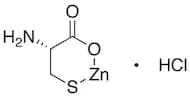
CAS:Producto controlado<p>Applications Increases activity of the antioxidative enzymes Catalase and Glutathione Peroxidase, thereby protecting retinal epithelial cells from high hydrogen peroxide concentrations.<br>References Hanley, W., et al.: Chem-Biol. Interactions, 21, 263 (1978),<br></p>Fórmula:C3H5NO2S·HCl·ZnForma y color:NeatPeso molecular:221.012Bis(2,2,6,6-tetramethyl-3,5-heptanedionato)magnesium, anhydrous, min. 98% [Mg(TMHD)2] , 12-0900, contained in high-temp 50 ml Swagelok® cylinder (96-1071) for CVD/ALD
CAS:<p>Bis(2,2,6,6-tetramethyl-3,5-heptanedionato)magnesium, anhydrous, min. 98% [Mg(TMHD)2] , 12-0900, contained in high-temp 50 ml Swagelok® cylinder (96-1071) for CVD/ALD</p>Fórmula:Mg(C11H19O2)2Pureza:min. 98%Forma y color:white pwdr.Peso molecular:390.85Copper(II) Acetate Monohydrate
CAS:Producto controlado<p>Applications Copper(II) Acetate Monohydrate is a versatile and cost-effective reagent that is used as a catalyst for N-monoalkylation of amino derivatives that are poor nucleophiles, and also for the synthesis of symmetrical 1,3-diynes. Copper(II) Acetate is also used as a mild caustic in the medical field.<br> Not a dangerous good if item is equal to or less than 1g/ml and there is less than 100g/ml in the package<br>References Balaraman, K. & Kesavan, V.: Synthesis, 2010, 3461 (2010); Martinez-Ascencio, A., et al.: Tetrahedron Lett., 51, 325 (2010); Theophanides, T. & Anastassopoulou, J.: Crit. Rev. Oncol. Hematol., 42, 57 (2002)<br></p>Fórmula:C4H8O4·Cu·H2OForma y color:NeatPeso molecular:183.65 + (18.02)Zinc citrate dihydrate
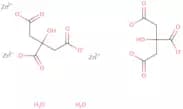
CAS:<p>Zinc citrate dihydrate is a photocatalyst that can be used to clean contaminated materials. It has been shown to have strong disinfectant properties, especially in the presence of sodium carbonate or citric acid. This substance is also used as a structural analysis agent for fabricating cavities and for gravimetric analysis of carbon sources. Zinc citrate dihydrate has also been found to have phototoxic effects, which are due to its ability to generate reactive oxygen species such as singlet oxygen and superoxide anion radicals. The active substances in zinc citrate dihydrate may cause genetic damage, as well as changes in the NMR spectra of rat primary hepatocytes.</p>Fórmula:(C6H8O7)2•Zn3•(H2O)2Pureza:Min. 95%Forma y color:PowderPeso molecular:616.46 g/molCopper (II) phosphate
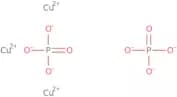
CAS:<p>Copper (II) phosphate is a chemical compound consisting of copper and phosphate ions. It has been used for wastewater treatment, as an analytical chemistry reagent, and as an oxidation catalyst. Copper (II) phosphate is also used in the synthesis of pharmaceuticals, such as alkylating agents and antibiotics. Copper (II) phosphate is stable in the presence of acids, alkalis, and organic solvents. It can be synthesized by reacting copper chloride with sodium carbonate in water at a temperature between 40-50 degrees Celsius. This reaction produces hydrogen bonds between the hydroxyl groups on the surface of the copper ion with those on the phosphorus atom. Thermal expansion measurements have shown that copper (II) phosphate expands at a rate that is dependent on temperature. The addition of nitrogen atoms to this compound increases its thermal expansion rate.</p>Fórmula:Cu3O8P2Pureza:Min. 95%Peso molecular:380.58 g/molCopper(II) nitrate hydrate
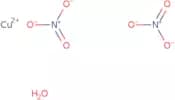
CAS:<p>Copper nitrate hydrate is an isomeric mixture of copper(II) nitrate and copper(I) nitrate. It is a diazonium salt that contains two aminoterephthalate ligands. The reaction mechanism of this compound involves the formation of a copper complex with sodium hydroxide. The product is an insoluble hydrated copper oxide, which can be precipitated from the solution by adding an acid or base. Copper nitrate hydrate can also be obtained by reacting copper(II) chloride with sodium hydroxide in water. This compound has been shown to have antimicrobial properties against Escherichia coli and Staphylococcus aureus, although it does not show any significant activity against Bacillus subtilis or Pseudomonas aeruginosa. Copper nitrate hydrate has been used as a precursor for the synthesis of nanotubes and polycarboxylic acids with molecular weights up to 6 kDa.</p>Fórmula:Cu•(HNO3)2•(H2O)xPureza:Min. 95%Forma y color:PowderCopper turnings
CAS:<p>Copper turnings are used in analytical chemistry as a chemical biology reagent. They can be used to measure enzyme activities and thermodynamic data of water vapor and copper chloride. Copper turnings have been shown to inhibit the growth of Hl-60 cells, which is a type of human leukemia. Copper turnings also have an electrochemical impedance spectroscopy (EIS) response that can be used for the determination of phase transition temperature.</p>Fórmula:CuPureza:Min. 95%Peso molecular:63.55 g/molZinc (II) Protoporphyrin IX
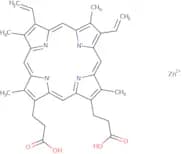
CAS:<p>Zinc protoporphyrin is a heme-based biochemical compound that is used as a calibration standard for spectrophotometric analysis. It has been shown to have an adverse effect on the cardiovascular system, such as atherosclerotic lesion formation in response to oxidative injury. Zinc protoporphyrin also has an effect on brain functions and bowel disease, which may be due to its ability to inhibit iron absorption and promote iron homeostasis.</p>Fórmula:C34H32N4O4ZnPureza:Min. 95%Peso molecular:626.03 g/mol
![Dichloro[rel-[N(S)]-N-[2-[(R)-phenylthio-κS]ethyl]-[1-pyrrolidineethanamine-κNN1,κN1](triphenylpho…](/_next/image/?url=https%3A%2Fstatic.cymitquimica.com%2Fproducts%2F08%2Fthumb-webp%2F44-0570.webp&w=3840&q=75)


![Tris(2,2,6,6-tetramethyl-3,5-heptanedionato)aluminum, 99% (99.9%-Al) [Al(TMHD)₃]](/_next/image/?url=https%3A%2Fstatic.cymitquimica.com%2Fproducts%2F08%2Fthumb-webp%2F13-5000.webp&w=3840&q=75)
![Diacetato{(S)-(-)-5,5'-bis[di(3,5-xylyl)phosphino]-4,4'-bi-1,3-benzodioxole}ruthenium(II) Ru(OAc)₂…](/_next/image/?url=https%3A%2Fstatic.cymitquimica.com%2Fproducts%2F08%2Fthumb-webp%2F44-0176.webp&w=3840&q=75)





![Bis(2,2,6,6-tetramethyl-3,5-heptanedionato)magnesium, anhydrous, min. 98% [Mg(TMHD)2] , 12-0900, c…](/_next/image/?url=https%3A%2Fstatic.cymitquimica.com%2Fproducts%2F08%2Fthumb-webp%2F98-4069.webp&w=3840&q=75)