Péptidos
Subcategorías de "Péptidos"
Se han encontrado 29635 productos de "Péptidos"
CRAMP (6-39)
Amino acids 6-39 of the cathelicidin-related anti-microbial peptide (CRAMP), the mouse homologue of the human LL-37 anti-microbial peptide.CRAMP possesses potent anti-bacterial activity against Gram-positive and Gram-negative bacterial strains with no haemolytic activity. As well as displaying direct anti-microbial activity, CRAMP also binds to lipopolysaccharide (LPS) to neutralise its activity.CRAMP is a cationic peptide, encoded for by the Camp gene and is highly expressed in bone marrow. Its expression is up-regulated by infectious and inflammatory signals and it is secreted by cells such as neutrophils-epithelial cells-and macrophages.Peso molecular:3,878.61 g/molMPZL1 Blocking Peptide
A synthetic peptide for use as a blocking control in assays to test for specificity of MPZL1 antibody, catalog no. 70R-6628
Pureza:Min. 95%[Cys(AF647)]-Jak2/3 substrate
This peptide is phosphorylated by Janus kinase 2 and 3 (JAK2 and JAK3) and is an ideal substrate for use in kinase assays. The JAK family of kinases is essential for the signalling of a host of immune modulators in tumour, stromal, and immune cells where they are highly expressed. JAK family proteins mediate the signalling of the interferon (IFN), IL-6, and IL-2 families of cytokines.JAK kinases are associated with cytokine receptors. Cytokine binding to these receptors results in activation of JAK kinases and receptor phosphorylation. Phosphorylated cytokine receptors recruit STAT proteins, which are then phosphorylated by the activated JAK kinases. Phosphorylated STAT proteins form homo- and hetero-dimers that translocate into the nucleus and function as transcription factors.This peptide contains an N-terminal Alexa Fluor 647 florescent dye. A cysteine residue has been added to the N-terminus for conjugation of the dye via the cysteine thiol moiety. AF647 is a bright, far-red-fluorescent dye with excitation between 594 nm and 633 nm, and is pH-insensitive over a wide molar range.ELAVL2 Blocking Peptide
A synthetic peptide for use as a blocking control in assays to test for specificity of ELAVL2 antibody, catalog no. 70R-4835Pureza:Min. 95%MiniAp-4 peptide
MiniAP-4 peptide is a short nontoxic derivative of apamin (a neurotoxin from bee venom) used as a blood-brain barrier (BBB) shuttle peptide.
KLPGF
KLPGF peptide is a sequence from egg white albumen. This peptide have recently shown interest for Alzheimer’s disease.
Biotin-SARS-CoV-2 Spike RBM 450-473 peptide
Biotin-SARS-CoV-2 Spike RBM 450-473 peptide is the biotinylated version of SARS-CoV-2 Spike RBM 450-473 peptide. SARS-CoV-2 Spike RBM 450-473 peptide is an epitope of interest of the SARS-CoV-2 Spike S glycoprotein Receptor-Binding Motif (RBM). Biotin-SARS-CoV-2 Spike RBM 450-473 peptide is useful for vaccine development and for structure-activity relationship studies
SARS-CoV-2 Spike (S) glycoprotein
Spike (S) glycoprotein corresponds to one of the leading targets for COVID-19 disease. Present on the surface of Sars-CoV-2 virus, Spike S protein is a class I fusion protein that allows the virus to enter host cells.
With a 1 273 aa length, Spike protein has 2 subunits : S1 contains the receptor-binding domain RBD and S2 induces the fusion of the viral envelop with the cellular membrane.
SARS-CoV-2 Spike RBM:
The receptor-binding domain in SARS-CoV-2 Spike protein contains a receptor-binding motif RBM. SARS-CoV-2 Spike RBM is the main functional motif in RBD and allows contacts between the S protein and the Angiotensin-Converting Enzyme receptor 2 (ACE2 receptor) which mediates the viral entry.NUDT16L1 Blocking Peptide
A synthetic peptide for use as a blocking control in assays to test for specificity of NUDT16L1 antibody, catalog no. 70R-8788Pureza:Min. 95%STX11 Blocking Peptide
A synthetic peptide for use as a blocking control in assays to test for specificity of STX11 antibody, catalog no. 70R-10383Pureza:Min. 95%Osteocalcin (Human, 38-49) Antiserum (Rabbit)
Osteocalcin (OC) is a bone-specific protein that plays important roles in bone metabolism. It is involved in the regulation of bone mineralization and turnover, as well as the formation of new bone matrix. The OC protein is a member of the family of bone regulatory proteins, which includes osteopontin and sclerostin. It interacts with many other proteins such as ion channels, receptors, and ligands. This antibody has been used to identify OC protein interactions with these proteins. It can be used for research purposes in pharmacology or cell biology applications.
Pureza:Min. 95%SLC5A4 Blocking Peptide
A synthetic peptide for use as a blocking control in assays to test for specificity of SLC5A4 antibody, catalog no. 70R-1794
Pureza:Min. 95%ZFYVE19 Blocking Peptide
A synthetic peptide for use as a blocking control in assays to test for specificity of ZFYVE19 antibody, catalog no. 70R-8903
COVID-19 variant pack
SARS-CoV-2 Spike (S) glycoprotein: Spike (S) glycoprotein corresponds to one of the leading targets for COVID-19 disease. Present on the surface of Sars-CoV-2 virus, Spike S protein in a class I fusion protein that allows the virus to enter host cells. Variants package available: Some proteins of Sars-CoV-2 are identified as leading targets for COVID-19 therapies. SB-PEPTIDE offers a special pack pre-made peptide libraries of Spike protein including peptides from COVID-19 variants: UK COVID-19 variant B.1.1.7, South Africa COVID-19 variant B.1.351, Brazil COVID-19 variant B.1.1.248. SB-PEPTIDE offers additional plate containing only peptides with Spike S protein mutation of COVID-19 B.1.1.7, B.1.3.5.1 and B.1.1.248 (cited below). Variants package and Spike (S) glycoprotein peptide library can be used for T-cell assays, immune monitoring, antigen specific T-cell stimulation, T-cell expansion and cellular immune response.SARS-CoV-2 Spike RBD 352-365 peptide
SARS-CoV-2 Spike RBD 352-365 peptide is an epitope of interest of the SARS-CoV-2 Spike S glycoprotein Receptor-Binding Domain (RBD). SARS-CoV-2 Spike RBD 352-365 peptide is useful for vaccine development and for structure-activity relationship studies SARS-CoV-2 Spike (S) glycoprotein Spike (S) glycoprotein corresponds to one of the leading targets for COVID-19 disease. Present on the surface of Sars-CoV-2 virus, Spike S protein is a class I fusion protein that allows the virus to enter host cells. With a 1 273 aa length, Spike protein has 2 subunits : S1 contains the receptor-binding domain RBD and S2 induces the fusion of the viral envelop with the cellular membrane. SARS-CoV-2 Spike RBD: The receptor-binding domain in SARS-CoV-2 Spike protein allows binding to the Angiotensin-Converting Enzyme receptor 2 (ACE2 receptor) which mediates the viral entry. SB-PEPTIDE also offers SARS-CoV-2 Spike RBD 352-365 (Biotin-LC) peptideKLHL7 Blocking Peptide
A synthetic peptide for use as a blocking control in assays to test for specificity of KLHL7 antibody, catalog no. 70R-3853Pureza:Min. 95%ZNF491 Blocking Peptide
A synthetic peptide for use as a blocking control in assays to test for specificity of ZNF491 antibody, catalog no. 70R-8423Pureza:Min. 95%L17E Cytosolic Delivery Peptide
CAS:Synthetic peptide toxin derivative of; M-lycotoxin from the Carolina wolf spider, Hogna carolinensis. This peptide can be used for transport into the cytoplasma and is available as a 0.5mg vial.
Fórmula:C134H220N38O31Pureza:Min. 95%Peso molecular:2,859.4 g/molm-dPEG®48-NH-CO(CH2)3CO-TFP Ester
m-dPEG®48-NH-CO(CH2)3CO-TFP Ester is a PEG compound with two different functional groups (also known as heterobifunctional). Unlike homobifunctional PEG compounds (same functional group on both ends), this type of compounds are more versatile as have two different anchor points. m-dPEG®48-NH-CO(CH2)3CO-TFP Ester is used as a linker and spacer to add a PEG moiety, via pegylation (a bioconjugation technique) to proteins, peptides, oligonucleotides, small molecules and nanoparticles.
Fórmula:C108H203F4NO51Pureza:Min. 95%Peso molecular:2,407.76 g/molAc-Ile-Glu-Thr-Asp-AMC
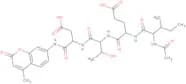
CAS:Ac-Ile-Glu-Thr-Asp-AMC is a high purity, water soluble peptide consisting of the amino acid sequence Ile-Glu-Thr-Asp. Ac-Ile-Glu-Thr-Asp-AMC has been shown to activate the nicotinic acetylcholine receptor and inhibit ligand binding to the NMDA glutamate receptor in rat cortical neurons. Ac-Ile-Glu-Thr-Asp AMC is also an inhibitor of voltage gated potassium channels and has been used as a research tool for studying ion channel function.Fórmula:C31H41N5O12Pureza:Min. 95%Peso molecular:675.68 g/molBz-DL-Arg-pNA • HCl [DL-BAPA]
CAS:Bz-DL-Arg-pNA • HCl [DL-BAPA] is a trypsin and trypsin-like protease substrate. It is used as a tool in biochemical studies to investigate the degradation of proteins by these enzymes. Bz-DL-Arg-pNA • HCl [DL-BAPA] is also used as an experimental model for diseases that affect enzyme activity, such as rheumatoid arthritis and multiple sclerosis.
Fórmula:C19H22N6O4•HClPureza:Min. 95%Peso molecular:434.88 g/molBiotin-SARS-CoV-2 Spike RBD 348-357 peptide
Biotin-SARS-CoV-2 Spike RBD 348-357 peptide is the biotinylated version of SARS-CoV-2 Spike RBD 348-357 peptide. SARS-CoV-2 Spike RBD 348-357 peptide is an epitope of interest of the SARS-CoV-2 Spike S glycoprotein Receptor-Binding Domain (RBD). Biotin-SARS-CoV-2 Spike RBD 348-357 peptide is useful for vaccine development and for structure-activity relationship studies
SARS-CoV-2 Spike (S) glycoprotein
Spike (S) glycoprotein corresponds to one of the leading targets for COVID-19 disease. Present on the surface of Sars-CoV-2 virus, Spike S protein is a class I fusion protein that allows the virus to enter host cells.
With a 1 273 aa length, Spike protein has 2 subunits : S1 contains the receptor-binding domain RBD and S2 induces the fusion of the viral envelop with the cellular membrane.
SARS-CoV-2 Spike RBD:
The receptor-binding domain in SARS-CoV-2 Spike protein allows binding to the Angiotensin-Converting Enzyme receptor 2 (ACE2 receptor) which mediates the viral entry.Amino-dPEG®4-t-boc-hydrazide
CAS:Amino-dPEG®4-t-boc-hydrazide is a PEG compound with two different functional groups (also known as heterobifunctional). Unlike homobifunctional PEG compounds (same functional group on both ends), this type of compounds are more versatile as have two different anchor points. Amino-dPEG®4-t-boc-hydrazide is used as a linker and spacer to add a PEG moiety, via pegylation (a bioconjugation technique) to proteins, peptides, oligonucleotides, small molecules and nanoparticles.Fórmula:C16H33N3O7Pureza:Min. 95%Peso molecular:379.45 g/molPPP2R3B Blocking Peptide
A synthetic peptide for use as a blocking control in assays to test for specificity of PPP2R3B antibody, catalog no. 70R-5596Pureza:Min. 95%SARS-CoV-2 Spike RBM 438-458 peptide
SARS-CoV-2 Spike RBM 438-458 peptide is an epitope of interest of the SARS-CoV-2 Spike S glycoprotein Receptor-Binding Motif (RBM). SARS-CoV-2 Spike RBM 438-458 peptide is useful for vaccine development and for structure-activity relationship studies SARS-CoV-2 Spike (S) glycoprotein Spike (S) glycoprotein corresponds to one of the leading targets for COVID-19 disease. Present on the surface of Sars-CoV-2 virus, Spike S protein is a class I fusion protein that allows the virus to enter host cells. With a 1 273 aa length, Spike protein has 2 subunits : S1 contains the receptor-binding domain RBD and S2 induces the fusion of the viral envelop with the cellular membrane. SARS-CoV-2 Spike RBM: The receptor-binding domain in SARS-CoV-2 Spike protein contains a receptor-binding motif RBM. SARS-CoV-2 Spike RBM is the main functional motif in RBD and allows contacts between the S protein and the Angiotensin-Converting Enzyme receptor 2 (ACE2 receptor) which mediates the viral entry. SB-PEPTIDE also offers SARS-CoV-2 Spike RBM 438-458 (Biotin-LC) peptideC19ORF47 Blocking Peptide
A synthetic peptide for use as a blocking control in assays to test for specificity of C19orf47 antibody, catalog no. 70R-3316Pureza:Min. 95%PKM2 Blocking Peptide
A synthetic peptide for use as a blocking control in assays to test for specificity of PKM2 antibody, catalog no. 70R-9543Pureza:Min. 95%Biotin-SARS-CoV-2 Spike RBD 336-347 peptide
Biotin-SARS-CoV-2 Spike RBD 336-347 peptide is the biotinylated version of SARS-CoV-2 Spike RBD 336-347 peptide. SARS-CoV-2 Spike RBD 336-347 peptide is an epitope of interest of the SARS-CoV-2 Spike S glycoprotein Receptor-Binding Domain (RBD). Biotin-SARS-CoV-2 Spike RBD 336-347 peptide is useful for vaccine development and for structure-activity relationship studies SARS-CoV-2 Spike (S) glycoprotein Spike (S) glycoprotein corresponds to one of the leading targets for COVID-19 disease. Present on the surface of Sars-CoV-2 virus, Spike S protein is a class I fusion protein that allows the virus to enter host cells. With a 1 273 aa length, Spike protein has 2 subunits : S1 contains the receptor-binding domain RBD and S2 induces the fusion of the viral envelop with the cellular membrane. SARS-CoV-2 Spike RBD: The receptor-binding domain in SARS-CoV-2 Spike protein allows binding to the Angiotensin-Converting Enzyme receptor 2 (ACE2 receptor) which mediates the viral entry.CKMM Blocking Peptide
A synthetic peptide for use as a blocking control in assays to test for specificity of CKM antibody, catalog no. 70R-1984Pureza:Min. 95%CEACAM4 Blocking Peptide
A synthetic peptide for use as a blocking control in assays to test for specificity of CEACAM4 antibody, catalog no. 70R-7236Pureza:Min. 95%Spike Omicron library
Overlaping peptide library of Spike Omicron mutant. 15 amino acids per peptide with offset 11. Purity crude. 1 peptide per well.APIP Blocking Peptide
A synthetic peptide for use as a blocking control in assays to test for specificity of APIP antibody, catalog no. 70R-4451Pureza:Min. 95%DYAMTWVR* - SIL Dupilimab signature peptide qualifier
Secondary SIL peptide for Dupilimab detection and quantification
Atg12 Blocking Peptide
A synthetic peptide for use as a blocking control in assays to test for specificity of Atg12 antibody, catalog no. 70R-9658Pureza:Min. 95%IFI44 Blocking Peptide
A synthetic peptide for use as a blocking control in assays to test for specificity of IFI44 antibody, catalog no. 70R-3661Pureza:Min. 95%IL1RL2 Blocking Peptide
A synthetic peptide for use as a blocking control in assays to test for specificity of IL1RL2 antibody, catalog no. 70R-8648Pureza:Min. 95%FADS1 Blocking Peptide
A synthetic peptide for use as a blocking control in assays to test for specificity of FADS1 antibody, catalog no. 70R-1837Pureza:Min. 95%Follicle Stimulating Hormone, human, recombinant
Follicle stimulating hormone (FSH) is a glycoprotein that is secreted by the anterior pituitary gland. FSH stimulates follicular growth in the ovary and regulates the production of estrogen and progesterone. FSH can be used to treat infertility in women, as well as male hypogonadism. It can also be used for assisted reproduction techniques such as in vitro fertilization, gamete intrafallopian transfer, testicular sperm extraction, and ovarian hyperstimulation. FSH is synthesized from human recombinant DNA and is chromatographically purified with a freeze-dried process. Additives may include antibiotics to prevent bacterial contamination during production or storage. FSH has been shown to act synergistically with estradiol to promote follicular growth in ovaries of immature rats.Pureza:Min. 95%Bombesin
Bombesin (BBN) is a 14-amino acid neuropeptide originally isolated from the skin of Bombina bombina. The bombesin-related family comprises three other peptides, the amphibian homologs alytesin and Neuromedin C (NMC), and the mammalian peptide named Gastrin-Releasing Peptide (GRP). Bombesin and bombesin-related peptides are characterized by a region of homology at the carboxy-terminus ending with Gly-His-Leu-Met-NH2, in which resides their biological activity.
Bombesin is active in mammals and affects a broad range of biological functions including smooth muscle contraction, cell growth, blood pressure, plasma glucose, as well as gastric secretions2. These effects are mediated by the interaction of Bombesin peptide with G protein-coupled receptors (GPCRs) called bombesin receptors that are well represented in the gastrointestinal tract and in the central nervous system (CNS).
Bombesin peptide is a potent natural agonist of the mammalian Gastrin Releasing Peptide Receptor (GRPR) also know as bombesin receptor 2 (BB2), whose endogenous ligand is the Gastrin Releasing Peptide (GRP). Bombesin has demonstrated a high affinity for human Gastrin-Releasing Peptide Receptors (hGRPR) in both human cells containing native GRP receptors and murine cells stably expressing human GRP receptors (IC50 = 0.17±0.01 nM and 0.07 ± 0.01 nM, respectively).There is increased interest in targeting the bombesin receptors to explore their roles in pathophysiological processes, and for diagnostic imaging of human cancers over-expressing Gastrin-Releasing Peptide Receptors (GRPR), such as prostate, breast, and small-cell lung carcinoma. Bombesin peptide is investigated as targeting peptide to deliver radiotracers and therapeutic agents into tumors. Moreover, many synthetic agonist analogs of the biologically active COOH terminus of bombesin-related peptides have been synthesized to develop more metabolically stable and selective ligands for Bombesin receptors.BNP-32 (Rat)
CAS:BNP-32 is a peptide that is an activator of the B2 receptor. It has been shown to inhibit the ion channels in cells, which may be due to its binding to the ligand-binding site on the receptor. BNP-32 has also been shown to bind to antibodies and can be used as a research tool for cell biology or other areas of life science. BNP-32 is a high purity product with CAS No. 123337-89-3.
Fórmula:C146H239N47O44S3Pureza:Min. 95%Peso molecular:3,452.9 g/molH-MDYKDHDGDYKDHDIDYKDDDDK-OH
3x DYKDDDDK peptide, also called 3x FLAG peptide, is a 23 aa length peptide used for the competitive elution of DYKDDDDK-tag fusion proteins (with excess of free 3x DYKDDDDK peptide) under non-denaturing conditions, especially when a DYKDDDDK-tagged protein is sensitive to low pH.
SLC5A9 Blocking Peptide
A synthetic peptide for use as a blocking control in assays to test for specificity of SLC5A9 antibody, catalog no. 70R-6790Pureza:Min. 95%SYVN1 Blocking Peptide
A synthetic peptide for use as a blocking control in assays to test for specificity of SYVN1 antibody, catalog no. 70R-7259Pureza:Min. 95%APYTFGQGTK - SIL Adalimumab signature peptide
APYTFGQGTK peptide is a sequence from light chain of Adalimumab monoclonal antibody. Due to its universal location in Adalimumab antibody, Stable Isotope Labeled (SIL) APYTFGQGTK is used as a specific signature peptide for the quantitation of Adalimumab.


![[Cys(AF647)]-Jak2/3 substrate](/_next/image/?url=https%3A%2Fstatic.cymitquimica.com%2Fproducts%2F3D%2Fthumb-webp%2FCRB1110313.webp&w=3840&q=75)





![Bz-DL-Arg-pNA • HCl [DL-BAPA]](/_next/image/?url=https%3A%2Fstatic.cymitquimica.com%2Fproducts%2F3D%2Fthumb-webp%2FSRN-3013.webp&w=3840&q=75)