Péptidos
Subcategorías de "Péptidos"
Se han encontrado 29706 productos de "Péptidos"
beta-Amyloid (1-34)
Catalogue peptide; min. 95% purity
Fórmula:C170H253N47O52Peso molecular:3,787.20 g/molRef: 3D-VAC-00310
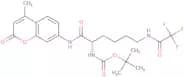
Producto descatalogadoBoc-Lys(Tfa)-AMC
CAS:Boc-Lys(Tfa)-AMC is a small molecule that inhibits the acetylation of histone H3 and has anticancer activity. Acetylation increases the rate of transcription and replication, whereas Boc-Lys(Tfa)-AMC inhibits this process by preventing acetylation. This drug also binds to δ-opioid receptors in cancer cells, triggering a redox signal that leads to inhibition of cancer cell proliferation. The mechanism of this drug's anticancer activity is unknown, but it may be due to its ability to inhibit enzyme activities or disulfide bond formation in vivo.
Fórmula:C23H28F3N3O6Pureza:Min. 95%Peso molecular:499.48 g/molRef: 3D-FB110609
Producto descatalogado[Tyr8,Nle11] Substance P
Catalogue peptide; min. 95% purity
Fórmula:C64H100N18O14Peso molecular:1,345.62 g/mol[Gln11]-beta-Amyloid (1-28)
Catalogue peptide; min. 95% purity
Fórmula:C145H210N42O45Peso molecular:3,261.54 g/molDisulfide biotin azide
CAS:Extraordinary strength of the streptavidin-biotin interaction allows for efficient capturing of even highly dilute targets; however, it makes recovery of proteins from affinity resins challenging. Conventional methods to elute biotinylated proteins from immobilized avidin include the following: (i) denaturation of streptavidin by boiling the resin in a denaturing buffer that may include high concentrations of chaotropic salts, (ii) trypsin digestion of proteins while they are bound to the resin, or (iii) elution of proteins with excess free biotin. These protocols can co-elute contaminant proteins by releasing nonspecifically bound proteins and/or naturally biotinylated proteins concurrently with labeled proteins. In addition, some of these methods can cause elution of high levels of resin-based peptides along with the proteins of interest, resulting in further sample contamination.
Disulfide Biotin Azide probe eliminates a major limitation of the streptavidin-biotin affinity purification. This reagent contains a biotin moiety linked to an azide moiety through a spacer arm containing a cleavable disulfide linker. Captured biomolecules can be efficiently released under mild conditions (50 mM dithiothreitol, 10 mM 2-mercaptoethanol or 1% sodium borohydride) and the small molecular fragment (188.25 Da) left on the labeled protein following cleavage. These features make the cleavable probe especially attractive for use in biomolecular labeling and proteomic studies.Fórmula:C27H48N8O7S3Pureza:Min 95%Peso molecular:692.92 g/molKinase Domain of Insulin Receptor (5)
Catalogue peptide; min. 95% purity
Fórmula:C72H110N19O33Peso molecular:1,862.77 g/molAdrenomedullin (1-52), human
Catalogue peptide; min. 95% purity
Fórmula:C264H406N80O77S3Peso molecular:6,028.72 g/molC-terminal Proghrelin Isoform Peptide, mouse
Catalogue peptide; min. 95% purity
Fórmula:C50H86N22O17Peso molecular:1,267.38 g/molBoc-D-Glu-OEt·DCHA
CAS:Producto controladoPlease enquire for more information about Boc-D-Glu-OEt·DCHA including the price, delivery time and more detailed product information at the technical inquiry form on this page
Fórmula:C12H21NO6·C12H23NPureza:Min. 95%Peso molecular:456.62 g/molRef: 3D-FB111281
Producto descatalogadoBiotin-Kinase Domain of Insulin Receptor (2)
Catalogue peptide; min. 95% purity
Fórmula:C72H122N21O29SPeso molecular:1,777.92 g/mol[Arg14,20,21, Leu16]-PACAP (1-27)-Gly-Lys-Arg, amide, human, ovine, rat
Catalogue peptide; min. 95% purity
Fórmula:C157H253N53O42Peso molecular:3,555.01 g/molRef: 3D-VAC-00488
Producto descatalogadoDynorphin A (3-13), porcine
Catalogue peptide; min. 95% purity
Fórmula:C64H114N22O12Peso molecular:1,383.76 g/molAllatostatin I (free acid)
Catalogue peptide; min. 95% purity
Fórmula:C61H94N18O16Peso molecular:1,335.5 g/molMSP-1 P2, Malaria Merozoite Surface Peptide-1
Catalogue peptide; min. 95% purity
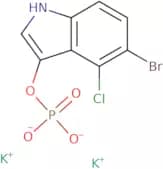
Fórmula:C116H190N32O35SPeso molecular:2,625 g/molBCIP dipotassium
CAS:BCIP (5-bromo-4-chloro-3-indolyl phosphate) dipotassium is a chromogenic substrate commonly used for the detection of the enzymatic activity of alkaline phosphatase. Upon dephosphorylation by alkaline phosphatase, BCIP produces a blue precipitate, which can be easily visualized. This substrate has various uses, including the detection of gene expression in molecular biology, the identification of alkaline phosphatase activity in clinical pathology, and the detection of protein-protein interactions in biochemistry. Its long-term stability in solution makes it a common choice for many applications.
Fórmula:C8H4BrClK2NO4PPureza:Min. 98 Area-%Forma y color:PowderPeso molecular:402.65 g/molRef: 3D-EB110885
Producto descatalogadoPeptide YY (3-36) (canine, mouse, porcine, rat)
Catalogue peptide; min. 95% purity
Fórmula:C190H288N54O57Peso molecular:4,240.64 g/molZ-Ala-Arg-Arg-AMC hydrochloride salt
CAS:Z-Ala-Arg-Arg-AMC hydrochloride salt is a synthetic amino acid that inhibits aminopeptidase activity. It is used to study the enzyme's role in the degradation of muscle proteins, and as a pharmaceutical drug for treating inflammatory bowel disease. The target enzyme is inhibited by binding to its active site, thereby preventing the breakdown of peptides. Z-Ala-Arg-Arg-AMC hydrochloride salt can be used as an inhibitor in the laboratory because it prevents denaturation of protein samples during analysis using electrophoresis or chromatography. This product also has been shown to have inhibitory effects on ileal aminopeptidases and prostate aminopeptidases, which may be due to its ability to bind to these enzymes and block their active sites.
Fórmula:C33H44N10O7•(HCl)xPureza:Min. 95%Peso molecular:692.77 g/mol



![[Tyr8,Nle11] Substance P](/_next/image/?url=https%3A%2Fstatic.cymitquimica.com%2Fproducts%2F3D%2Fthumb-webp%2FVAC-00677.webp&w=3840&q=75)

![[Gln11]-beta-Amyloid (1-28)](/_next/image/?url=https%3A%2Fstatic.cymitquimica.com%2Fproducts%2F3D%2Fthumb-webp%2FVAC-00315.webp&w=3840&q=75)


![[Arg14,20,21, Leu16]-PACAP (1-27)-Gly-Lys-Arg, amide, human, ovine, rat](/_next/image/?url=https%3A%2Fstatic.cymitquimica.com%2Fproducts%2F3D%2Fthumb-webp%2FVAC-00488.webp&w=3840&q=75)