Sustratos de enzimas
Los sustratos enzimáticos son moléculas sobre las cuales actúan las enzimas para catalizar reacciones químicas. El sustrato se une al sitio activo de la enzima, donde sufre una transformación específica para formar el producto de la reacción. Los sustratos enzimáticos son herramientas esenciales en la investigación para estudiar la cinética enzimática, la especificidad y el mecanismo de acción. También se utilizan en ensayos diagnósticos y estudios bioquímicos. En CymitQuimica, ofrecemos una selección diversa de sustratos enzimáticos de alta calidad para apoyar su investigación en enzimología y bioquímica.
Subcategorías de "Sustratos de enzimas"
Se han encontrado 1527 productos de "Sustratos de enzimas"
Ordenar por
Pureza (%)
0
100
|
0
|
50
|
90
|
95
|
100
Coelenterazine e
CAS:<p>Coelenterazine e is a synthetic, fluorescent amino acid that can be used to measure calcium ion concentration. It binds to calcium ions and emits light when excited with blue light. Coelenterazine e is an analog of coelenteramide, which is a luminescent protein found in jellyfish. Coelenterazine e has been shown to emit fluorescence when it interacts with calcium ions, while coelenteramide emits bioluminescence instead. The emission of light from coelenterazine e is due to the stabilization of the molecule by calcium ions.</p>Fórmula:C28H23N3O3Pureza:Min. 90.0 Area-%Peso molecular:449.51 g/molDehydroluciferin
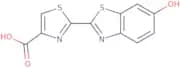
CAS:<p>Dehydroluciferin is a bioluminescence probe that is a potent inhibitor of the firefly luciferase reaction. It is a byproduct of the oxidation of luciferin, the substrate for firefly luciferase, which catalyzes the bioluminescence reaction. It can also form during the synthesis or storage of luciferin. Its presence can potentially lead to issues in bioluminescent assays.</p>Fórmula:C11H6N2O3S2Pureza:Min. 97 Area-%Forma y color:PowderPeso molecular:278.31 g/molN-Acetyl-3,7-dihydroxyphenoxazine
CAS:<p>N-Acetyl-3,7-dihydroxyphenoxazine is a fluorescent probe, which is synthesized from chemical precursors and used primarily in biochemical research. This compound acts by undergoing a chemical reaction with hydrogen peroxide, resulting in the formation of resorufin, a highly fluorescent compound. The distinctive property of this probe is its capacity to produce a measurable fluorescent signal upon interaction with hydrogen peroxide, making it an invaluable tool for detecting and quantifying this reactive oxygen species.</p>Fórmula:C14H11NO4Peso molecular:257.24 g/molRef: 3D-J-100008
1gA consultar5gA consultar250mgA consultar500mgA consultar2500mgA consultar-Unit-ggA consultar4-Nitrophenyl phosphate disodium hexahydrate
CAS:<p>4-Nitrophenyl phosphate disodium salt hexahydrate is a substrate of the hydrolase alkaline phosphatase. The products of the enzymatic reaction are 4-nitrophenol and phosphate.</p>Fórmula:C6H16NNa2O12PForma y color:PowderPeso molecular:371.15 g/mol4-Nitrophenyl a-L-arabinopyranoside
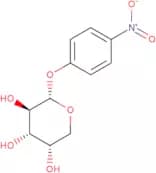
CAS:<p>Substrate for a-L-arabinopyranosidase</p>Fórmula:C11H13NO7Pureza:Min. 98 Area-%Forma y color:White PowderPeso molecular:271.22 g/mol3,4-Cyclohexenoesculetine β-D-glucopyranoside
CAS:<p>Chromogenic substrate for beta-glucosidase</p>Fórmula:C19H22O9Pureza:Min. 95%Forma y color:PowderPeso molecular:394.37 g/mol4-Trifluoromethylumbelliferyl b-D-glucopyranoside
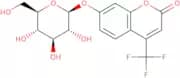
CAS:<p>4-Trifluoromethylumbelliferyl b-D-glucopyranoside is a fluorogenic substrate for beta-glucosidase. Upon hydrolysis, the fluorogenic moiety (blueish) 4-trifluoromethylumbelliferone (also known as TFMU) is released. 4-Trifluoromethylumbelliferyl b-D-glucopyranoside is commonly used in bacterial detection and in Gaucher disease diagnosis.</p>Pureza:Min. 95%Forma y color:White To Off-White SolidPeso molecular:392.28 g/mol6-(b-D-Galactopyranosyloxy)-9-(4-methoxy-2-methylphenyl)-3H-xanthen-3-one
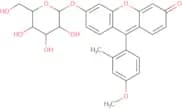
CAS:<p>6-(b-D-Galactopyranosyloxy)-9-(4-methoxy-2-methylphenyl)-3H-xanthen-3-one (MGBG) is a hydrophilic activatable fluorescence probe that has been shown to be effective in photodynamic therapy. MGBG is activated by light and has a high affinity for esterases, which are found in many tissues. The fluorescence of the MGBG is quenched by the esterase enzymes, but when it is exposed to light and oxygen, the probe becomes activated and its fluorescence increases. MGBG can be used as a fluorescent probe for intraperitoneal tumor resection or as a fluorescent imaging agent in optical microscopy.</p>Pureza:Min. 95%Peso molecular:494.49 g/molL-Luciferin, potassium salt
CAS:<p>L-Luciferin is an enzyme substrate that is used in the detection of bioluminescence. It is a fluorogenic substrate that can be used to detect the presence of glucose in urine. L-Luciferin is also a chemiluminescent substrate that can be used to detect ATP, which is required for cell metabolism. L-Luciferin has been shown to be stable at pH levels ranging from 2.5 to 9 and can be stored for up to 3 years when stored at 4°C with no light or oxygen exposure. This product has CAS No. 754978-59-1, indicating high purity and quality. L-Luciferin will not stain or react with other compounds, making it highly suitable for use as a conjugate in diagnostic tests or as a ligand in fluorescent staining reactions.</p>Fórmula:C11H7KN2O3S2Pureza:Min. 98.0 Area-%Peso molecular:318.42 g/molCoelenterazine - lyopholised
CAS:<p>Coelenterazine is a bio-luminescent substrate of luciferases such as Renilla luciferase (Rluc) and Gaussia luciferase (Gluc). The main applications of Coelenterazine are monitoring of reporter genes and chemiluminescence-based methods for Calcium detection. The substrate is also used in bioluminescence resonance energy transfer (BRET), ELISA, HTS and chemiluminescent detection of superoxide anion and peroxynitritein cells or tissues. About this grade Coelenterazine, native, dried (C-7002): in order to provide milligram and sub-milligram quantities of native Coelenterazine we pre-dissolve the substance; defined amounts of Coelenterazine are subsequently dried under nitrogen in individual vials. Coelenterazine, native, dried is identical in quality and chemistry to our product Coelenterazine, native which is provided as a powder.<br>Information to the user: since Coelenterazine is sensitive to oxygen, degas your solvents for stock solutions, if possible. To dissolve Coelenterazine, native, dried please proceed as follows. 1) Add the appropriate amount of solvent. If possible through the septum using a needle. Otherwise open the cap with pliers. 2) Vortex the closed vial briefly to completely dissolve the content of the vial. 3) Take out the solution, if possible with a needle through the septum.</p>Fórmula:C26H21N3O3Pureza:Min. 95 Area-%Peso molecular:423.48 g/mol4-Methylumbelliferyl-α-D-glucopyranoside
CAS:<p>Fluorogenic substrate for α-D-glucosidase. It has been used in studies of Pompe's disease (Glycogen Storage Disease). Used for differentiation and enumeration of Enterobactersakazakii based on α-glucosidase activity.</p>Fórmula:C16H18O8Pureza:Min. 99 Area-%Peso molecular:338.32 g/molLuciferin-α-D-galactoside, sodium salt
<p>Luciferin-alpha-D-galactoside, sodium salt (LDA) is a bioluminescence substrate. It is used in diagnostic tests for the detection of bacteria and fungi. LDA is also used to measure the effectiveness of biocides and disinfectants. This product has been shown to be a potent fluorogenic substrate in chemiluminescent assays that can be used effectively with firefly luciferase.</p>Fórmula:C17H17NaN2O8S2Pureza:Min. 94 Area-%Peso molecular:464.44 g/molRef: 3D-L-8126
5mgA consultar10mgA consultar25mgA consultar50mgA consultar100mgA consultar-Unit-mgmgA consultar2-Naphthyl-α-L-fucopyranoside
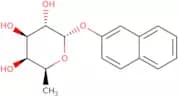
CAS:<p>Chromogenic substrate for α-L-Fucosidase. 2-naphthol is released upon hydrolyzation. By simultaneous coupling with a suitable staining reagent, such as hexazonium p-rosaniline, the corresponding azo-dye is formed. Naphthols can also be detected by fluorescence analysis.</p>Fórmula:C16H18O5Pureza:Min. 98 Area-%Peso molecular:290.32 g/mol2-Chloro-4-nitrophenyl a-D-maltotrioside
CAS:<p>2-Chloro-4-nitrophenyl a-D-maltotrioside (2CNP) is a potent hypoglycemic agent that has been shown to decrease postprandial blood glucose levels in humans. 2CNP is a white crystalline solid that is soluble in water and ethanol. The transfer reactions of 2CNP are enhanced by benzalkonium chloride, which forms an organic complex with the drug. The optimum concentration for the hypoglycemic effect of 2CNP is determined to be 10 μM, which can be detected using an optical sensor. This compound also inhibits α-amylase and other enzymes involved in carbohydrate metabolism, leading to the accumulation of glycogen and lowering the blood glucose level.</p>Fórmula:C24H34CiNO18Pureza:Min. 95%Forma y color:Off-White Yellow PowderPeso molecular:659.98 g/mol2'-(4-Methylumbelliferyl)-α-D-N-acetylneuraminic acid, sodium salt
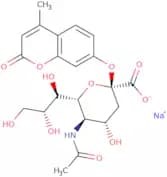
CAS:<p>4-Methylumbelliferyl N-acetyl-a-D-neuraminic acid sodium salt (4-MUNANA) is a fluorogenic substrate of neuraminidase. 4-Methylumbelliferone is released from 4-MUNANA by neuraminidase in the assay and can be detected fluorometrically with excitation at 365-380 nm and emission at 445-454 nm. It can also be used for fluorescent staining of sialidases in PAGE.</p>Fórmula:C21H24NNaO11Pureza:Min. 98 Area-%Peso molecular:489.42 g/mol5-Nitro-3-indolyl-b-D-galactopyranoside
<p>5-Nitro-3-indolyl-b-D-galactopyranoside is a substrate for a number of enzymes, including beta-galactosidase, beta-glucuronidase, and beta-mannosidase. It is used as an enzyme substrate in diagnostics to measure the activity of these enzymes. 5N3IG was also used to study the effects of conjugation on enzyme activity. 5N3IG is available in high purity and high quality at CAS No.</p>Pureza:Min. 95%Luc-Enterococcus K
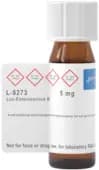
<p>Luc-Enterococcus K (LK) is a Chromogenic substrate that can be used for the detection of Enterococcus. LK is a conjugate of beta-lactamase and luciferase, which are both enzymes. LK is used in diagnostics to detect the presence of Enterococcus in food and environmental samples. LK can also be used as a chemiluminescent substrate for the detection of Enterococcus in clinical specimens or as an enzyme substrate for the detection of Enterococcus in clinical specimens. CAS No.: 64739-74-8</p>Fórmula:C17H17KN2O8S2Pureza:Min. 94 Area-%Peso molecular:480.55 g/mol2-Nitrophenyl-β-D-thiogalactopyranoside
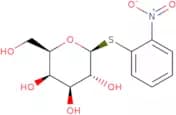
CAS:<p>2-Nitrophenyl-beta-D-thiogalactopyranoside is a chromogenic substrate used to detect the presence of galactosidase enzymes in various biological and biochemical assays. It consists of a nitrophenyl group attached to a galactose sugar molecule through a thioglycosidic bond. When acted upon by enzymes such as galactosidases, it releases the colored nitrophenyl group, which can be detected using spectrophotometry. This substrate is commonly used in assays for the detection of LacZ activity in bacterial cultures, as lacZ encodes for β-galactosidase.</p>Fórmula:C12H15NO7SPureza:Min. 98 Area-%Forma y color:Yellow PowderPeso molecular:317.32 g/molL-Leucine 7-amido-4-methylcoumarin hydrochloride
CAS:<p>Sensitive fluorogenic substrate for leucine aminopeptidase or a broad specificity aminopeptidase like aminopeptidase M that releases a bright blue fluorescent dye, 7-amino-4-methylcoumarin upon enzyme activity (excitation 380nm emission 440nm).</p>Fórmula:C16H21ClN2O3Pureza:Min. 97.5 Area-%Peso molecular:324.81 g/molRef: 3D-L-2800
1gA consultar100mgA consultar250mgA consultar500mgA consultar2500mgA consultar-Unit-ggA consultarD-Luciferin Firefly, sodium salt monohydrate
CAS:<p>Water soluble substrate for firefly luciferase.</p>Fórmula:C11H9N2NaO4S2Pureza:Min. 99.0 Area-%Peso molecular:320.32 g/mol