Sustratos de enzimas
Los sustratos enzimáticos son moléculas sobre las cuales actúan las enzimas para catalizar reacciones químicas. El sustrato se une al sitio activo de la enzima, donde sufre una transformación específica para formar el producto de la reacción. Los sustratos enzimáticos son herramientas esenciales en la investigación para estudiar la cinética enzimática, la especificidad y el mecanismo de acción. También se utilizan en ensayos diagnósticos y estudios bioquímicos. En CymitQuimica, ofrecemos una selección diversa de sustratos enzimáticos de alta calidad para apoyar su investigación en enzimología y bioquímica.
Subcategorías de "Sustratos de enzimas"
Se han encontrado 1527 productos de "Sustratos de enzimas"
Ordenar por
Pureza (%)
0
100
|
0
|
50
|
90
|
95
|
100
1-Naphthyl β-D-glucuronide
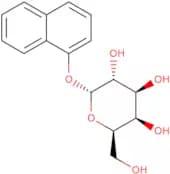
CAS:<p>1-Naphthyl beta-D-glucuronide (NPG) is a chromogenic enzyme substrate used to detect the presence of β-glucuronidase activity. Upon hydrolysis by the enzyme, it produces a yellow product that can be detected by spectrophotometry or visually. It is commonly used in clinical assays to detect the presence of the enzyme in urine samples, as elevated levels can indicate liver or urinary tract diseases. It is also utilized in environmental testing, as some bacteria strains can produce the enzyme as a by-product, making NPG a useful tool for detecting these strains in contaminated water or food sources.</p>Fórmula:C16H16O7Pureza:Min. 95%Forma y color:White PowderPeso molecular:320.29 g/mol1-Naphthyl a-D-galactopyranoside
CAS:<p>1-Naphthyl a-D-galactopyranoside is a chromogenic substrate use to detect alpha-galactosidase activity.</p>Fórmula:C16H18O6Pureza:Min. 95%Forma y color:PowderPeso molecular:306.31 g/molAldol® 518 myo-inositol-1-phosphate - Biosynth Patent: EP 2427431 and US 8940909
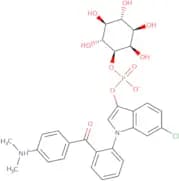
CAS:<p>Aldol® 518 myo-inositol-1-phosphate is a chromogenic and fluorogenic enzyme substrate used for detection of phosphatidyl-inositol specific phospholipase C activity (PI-PLC, EC 4.6.1.13). The colorless enzyme substrate is cleaved by PI-PLC or PI-PLC-positive microorganisms grown in liquid or solid media, yielding an intense red coloration. In combination with Aldol® 355 fluorescence enhancer, red fluorescence can also obtained. Aldol® 518 myo-inositol-1-phosphate is suitable for use in liquid and solid media, under aerobic as well as anaerobic conditions.</p>Fórmula:C29H33ClN3O10PPureza:Min. 95 Area-%Forma y color:PowderPeso molecular:650.02 g/molFluorescein-dipalmitoylphosphatidylethanolamine triethylammonium salt
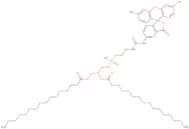
CAS:<p>Fluorescein-dipalmitoylphosphatidylethanolamine triethylammonium salt is a fluorescent phospholipid derivative for phospholipase. This substrate consists of a fluorescein conjugated to DPPE (dipalmitoylphosphatidylethanolamine), a key component of biological membranes. This compound is frequently used in membrane dynamics studies and lipid metabolism research. The fluorescein moiety allows visualization of lipid interactions in model membranes, liposomes, or live-cell imaging applications. The triethylammonium salt form enhances solubility and stability, property that facilitates its use in aqueous and lipid-based environments.</p>Pureza:Min. 95%Forma y color:PowderPeso molecular:1,182.53 g/molN-α-CBZ-L-citrulline-p-nitroanilide
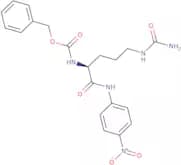
CAS:<p>Nalpha-CBZ-L-Citrulline-p-nitroanilide is a synthetic chromogenic enzyme substrate used in protease enzymatic stutides. After hydrolysis, p-nitroaniline is released, which produces a yellow color detectable spectrophotometrically at 405 nm.</p>Fórmula:C20H23N5O6Pureza:Min. 95%Peso molecular:429.43 g/mol6-Hexadecanoylamino-4-methylumbelliferone
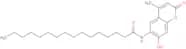
CAS:<p>Fluorochrome for calibration of fluorimeters. Used with corresponding fluorogenic substrates for the diagnosis of Krabbe - and Niemann-Pick A/B disease.</p>Fórmula:C26H39NO4Pureza:Min. 95%Forma y color:White PowderPeso molecular:429.59 g/mol4-Nitrophenyl-α-D-galactopyranoside
CAS:<p>Chromogenic substrate yielding a soluble chromophore for the colorimetric assay of α-D-galactosidase upon cleavage. Used for the detection of hydrolases in tissues and membranes.</p>Fórmula:C12H15NO8Pureza:Min. 99.0 Area-%Peso molecular:301.26 g/molLuc-S.aureus K
<p>Luc-S.aureus K is an enzyme conjugate containing luciferase and a specific antibody against Staphylococcus aureus. It is used for detection of S.aureus in laboratory cultures, food, and environmental samples. The light produced by this product is proportional to the amount of bacteria present in the sample. This product can be used as a chemiluminescent substrate for detecting alkaline phosphatase activity or as a fluoro-luminescent substrate for detecting beta-galactosidase activity. Luc-S.aureus K has high purity and high quality, with 100% specific binding affinity for S.aureus and no cross reactivity with other bacteria or host cells, making it suitable for use in diagnostic applications.</p>Fórmula:C17H17KN2O8S2Pureza:Min. 85 Area-%Peso molecular:480.55 g/molRef: 3D-L-8274
5mgA consultar10mgA consultar25mgA consultar50mgA consultar100mgA consultar-Unit-mgmgA consultarPhosphoric acid, mono(4-nitrophenyl) ester
CAS:<p>Phosphoric acid, mono(4-nitrophenyl) ester is an inhibitor that binds to the human serum albumin (HSA), thereby preventing it from binding to the transcriptional regulatory protein. This leads to a decrease in the activity of this protein and consequently less inhibition of gene expression. The structural analysis of this inhibitor has shown that it forms hydrogen bonding interactions with basic proteins, while its reactivity is mainly dependent on Michaelis–Menten kinetics. The inhibitor also inhibits enzyme activities by binding to their active sites, reducing the enzyme's ability to catalyze reactions.</p>Fórmula:C6H6NO6PPeso molecular:219.09 g/molRef: 3D-P-6460
1kgA consultar50gA consultar100gA consultar250gA consultar500gA consultar-Unit-kgkgA consultar4-Methylumbelliferyl a-L-idopyranosiduronic acid sodium salt
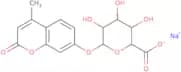
CAS:<p>PAIRED PRODUCT AVAILABLE: alpha-L-iduronidase Enzyme, FI179383.<br>4MU-alpha-L-idopyranosiduronic acid is a fluorogenic substrate for alpha-L-iduronidase. Active alpha-L-iduronidase cleaves the MU moiety from the synthetic substrate, which results in release of a fluorescent signal (Ex 360 nm / Em 455 nm). The reaction is stopped by the addition of sodium carbonate. 4MU-alpha-L-idopyranosiduronic acid is used in alpha-L-iduronidase assays in the context of biochemical characterisation of samples from patients affected by lysosomal storage disease mucopolysaccharidosis I (MPS I).</p>Fórmula:C16H15NaO9Pureza:Min. 98 Area-%Forma y color:White PowderPeso molecular:374.27 g/mol5-Cyano-3-indoxyl-β-D-galactopyranoside
<p>For detection of beta-galactosidase activity. <br>The colors of the chromogen can be adjusted by incorporating different functional groups, e.g. cyano or nitro group, which yields purple or black green colonies with beta-galactosidase positive strain.</p>Fórmula:C15H16N2O6Peso molecular:320.3 g/mol4-Trifluoromethylumbelliferyl β-D-galactopyranoside
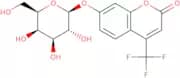
CAS:<p>4-Trifluoromethylumbelliferyl β-D-galactopyranoside is a fluorogenic substrate for beta-galactosidase	. Upon hydrolysis, the fluorogenic moiety (blueish) 4-trifluoromethylumbelliferone (also known as TFMU) is released. 4-Trifluoromethylumbelliferyl β-D-galactopyranoside is commonly used in bacterial detection and in LacZ gene expression assays.</p>Fórmula:C16H15F3O8Pureza:Min. 95%Forma y color:PowderPeso molecular:392.28 g/mol4-Nitrophenyl O-(N-acetyl-a-neuraminosyl)-(2,3)-O-b-D-galactopyranosyl-(1,3)-2-acetamido-2-deoxy-a-D-galactopyran oxide
CAS:<p>4-Nitrophenyl O-(N-acetyl-a-neuraminosyl)-(2,3)-O-b-D-galactopyranosyl-(1,3)-2-acetamido-2-deoxy-a-D-galactopyran oxide is a fluorogenic substrate that is used in the detection of glycosidases. It has been shown to be an excellent ligand for the enzyme beta galactosidase, which cleaves the glycan substrate 4NPOBGPA into 4NP and O-(N acetyl) neuraminic acid. 4NPOBGPA can be used as a chromogenic substrate for detecting beta galactosidase activity and can also be conjugated to other fluorescent molecules. This product is high purity and high quality.</p>Pureza:Min. 95%Peso molecular:795.7 g/mol4-Methylumbelliferyl nonanoate
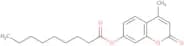
CAS:<p>4-Methylumbelliferyl nonanoate is a fluorogenic substrate for lipase. After enzymatic cleaveage, free 4-methylumbelliferone (also known as hymecromone) is released, exhibiting blue fluorescence upon excitation with UV light. The strongest fluorescence of 4-methylumbelliferone requires deprotonation of the hydroxyl group (thus requires alkaline pH), with a maximal fluorescence intensity obtained with excitation at 350 to 370 nm and emission at 440 to 470 nm. The use of 4-methylumbelliferyl nonanoateas a substrate for measuring the lipase activity is used for the detection of lipase deficiency that could lead to pancreatic insufficiency.</p>Fórmula:C19H24O4Pureza:Min. 95%Forma y color:PowderPeso molecular:316.39 g/molNaphthol AS-D chloroacetate
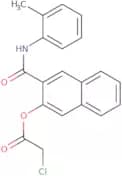
CAS:<p>Histochemical substrate for esterase</p>Fórmula:C20H16ClNO3Pureza:Min. 98 Area-%Forma y color:PowderPeso molecular:353.8 g/mol4-Trifluoromethylumbelliferyl-β-D-galactopyranoside
CAS:<p>4-Trifluoromethylumbelliferyl-beta-D-galactopyranoside is a fluorogenic substrate for beta-galactosidase. It is used in the detection of beta-galactosidase activity in cell lysates and culture media, as well as in food testing. This compound has been shown to be highly pure, with a purity greater than 98%. 4-Trifluoromethylumbelliferyl-beta-D-galactopyranoside has also been shown to have high chemiluminescence, making it an ideal candidate for use in diagnostics.</p>Fórmula:C16H15F3O8Peso molecular:392.29 g/mol5-Bromo-4-chloro-3-indoxyl phosphate p-toluidine, micronized
CAS:<p>A substrate for alkaline phosphatase yielding a blue insoluble product upon cleavage. Colour can be further enhanced when used together with Nitroblue tetrazolium. The substrate system is versatile and has functions in a variety of applications, including Northern, Southern, and Western blotting, in situ hybridization, ELISAs, microarray and immunohistochemistry. The micronized structure enhances solubility.</p>Fórmula:C8H6BrClNO4P•C7H9NPureza:Min. 95%Forma y color:PowderPeso molecular:433.63 g/mol4-Methylumbelliferyl b-D-cellotrioside
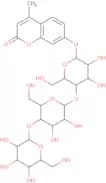
CAS:<p>Fluorogenic cellulose analogue</p>Fórmula:C28H38O18Pureza:Min. 95%Forma y color:PowderPeso molecular:662.6 g/molD-Luciferin Firefly, potassium salt
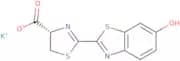
CAS:<p>Water soluble substrate for firefly luciferase. Used for imaging the expression of the LUC marker gene and luciferase-fusion conjugates in living cells, tissues and organisms. Extensively utilized in reporter gene assays, immunoassays and hygiene monitoring.</p>Fórmula:C11H7KN2O3S2Pureza:Min. 99.0 Area-%Peso molecular:318.42 g/mol6-Chloro-3-indolyl β-D-cellobioside
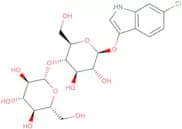
CAS:<p>6-Chloro-3-indolyl b-D-cellobioside is a chromogenic substrate that produces a salmon-pink color after enzymatic cleavage. It is used for detecting the activity of beta-D-cellobiosidase in enzyme assays.</p>Pureza:Min. 95%Forma y color:White To Off-White SolidPeso molecular:491.87 g/mol