Sustratos de enzimas
Los sustratos enzimáticos son moléculas sobre las cuales actúan las enzimas para catalizar reacciones químicas. El sustrato se une al sitio activo de la enzima, donde sufre una transformación específica para formar el producto de la reacción. Los sustratos enzimáticos son herramientas esenciales en la investigación para estudiar la cinética enzimática, la especificidad y el mecanismo de acción. También se utilizan en ensayos diagnósticos y estudios bioquímicos. En CymitQuimica, ofrecemos una selección diversa de sustratos enzimáticos de alta calidad para apoyar su investigación en enzimología y bioquímica.
Subcategorías de "Sustratos de enzimas"
Se han encontrado 1527 productos de "Sustratos de enzimas"
Ordenar por
Pureza (%)
0
100
|
0
|
50
|
90
|
95
|
100
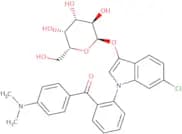
Aldol® 518 α-D-galactopyranoside, Biosynth Patent: EP 2427431 and US 8940909
CAS:<p>Aldol® 518 alpha-D-galactopyranoside is a chromogenic and fluorogenic enzyme substrate used for detection of alpha-galactosidase activity. The enzyme substrate is cleaved by alpha-galactosidase positive bacteria and yeasts in liquid or solid media, yielding red color and red fluorescence signal. Aldol® 518 alpha-D-galactopyranoside can also be used to detect alpha-galactosidase (encoded by the Mel1 gene) in yeast gene reporter assays or for identification of alpha-gal positive transformants on agar plates. Aldol® 518 alpha-D-galactopyranoside can be used under aerobic and anaerobic conditions.</p>Fórmula:C29H29ClN2O7Pureza:Min. 95.0 Area-%Peso molecular:553.01 g/molL-Histidine 7-amido-4-methylcoumarin hydrochloride
CAS:<p>L-Histidine 7-amido-4-methylcoumarin hydrochloride is a synthetic peptide substrate used as a fluorogenic substrate for histidine aminopeptidase.</p>Fórmula:C16H17ClN4O3Pureza:Min. 95%Peso molecular:348.79 g/mol2-Chloro-4-nitrophenyl a-D-maltotrioside
CAS:<p>2-Chloro-4-nitrophenyl a-D-maltotrioside (2CNP) is a potent hypoglycemic agent that has been shown to decrease postprandial blood glucose levels in humans. 2CNP is a white crystalline solid that is soluble in water and ethanol. The transfer reactions of 2CNP are enhanced by benzalkonium chloride, which forms an organic complex with the drug. The optimum concentration for the hypoglycemic effect of 2CNP is determined to be 10 μM, which can be detected using an optical sensor. This compound also inhibits α-amylase and other enzymes involved in carbohydrate metabolism, leading to the accumulation of glycogen and lowering the blood glucose level.</p>Fórmula:C24H34CiNO18Pureza:Min. 95%Forma y color:Off-White Yellow PowderPeso molecular:659.98 g/molLuc-Salmonella
<p>Luc-Salmonella is a conjugate of the enzyme luciferase and the substrate 5-bromo-4-chloro-3-indolyl phosphate. Luc-Salmonella has been used for diagnostic purposes in the detection of bacteria in culture media, as well as in environmental and food testing. Luc-Salmonella can be used to detect Salmonella, which is a bacterium that can cause gastrointestinal disease. Luminescence is measured using a luminometer or fluorimeter with an excitation wavelength of 485 nm and emission wavelengths at 510 nm. Luminescence from Luc-Salmonella is typically measured after 1 hour incubation with bacterial cells.<br>Luc-Salmonella has been shown to have high purity and quality due to its unique composition of enzyme substrate. This product has been tested for contamination by sensitive assays such as chemiluminescence, bioluminescence, or fluorescence. The purity level of Luc-Sal</p>Pureza:Min. 96 Area-%Ref: 3D-L-8281
5mgA consultar10mgA consultar25mgA consultar50mgA consultar100mgA consultar-Unit-mgmgA consultar4-Methylumbelliferyl phosphate, bis(2-amino-2-methyl-1,3-propanediol) salt
CAS:<p>Sensitive fluorogenic substrate for fluorometric and UV-spectrophotometric assays of phosphatases.</p>Fórmula:C18H31N2O10PPureza:Min. 98.0 Area-%Peso molecular:466.43 g/mol1-Naphthyl β-D-glucuronide
CAS:<p>1-Naphthyl beta-D-glucuronide (NPG) is a chromogenic enzyme substrate used to detect the presence of β-glucuronidase activity. Upon hydrolysis by the enzyme, it produces a yellow product that can be detected by spectrophotometry or visually. It is commonly used in clinical assays to detect the presence of the enzyme in urine samples, as elevated levels can indicate liver or urinary tract diseases. It is also utilized in environmental testing, as some bacteria strains can produce the enzyme as a by-product, making NPG a useful tool for detecting these strains in contaminated water or food sources.</p>Fórmula:C16H16O7Pureza:Min. 95%Forma y color:White PowderPeso molecular:320.29 g/mol5-Bromo-4-chloro-3-indolyl b-D-glucuronide sodium salt
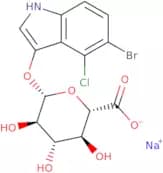
CAS:<p>Chromogenic substrate for beta-glucuronidase</p>Fórmula:C14H12BrClNNaO7Pureza:Min. 98 Area-%Forma y color:White Off-White PowderPeso molecular:444.59 g/mol4-Methylumbelliferyl-α-L-rhamnopyranoside
CAS:<p>4-Methylumbelliferyl-alpha-L-rhamnopyranoside is a fluorogenic substrate used in enzyme assays. It is a substrate of the enzyme beta-galactosidase, which catalyzes the hydrolysis of terminal galactose residues from polysaccharides and glycoproteins. The fluorescent product 4-methylumbelliferone (4MU) is formed by cleavage of the terminal galactose residue and can be measured spectrophotometrically at 360 nm. 4-Methylumbelliferone has been used for chemiluminescent detection in immunoassays and as a substrate for bioluminescence reactions.</p>Fórmula:C16H18O7Pureza:Min. 98.0 Area-%Peso molecular:322.32 g/molRef: 3D-M-6185
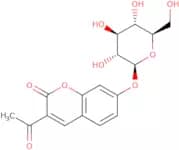
1gA consultar5gA consultar10gA consultar500mgA consultar2500mgA consultar-Unit-ggA consultar3-Acetylumbelliferyl b-D-glucopyranoside
CAS:<p>3-Acetylumbelliferyl beta-D-glucopyranoside is a fluorogenic enzyme substrate for beta-galactosidase-6-phosphatase. It is used in in diagnostic assays such as Gaucher disease.</p>Fórmula:C17H18O9Pureza:Min. 95%Forma y color:PowderPeso molecular:366.32 g/mol4-Methylumbelliferyl b-D-glucuronide trihydrate
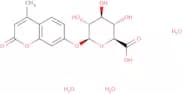
CAS:<p>Fluorogenic substrate for beta-glucuronidase GUS</p>Fórmula:C16H22O12Pureza:Min. 98 Area-%Forma y color:White PowderPeso molecular:406.34 g/molAldol® 518 myo-inositol-1-phosphate - Biosynth Patent: EP 2427431 and US 8940909
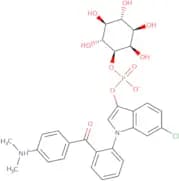
CAS:<p>Aldol® 518 myo-inositol-1-phosphate is a chromogenic and fluorogenic enzyme substrate used for detection of phosphatidyl-inositol specific phospholipase C activity (PI-PLC, EC 4.6.1.13). The colorless enzyme substrate is cleaved by PI-PLC or PI-PLC-positive microorganisms grown in liquid or solid media, yielding an intense red coloration. In combination with Aldol® 355 fluorescence enhancer, red fluorescence can also obtained. Aldol® 518 myo-inositol-1-phosphate is suitable for use in liquid and solid media, under aerobic as well as anaerobic conditions.</p>Fórmula:C29H33ClN3O10PPureza:Min. 95 Area-%Forma y color:PowderPeso molecular:650.02 g/molFluorescein-dipalmitoylphosphatidylethanolamine triethylammonium salt
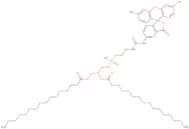
CAS:<p>Fluorescein-dipalmitoylphosphatidylethanolamine triethylammonium salt is a fluorescent phospholipid derivative for phospholipase. This substrate consists of a fluorescein conjugated to DPPE (dipalmitoylphosphatidylethanolamine), a key component of biological membranes. This compound is frequently used in membrane dynamics studies and lipid metabolism research. The fluorescein moiety allows visualization of lipid interactions in model membranes, liposomes, or live-cell imaging applications. The triethylammonium salt form enhances solubility and stability, property that facilitates its use in aqueous and lipid-based environments.</p>Pureza:Min. 95%Forma y color:PowderPeso molecular:1,182.53 g/mol5-Bromo-4-chloro-3-indoxyl-β-D-glucuronic acid, sodium salt trihydrate
CAS:<p>Chromogenic substrate for beta-glucuronidase (GUS) yielding blue precipitate upon cleavage. Used for identification of beta-glucuronidase. X-beta-D-glucuronide has been reported as chromogenic substrate in a number of chromogenic E. coli/ coliform culture media. About 95% of common E. coli possess beta-D-glucuronidase activity. Such chromogenic culture media are used for detection and enumeration of E. coli in food samples such as meat, dairy products and shellfish and have clinical applications in the assessment of urinary infections. It has gained international acceptance as highly accurate test for the presence of E. coli in drinking water samples. It is also used for the detection of the expression of GUS (E. coli beta-glucuronidase) gene fusion marker constructs in plants. The sodium salt has advantages over the cyclohexylammonium salt as being non-electrostatic and possessing a naturally-occurring cation.</p>Fórmula:C14H18BrClNNaO10Pureza:Min. 99.0 Area-%Peso molecular:498.65 g/mol4-Nitrophenyl sulfate potassium salt
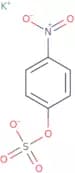
CAS:<p>4-Nitrophenyl sulfate potassium salt is a chromogenic substrate for arylsulfatase. Upon hydrolysis, para-nitrophenol is released yielding a yellowish colour. 4-Nitrophenyl sulfate potassium salt is used in different applications such as the Metachromatic leukodystrophy diagnosis, sulfatase activity assays</p>Fórmula:C6H4KNO6SPureza:Min. 95%Forma y color:PowderPeso molecular:257.26 g/mol4-Nitrophenyl-β-D-glucopyranoside
CAS:<p>Chromogenic β-glucosidase substrate yielding a yellow solution upon cleavage.</p>Fórmula:C12H15NO8Pureza:Min. 99.0 Area-%Peso molecular:301.25 g/mol2-Chloro-4-nitrophenyl-α-L-fucopyranoside
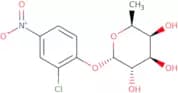
CAS:<p>Alternative chromogenic substrate for alpha-D-galactosidase</p>Fórmula:C12H14ClNO7Pureza:Min. 98 Area-%Forma y color:White PowderPeso molecular:319.69 g/mol7-((4'-L-Alaninamido)-rac-3'-hydroxybutyloxy) coumarin hydrochloride
<p>This Clips-O substrate 7-((4'-L-Alaninamido)-rac-3'-hydroxybutyloxy) coumarin allows the detection of single and dual enzymatic activity (L-alanine aminopetidase and oxidation of 4-amino-3-hydroxybutyloxy spacer either enzymatically or by exposure to sodium periodate) with a single substrate resulting in a fluorescent signal. The main virtues of Clips-O substrates are an increased stability towards non-enzymatic hydrolysis that results in a reduced background and high sensitivity.</p>Fórmula:C16H21ClN2O5Pureza:Min. 95%Forma y color:PowderPeso molecular:356.8 g/molN-Methylindoxyl-β-D-galactopyranoside monohydrate
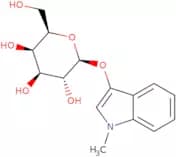
CAS:<p>N-Methylindoxyl-beta-D-galactopyranoside monohydrate (MG) is a chromogenic probe that interacts with galactose residues found on glycoproteins, which are found on cell surfaces, leading to activation of cells. MG also binds specifically to the surface of lung cells and can inhibit the development of certain types of infections..</p>Fórmula:C15H21NO7Pureza:Min. 98 Area-%Forma y color:PowderPeso molecular:327.33 g/molAldol® 515 4-acetoxybutyrate solution, 0.75 M in DMSO, Biosynth Patent: EP 2427431 and US 8940909
CAS:Producto controlado<p>Aldol® 515 4-acetoxybutyrate solution, 0.75 M in DMSO, is a chromogenic substrate that can be used to measure the activity of aldolase. It is a liquid at room temperature and has a pH of 7.2. The Aldol® 515 4-acetoxybutyrate solution, 0.75 M in DMSO, is soluble in water and organic solvents such as DMSO and ethanol. This product does not contain any preservatives or additives and is suitable for use with humans and animals. Aldol® 515 4-acetoxybutyrate solution, 0.75 M in DMSO, is manufactured by Cymit Quimica under patents EP 2427431 and US 8940909.br>br><br>Aldolase catalyzes the conversion of dihydroxyacetone phosphate (DHAP) to glyceraldehyde 3-phosphate</p>Fórmula:C29H28N2O5Pureza:Min. 95 Area-%Peso molecular:484.54 g/molL-Luciferin, potassium salt
CAS:<p>L-Luciferin is an enzyme substrate that is used in the detection of bioluminescence. It is a fluorogenic substrate that can be used to detect the presence of glucose in urine. L-Luciferin is also a chemiluminescent substrate that can be used to detect ATP, which is required for cell metabolism. L-Luciferin has been shown to be stable at pH levels ranging from 2.5 to 9 and can be stored for up to 3 years when stored at 4°C with no light or oxygen exposure. This product has CAS No. 754978-59-1, indicating high purity and quality. L-Luciferin will not stain or react with other compounds, making it highly suitable for use as a conjugate in diagnostic tests or as a ligand in fluorescent staining reactions.</p>Fórmula:C11H7KN2O3S2Pureza:Min. 98.0 Area-%Peso molecular:318.42 g/mol