Sustratos de enzimas
Los sustratos enzimáticos son moléculas sobre las cuales actúan las enzimas para catalizar reacciones químicas. El sustrato se une al sitio activo de la enzima, donde sufre una transformación específica para formar el producto de la reacción. Los sustratos enzimáticos son herramientas esenciales en la investigación para estudiar la cinética enzimática, la especificidad y el mecanismo de acción. También se utilizan en ensayos diagnósticos y estudios bioquímicos. En CymitQuimica, ofrecemos una selección diversa de sustratos enzimáticos de alta calidad para apoyar su investigación en enzimología y bioquímica.
Subcategorías de "Sustratos de enzimas"
Se han encontrado 1527 productos de "Sustratos de enzimas"
Ordenar por
Pureza (%)
0
100
|
0
|
50
|
90
|
95
|
100
4-Nitrophenyl 2-acetamido-6-O-(2-acetamido-2-deoxy-b-D-glucopyranosyl)-3-O-(b-D-galactopyranosyl)-2-deoxy-a-D-galactopyranoside
CAS:<p>4-Nitrophenyl 2-acetamido-6-O-(2-acetamido-2-deoxy-b-D-glucopyranosyl)-3-O-(b-D-galactopyranosyl)-2-deoxy-a-D-galactopyranoside is a specific chromogenic substrate designed for the highly sensitive and accurate detection of glycosidase enzyme activity. Glycosidases are responsible for the cleavage of glycosidic bonds between saccharide units in various carbohydrates. The hydrolysis of this substrate by glycosidase enzymes produces 4-nitrophenol, a yellow-colored compound that can be easily monitored through spectrophotometric measurements due to its strong absorbance at 405 nm. This chromogenic substrate is widely used in the analysis of glycosidase activity in various biological samples, including bacterial, fungal, and plant tissues, as well as in environmental samples and biotechnological applications.</p>Fórmula:C28H41N3O18Pureza:Min. 95 Area-%Forma y color:White PowderPeso molecular:707.63 g/molLipase substrate
CAS:<p>Synthetic chromogenic substrate for detection of lipase enzyme activity that produces a red coloured product, Suitable for use in serum of plasma matrices. This lipase substrate is commonly used in veterinary diagnostics for monitoring and detecting canine pancreatitis,</p>Fórmula:C45H69NO8Peso molecular:752.03 g/mol1-Methyl 2-(4-methyl-2-oxo-2H-1-benzopyran-7-yl)ethanedioate
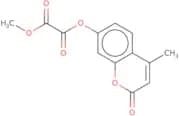
CAS:<p>Inorganic phosphate targeted colorimetric probe</p>Fórmula:C13H10O6Pureza:Min. 95%Peso molecular:822.35 g/molD-Luciferin Firefly, potassium salt - endotoxin free
CAS:<p>Water soluble substrate for firefly luciferase. Used for imaging the expression of the LUC marker gene and luciferase-fusion conjugates in living cells, tissues and organisms. Extensively utilized in reporter gene assays, immunoassays and hygiene monitoring. Endotoxin free product.</p>Fórmula:C11H7KN2O3S2Pureza:Min. 95%Forma y color:PowderPeso molecular:318.42 g/mol4-Methylumbelliferyl caprylate
CAS:<p>Fluorogenic substrate for esterase with C8 activity yielding a blue fluorescent solution upon cleavage. Used for the identification of Salmonella spp. based on the detection of caprylate esterase.</p>Fórmula:C18H22O4Pureza:Min. 98 Area-%Peso molecular:302.37 g/molRef: 3D-M-5526
1gA consultar5gA consultar10gA consultar25gA consultar2500mgA consultar-Unit-ggA consultar4-Nitrophenyl-α-L-fucopyranoside
CAS:<p>Chromogenic substrate yielding a soluble yellow chromophor for the colorimetric assay of α-L-fucosidase, especially in human serum.</p>Fórmula:C12H15NO7Pureza:Min. 98 Area-%Peso molecular:285.26 g/mol2-O-(4-Nitrophenyl)-a-D-N-glycolylneuraminic acid
CAS:<p>2-O-(4-Nitrophenyl)-a-D-N-glycolylneuraminic acid is commonly used to measure the activity of sialidase enzymes, specifically those that cleave glycoconjugates containing 2-O-(4-nitrophenyl)-alpha-D-N-glycolylneuraminic acid. The resulting product can be detected by measuring the absorbance at a specific wavelength using a spectrophotometer. This substrate offers a high degree of specificity for glycolylneuraminic acid-containing substrates and is useful for both research and diagnostic purposes.</p>Pureza:Min. 95%Forma y color:PowderPeso molecular:446.36 g/mol4-Methylumbelliferyl 2-acetamido-2-deoxy-b-D-glucopyranoside-6-sulfate sodium salt
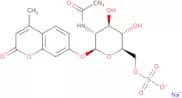
CAS:<p>4-Methylumbelliferyl 2-acetamido-2-deoxy-beta-D-glucopyranoside-6-sulfate sodium salt is a high-quality fluorogenic substrate specifically designed for the detection and quantification of various enzymes, including beta-glucosidases and sulfatases. Upon hydrolysis by the target enzyme, this substrate releases the highly fluorescent 4-methylumbelliferone, allowing for real-time monitoring and accurate measurement of enzyme activities in biochemical assays, diagnostic tests, and research applications. 4-Methylumbelliferyl 2-acetamido-2-deoxy-beta-D-glucopyranoside-6-sulfate sodium salt has excellent solubility in water, ensuring a consistent and reliable performance in different experimental conditions. This versatile substrate is an essential tool for researchers and industry professionals who require a sensitive and reproducible detection method for enzymes of interest.</p>Fórmula:C18H20NO11SNaPureza:Min. 98 Area-%Forma y color:White PowderPeso molecular:481.41 g/mol5-Bromo-4-chloro-3-indoxyl-α-D-N-acetylneuraminic acid, cyclohexylammonium salt
<p>5-Bromo-4-chloro-3-indoxyl-alpha-D-N-acetylneuraminic acid, cyclohexylammonium salt is a chemiluminescent substrate that provides a significant increase in light emission. It has a CAS number of 59820-92-0 and is supplied in high purity and high quality. This product is used for the detection of various biological reactions, including diagnostics, enzyme substrates, food testing, and more.</p>Pureza:Min. 95%Resorufin β-D-cellobioside
CAS:<p>Resorufin beta-D-cellobioside is a fluorogenic substrate for the enzyme beta-glucosidase. It is soluble in water and can be used as a chromogenic substrate for beta-galactosidase. Resorufin beta-D-cellobioside is also used as a ligand to study protein interactions, such as those between lectins and glycoproteins. This product is of high purity and quality, with CAS No. 1000404-48-7.</p>Fórmula:C24H27NO13Pureza:Min. 95 Area-%Peso molecular:537.47 g/molRef: 3D-R-2056
10mgA consultar25mgA consultar50mgA consultar100mgA consultar250mgA consultar-Unit-ggA consultarL-Phenylalanine 7-amido-4-methylcoumarin trifluoroacetate salt
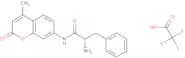
CAS:<p>L-Phenylalanine 7-amido-4-methylcoumarin trifluoroacetate salt is a fluorogenic peptide substrate for aminopeptidase. This AMC peptide substrate is normally used to rapidly profile the N-terminal specificity of proteases.</p>Fórmula:C19H18N2O3•C2HF3O2Pureza:Min. 98 Area-%Forma y color:White PowderPeso molecular:436.38 g/mol4-Nitrophenyl 2-O-trans-feruloyl-a-L-arabinofuranoside
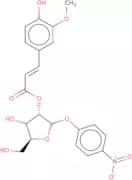
CAS:<p>4-Nitrophenyl 2-O-trans-feruloyl-alpha-L-arabinofuranoside is a chromogenic substrate for alpha-L-arabinofuranosidase. Upon hydrolysis, para-nitrophenol is released yielding a yellowish colour. 4-Nitrophenyl 2-O-trans-feruloyl-alpha-L-arabinofuranoside is used in different applications such as the Plant biomass analysis, bacterial arabinan degradation assays</p>Fórmula:C21H21NO10Pureza:Min. 95%Forma y color:PowderPeso molecular:447.39 g/molN-Acetyl-glycine p-nitroanilide
CAS:<p>Substrate for hydrolases</p>Fórmula:C10H10N2O5Pureza:Min. 95%Forma y color:Yellow powder.Peso molecular:238.2 g/mol5-Bromo-4-chloro-3-indolyl a-L-arabinofuranoside
<p>5-Bromo-4-chloro-3-indolyl a-L-arabinofuranoside is a chromogenic substrate used to detect the specific enzymatic activity of alpha-L-arabinofuranosidase. After cleavage, 5-bromo-4-chloro-indoxyl is released, resulting in a blue to blue-green color change in bacterial colonies or media. 5-Bromo-4-chloro-3-indolyl a-L-arabinofuranoside is used in bacterial arabinan degradation assays (e.g. Bacillus spp.).</p>Fórmula:C13H13BrClNO5Pureza:Min. 98.0 Area-%Forma y color:PowderPeso molecular:378.6 g/molD-Luciferin Firefly
CAS:<p>Substrate for firefly luciferase used for imaging the expression of the LUC marker gene and luciferase-fusion conjugates in living cells, tissues and organisms. Extensively utilized in reporter gene assays, immunoassays and hygiene monitoring.</p>Fórmula:C11H8N2O3S2Pureza:Min. 99.0 Area-%Peso molecular:280.33 g/molRef: 3D-L-8200
1gA consultar10mgA consultar250mgA consultar500mgA consultar2500mgA consultar-Unit-ggA consultarAldol® 455 alpha-D-glucopyranoside - Biosynth Patent: EP 2427431 and US 8940909
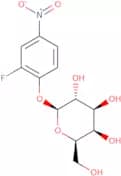
<p>Aldol® 455 alpha-D-glucopyranoside is a high quality, environmentally tested, staining, and ligand for bioluminescent assays. It has been shown to be a chromogenic substrate for diagnostics and a fluorogenic substrate for enzymes such as alpha-glucosidase, producing a yellow/green-orange color. Aldol® 455 alpha-D-glucopyranoside is also used in culture media and food testing.</p>Fórmula:C27H24ClNO7Pureza:Min. 95 Area-%Forma y color:PowderPeso molecular:509.93 g/mol2-Fluoro-4-nitrophenyl b-D-galactopyranoside
CAS:<p>2-Fluoro-4-nitrophenyl b-D-galactopyranoside is a chromogenic substrate in enzymatic assays with β-galactosidase. Commonly abbreviated as PFONPG, it is a hydrophilic compound that can be dissolved in saline and blood samples, which makes it a suitable candidate for diagnostic applications as a gene reporter probe by simple analytic methodologies. 2-Fluoro-4-nitrophenyl b-D-galactopyranoside have been used to detect and monitor the growth of prostate tumor cells.</p>Pureza:Min. 95%Forma y color:PowderPeso molecular:319.24 g/mol2-Chloro-4-nitrophenyl b-D-maltoside
<p>2-Chloro-4-nitrophenyl b-D-maltoside is a fluorescent substrate used in diagnostic kits. It is used to detect the presence of beta-glucuronidase enzymes, which are found in many bacteria and fungi. 2-Chloro-4-nitrophenyl b-D-maltoside has been shown to be a superior substrate for beta-glucuronidase as it can be used at lower concentrations and is more stable than other substrates. The enzyme hydrolyzes the 2,4 nitrophenyl ester bond and releases the fluorogenic product 4-(2'-hydroxyethyl)benzene diazonium chloride (HED). This product emits light under ultraviolet light, making it ideal for use in Bioluminescence Assays.</p>Pureza:Min. 95%Ethyl umbelliferone-3-carboxylate-α-D-glucopyranoside
<p>Ethyl umbelliferone-3-carboxylate-a-D-glucopyranoside is a fluorogenic substrate used for detecting alpha-glucosidase activity in enzymatic assays. When alpha-glucosidase cleaves , the glycosidic bond, umbelliferone-3-carboxylate is released, which exhibits strong fluorescence. This substrate is commonly utilized in glycobiology research, diagnostic tests, and high-throughput screening of enzyme inhibitors.</p>Fórmula:C18H20O10Pureza:Min. 95%Forma y color:Off-white to yellow solid.Peso molecular:396.35 g/mol4-Methylumbelliferyl acetate
CAS:<p>Fluorogenic substrate for carboxylesterase</p>Fórmula:C12H10O4Pureza:Min. 95%Forma y color:White PowderPeso molecular:218.21 g/mol