Sustratos de enzimas
Subcategorías de "Sustratos de enzimas"
Se han encontrado 1525 productos de "Sustratos de enzimas"
3,4-Cyclohexenoesculetin β-D-galactopyranoside
CAS:Chromogenic substrate for beta-galactosidase
Fórmula:C19H22O9Pureza:Min. 95 Area-%Peso molecular:394.37 g/molDL-threo-2-methylisocitrate sodium salt
CAS:DL-threo-2-methylisocitrate sodium salt is an enzyme substrate for isocitrate lyase 1 (ICL1), an enzyme involved in the glyoxylate cycle, a metabolic pathway that allows organisms to convert acetate into glucose. It is also a substrate for bovine heart aconitase and acts as inhibitor of TPN-linked isocitrate dehydrogenase.
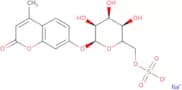
Fórmula:C7H10O7·xNaPureza:Min. 95%Forma y color:PowderPeso molecular:206.15 g/mol4-Methylumbelliferyl b-D-galactopyranoside-6-sulphate sodium salt - Moscerdam™ biochemical purity
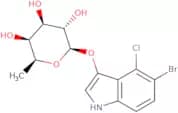
CAS:4-MU-Gal-6S (M4A) is a fluorogenic substrate of galactose-6-sulfate sulfatase (GALNS), used for the diagnosis of Mucopolysaccharidosis IV type A (MPS IV A). MPS IV, also known as Morquio syndrome, is a rare metabolic disorder in which the human body cannot process glycosaminoglycans (GAGs). MPS IV A is caused by the deficiency of the enzyme N-acetyl-galactosamine-6-sulfatase resulting in accumulation of keratan and chondroitin sulfate in tissues. M4A is used as the GALNS substrate in the anti-lysosomal enzyme antibody assay for the treatments of lysosomal storage disorders (LSDs) with enzyme replacement therapies (ERTs).Fórmula:C16H17NaO11SPureza:Min. 97 Area-%Forma y color:White PowderPeso molecular:440.36 g/mol5-Bromo-4-chloro-3-indolyl b-L-fucopyranoside
CAS:5-Bromo-4-chloro-3-indolyl β-L-fucopyranoside (X-Fuc) is a chromogenic substrate specifically designed for the identification and detection of fucosidase enzyme activity. Upon cleavage by fucosidase, it generates a blue-colored 5-Bromo-4-chloro-3-hydroxy-indole precipitate, which can be easily observed under a microscope or spectrophotometer. This feature makes X-Fuc an invaluable tool across various applications, such as biochemical analysis, histochemical staining, cell biology, and enzyme kinetic assays. By providing a fast, sensitive, and reliable readout for fucosidase activity, 5-Bromo-4-chloro-3-indolyl β-L-fucopyranoside facilitates essential research in the understanding of biological processes and the development of therapeutic interventions.Fórmula:C14H15BrClNO5Pureza:Min. 95%Forma y color:White PowderPeso molecular:392.63 g/molAldol® 467 beta-D-galactopyranoside, Biosynth Patent: EP 2427431 and US 8940909
CAS:Aldol® 467 beta-D-galactopyranoside is a chromogenic and fluorogenic enzyme substrate used for detection of beta-galactosidase activity. The colorless product is cleaved by lactose-utilizing bacteria grown in liquid or solid media, yielding yellow coloration and green fluorescence. Aldol® 467 beta-D-galactopyranoside can also be used in beta-galactosidase gene reporter assays or immunoassay applications (ELISA). Aldol® 467 beta-D-galactopyranoside can be used under aerobic and anaerobic conditions.
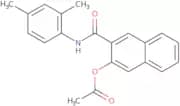
Fórmula:C29H28ClNO9Pureza:Min. 95%Forma y color:PowderPeso molecular:570 g/molNaphthol AS-MX acetate
CAS:Modified naphtol AS substrate used in histochemical and cytochemical staining
Fórmula:C21H19NO3Pureza:Min. 80%Forma y color:White Off-White PowderPeso molecular:333.38 g/mol4-Methylumbelliferyl-α-D-mannopyranoside
CAS:4-Methylumbelliferyl alpha-D-mannopyranoside (4-MU-a-D-Man) is a fluorogenic substrate used in activity assays for alpha-mannosidase. When it is hydrolyzed by alpha-mannosidase, it produces a fluorescent compound, 4-methylumbelliferone (4-MU). 4-MU-a-D-Man is often used in medical research to monitor the activity of alpha-mannosidase, which is important in lysosomal storage diseases. In addition, 4-Methylumbelliferyl alpha-D-mannopyranoside has been used to study the the activity of concanavalin A, a lectin that specifically binds to alpha-D-mannopyranosyl and alpha-D-glucopyranosyl residues on various glycoproteins. The use of this fluorogenic enzyme substrate permits study the degree of alpha-D-mannosidic linkage cleavage by the enzyme.Fórmula:C16H18O8Pureza:Min. 98 Area-%Peso molecular:338.32 g/molRef: 3D-M-5730
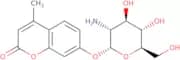
1gA consultar5gA consultar10gA consultar500mgA consultar2500mgA consultar-Unit-ggA consultar4-Methylumbelliferyl a-D-glucosaminide
CAS:4-Methylumbelliferyl alpha-D-glucosaminide is a fluorogenic substrate for alpha-N-acetylglucosaminidase. After enzymatic cleaveage, free 4-methylumbelliferone (also known as hymecromone) is released, exhibiting blue fluorescence upon excitation with UV light. The strongest fluorescence of 4-methylumbelliferone requires deprotonation of the hydroxyl group (thus requires alkaline pH), with a maximal fluorescence intensity obtained with excitation at 350 to 370 nm and emission at 440 to 470 nm. The use of 4-methylumbelliferyl alpha-D-glucosaminideas a substrate for measuring the alpha-N-acetylglucosaminidase activity is used for Sanfilippo syndrome B and Mucopolysaccharidosis IIIB (MPS IIIB) diagnosis.Fórmula:C16H19NO7Pureza:Min. 90 Area-%Forma y color:White PowderPeso molecular:337.32 g/mol4-Methylumbelliferyl phosphate bis(cyclohexylammonium) salt
CAS:Sensitive fluorogenic substrate for fluorometric and UV-spectrophotometric assays of phosphatases. This may also be used for in-gel assaysFórmula:C22H35N2O6PPureza:Min 99%Forma y color:White to off-white solid.Peso molecular:454.50 g/molCelluchrome
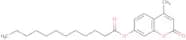
Celluchrome (short name for remazol brilliant blue carboxymethyl cellulose or RBB-CMC) is a chromogenic substrate for cellulases. With a higher sensitivity, RBB-CMC allows for the detection of the enzyme activity even when small amounts are present.Pureza:Min. 95%Forma y color:Powder4-Methylumbelliferyl dodecanoate
CAS:4-Methylumbelliferyl dodecanoate is a fluorogenic substrate for lipase. After enzymatic cleaveage, free 4-methylumbelliferone (also known as hymecromone) is released, exhibiting blue fluorescence upon excitation with UV light. The strongest fluorescence of 4-methylumbelliferone requires deprotonation of the hydroxyl group (thus requires alkaline pH), with a maximal fluorescence intensity obtained with excitation at 350 to 370 nm and emission at 440 to 470 nm. The use of 4-methylumbelliferyl dodecanoateas a substrate for measuring the lipase activity is used for detecting pancreatic insufficiency in diagnosis assays as well as the screening of lipase deficiency.Fórmula:C22H30O4Pureza:Min. 95%Forma y color:PowderPeso molecular:358.47 g/molResorufin N-acetyl-b-D-glucosamine
CAS:Resorufin N-acetyl-b-D-glucosamine is fluorogenic substrate for N-acetyl-beta-D-glucosaminidase (NAG).
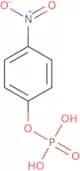
Fórmula:C20H20N2O8Pureza:Min. 98 Area-%Forma y color:Orange PowderPeso molecular:416.38 g/molPhosphoric acid, mono(4-nitrophenyl) ester
CAS:Phosphatase substrate
Fórmula:C6H6NO6PPureza:Min. 95%Forma y color:White PowderPeso molecular:219.09 g/mol4-Methylumbelliferyl a-L-idopyranosiduronic acid 2-sulphate disodium salt - Moscerdam™ biochemical purity
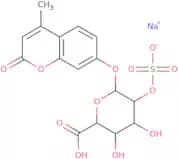
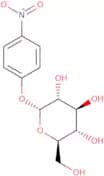
CAS:PAIRED PRODUCT AVAILABLE: alpha-L-iduronidase Enzyme, FI1793834MU-alpha-L-iduronide-2-sulphate (M2) is a fluorogenic substrate of iduronate-2-sulphatase (IDS), used in a 2-step assay coupled with alpha-L-iduronidase. The assay is used in biochemical testing for Hunter syndrome (mucopolysaccharidosis II / MPS II). In a first step, IDS from biological samples cleaves the sulphate group from M2. In a second step, exogeneous alpha-L-iduronidase which cleaves the 4-MU moiety is added to the reaction, resulting in release of a fluorescent signal (Ex 360 nm / Em 455 nm). The reaction is stopped by the addition of sodium carbonate.Fórmula:C16H14Na2O12SPureza:Min. 99 Area-%Forma y color:White PowderPeso molecular:476.32 g/mol4-Nitrophenyl-alpha-D-glucopyranoside, beta-Anomer < 0.1%
CAS:4-Nitrophenyl-alpha-D-glucopyranoside, beta-Anomer is a chromogenic sugar that can be used as an indicator for the presence of 4-nitrophenol. It is a highly reactive compound that spontaneously reacts with nitrobenzene to form a dinitroaniline. This anomeric structure is easily oxidized by air and light to form the corresponding o-dinitroaniline. When this reaction occurs, this substance changes color from yellow to red.
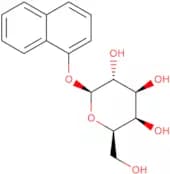
Fórmula:C12H15NO8Pureza:Min. 99.0 Area-%Peso molecular:301.26 g/mol1-Naphthyl β-D-galactopyranoside
CAS:1-Naphthyl b-D-galactopyranoside is a chromogenic substrate used to detect the presence of beta-galactosidase enzymes. The enzyme cleaves the substrate to produce a colored product that can be quantified and visualized. This substrate is commonly used in applications such as the detection of lacZ gene expression in bacterial colonies or in histochemical staining of tissues to identify beta-galactosidase activity.Fórmula:C16H18O6Pureza:Min. 95%Forma y color:PowderPeso molecular:306.32 g/mol2-Naphthyl caprylate
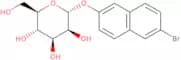
CAS:2-Naphthyl caprylate is a substrate that is employed in an assays for carboxylesterase and lipase and when hydrolyzed, produces 2-naphthol, a compound that can also be identified via fluorescence analysis. By combining it with a diazonium salt, the formation of the corresponding azo dye occurs. In particular, this substrate is used to detect the extracellular lipase of Pseudomonas fluorescens B52.Fórmula:C18H22O2Pureza:Min. 95%Forma y color:White PowderPeso molecular:270.37 g/mol6-Bromo-2-naphthyl α-D-mannopyranoside
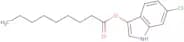
CAS:Chromogenic substrate to visualize the activity of alpha-D-mannopyranoside; red color producedFórmula:C16H17BrO6Pureza:Min. 95%Forma y color:PowderPeso molecular:385.21 g/mol6-Chloro-3-indoxyl nonanoate
CAS:6-Chloro-3-indoxyl nonanoate is a fluorescent substrate that is used in the detection of beta-galactosidase activity. It has been used to detect the enzyme levels in various culture media and as a high quality, food testing, and environmental testing. The product is also used as a ligand for enzyme inhibition studies. 6-Chloro-3-indoxyl nonanoate has shown to be an excellent fluoroquinolone substrate for chemiluminescence assays. This product is CAS No. 133950-72-8 and is of high purity and high quality.
Pureza:Min. 95%Peso molecular:307.81 g/mol4-Methylumbelliferyl 2-acetamido-2-deoxy-a-D-glucopyranoside
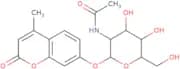
CAS:4-Methylumbelliferyl 2-acetamido-2-deoxy-alpha-D-glucopyranoside is a fluorogenic substrate for alpha-N-acetylglucosaminidase. After enzymatic cleaveage, free 4-methylumbelliferone (also known as hymecromone) is released, exhibiting blue fluorescence upon excitation with UV light. The strongest fluorescence of 4-methylumbelliferone requires deprotonation of the hydroxyl group (thus requires alkaline pH), with a maximal fluorescence intensity obtained with excitation at 350 to 370 nm and emission at 440 to 470 nm. The use of 4-methylumbelliferyl 2-acetamido-2-deoxy-alpha-D-glucopyranosideas a substrate for measuring the alpha-N-acetylglucosaminidase activity is used for Sanfilippo syndrome B screening and mucopolysaccharidosis diagnosis.Fórmula:C18H21NO8Pureza:Min. 98 Area-%Forma y color:PowderPeso molecular:379.36 g/mol