Sustratos de enzimas
Los sustratos enzimáticos son moléculas sobre las cuales actúan las enzimas para catalizar reacciones químicas. El sustrato se une al sitio activo de la enzima, donde sufre una transformación específica para formar el producto de la reacción. Los sustratos enzimáticos son herramientas esenciales en la investigación para estudiar la cinética enzimática, la especificidad y el mecanismo de acción. También se utilizan en ensayos diagnósticos y estudios bioquímicos. En CymitQuimica, ofrecemos una selección diversa de sustratos enzimáticos de alta calidad para apoyar su investigación en enzimología y bioquímica.
Subcategorías de "Sustratos de enzimas"
Se han encontrado 1529 productos de "Sustratos de enzimas"
Ordenar por
Pureza (%)
0
100
|
0
|
50
|
90
|
95
|
100
4-Methylumbelliferyl phosphate, disodium salt trihydrate
CAS:Sensitive fluorogenic substrate for fluorometric and UV-spectrophotometric assays of phosphatases.Fórmula:C10H13Na2O9PPeso molecular:354.16 g/mol2,5-dioxabicyclo[2.2.1]heptan-7-one
Please enquire for more information about 2,5-dioxabicyclo[2.2.1]heptan-7-one including the price, delivery time and more detailed product information at the technical inquiry form on this page
Fórmula:C5H6O3Pureza:Min. 95%Peso molecular:114.10 g/mol4-Methylumbelliferyl b-D-ribofuranoside
CAS:The 4-Methylumbelliferyl b-D-ribofuranoside is a top-notch fluorogenic substrate for glycosidase activity detection. Upon hydrolysis by enzymes, it generates a strongly fluorescent 4-methylumbelliferone molecule, enabling rapid assay results and real-time monitoring of enzymatic reactions. This product is suitable for many biological research applications, such as in vitro analysis, diagnostic testing, and drug discovery. With its high sensitivity and specificity, it delivers consistent and accurate results, making it an essential tool for scientists and researchers.Fórmula:C15H16O7Pureza:Min. 95%Forma y color:White PowderPeso molecular:308.28 g/mol4-Methylumbelliferyl 4-O-(α-L-fucopyranosyl)-β-D-galactopyranoside
CAS:4-Methylumbelliferyl 4-O-(alpha-L-fucopyranosyl)-beta-D-galactopyranoside is a fluorogenic substrate for alpha-L-fucosidase. After enzymatic cleaveage, free 4-methylumbelliferone (also known as hymecromone) is released, exhibiting blue fluorescence upon excitation with UV light. The strongest fluorescence of 4-methylumbelliferone requires deprotonation of the hydroxyl group (thus requires alkaline pH), with a maximal fluorescence intensity obtained with excitation at 350 to 370 nm and emission at 440 to 470 nm. The use of 4-methylumbelliferyl 4-O-(alpha-L-fucopyranosyl)-beta-D-galactopyranosideas a substrate for measuring the alpha-L-fucosidase activity is used for fucosidosis diagnosis and in screening studies of glycoprotein metabolism disorders.Fórmula:C22H28O12Pureza:Min. 95 Area-%Forma y color:PowderPeso molecular:484.45 g/molLuc-phosphate Na enhanced
Luc-phosphate Na enhanced is a bioluminescent substrate used to detect phosphatase activity in bacterial assays.
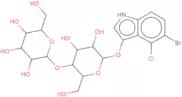
Fórmula:C18H12N2Na3O7PS2Pureza:Min. 97 Area-%Peso molecular:531.95 g/mol5-Bromo-4-chloro-3-indolyl a-D-maltopyranoside
CAS:5-Bromo-4-chloro-3-indolyl a-D-maltopyranoside is a chromogenic substrate used to detect the specific enzymatic activity of alpha-glucosidase. After cleavage, 5-bromo-4-chloro-indoxyl is released, resulting in a blue to blue-green color change in bacterial colonies or media. 5-Bromo-4-chloro-3-indolyl a-D-maltopyranoside is used in Pompe disease screening and glycogen storage disorder diagnosis.Fórmula:C20H25BrClNO11Pureza:Min. 95%Forma y color:PowderPeso molecular:570.77 g/mol4-Trifluoromethylumbelliferyl-β-D-galactopyranoside
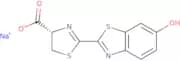
CAS:4-Trifluoromethylumbelliferyl-beta-D-galactopyranoside is a fluorogenic substrate for beta-galactosidase. It is used in the detection of beta-galactosidase activity in cell lysates and culture media, as well as in food testing. This compound has been shown to be highly pure, with a purity greater than 98%. 4-Trifluoromethylumbelliferyl-beta-D-galactopyranoside has also been shown to have high chemiluminescence, making it an ideal candidate for use in diagnostics.Fórmula:C16H15F3O8Peso molecular:392.29 g/molD-Luciferin sodium salt
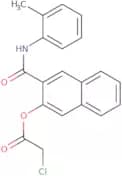
CAS:Bioluminescent substrate for luciferaseFórmula:C11H7N2NaO3S2Pureza:Min. 99 Area-%Forma y color:PowderPeso molecular:302.3 g/molNaphthol AS-D chloroacetate
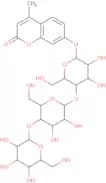
CAS:Histochemical substrate for esteraseFórmula:C20H16ClNO3Pureza:Min. 98 Area-%Forma y color:PowderPeso molecular:353.8 g/mol4-Methylumbelliferyl b-D-cellotrioside
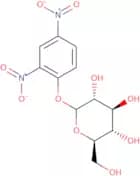
CAS:Fluorogenic cellulose analogueFórmula:C28H38O18Pureza:Min. 95%Forma y color:PowderPeso molecular:662.6 g/mol2,4-Dinitrophenyl β-D-glucopyranoside
CAS:2,4-Dinitrophenyl-beta-D-glucopyranoside is a chromogenic substrate used to assay enzymes, such as glucosidases. These enzymes catalyze the hydrolysis of glycosidic bonds in sugars.Fórmula:C12H14N2O10Pureza:Min. 95%Forma y color:PowderPeso molecular:346.25 g/molNucleic Acid Dye Green I, 10,000X in DMSO
CAS:Green I is a nucleic acid dye that has been shown to have antioxidative properties. It inhibits protein synthesis in mammalian cells by binding to the DNA and blocking transcription. Green I has also been shown to inhibit the growth of tumor cells and to cause cell death by oxidative damage. Green I is not genotoxic, but it can cause false positive results in genotoxicity tests. Green I has also been shown to be a potential biomarker for renal cell cancer, as well as a prognostic marker for this cancer. This dye enhances polymerase chain reaction (PCR) and is used in biological research because of its ability to bind with proteins and form complexes with DNA.Fórmula:C32H37N4SPeso molecular:509.27 g/molEsculetin-7-β-D-galactopyranoside
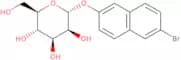
Esculetin-7-beta-D-galactopyranoside, also known as 6,7-Dihydroxycoumaryl-7-beta-D-galactopyranoside, is a fluorogenic substrate used in the detection of beta-galactosidase activity. This coumarin derivative, when hydrolyzed, yields esculetin (6,7-dihydroxycoumarin) which, in the presence of iron salts, forms a brown-black complex.Fórmula:C15H16O9Pureza:Min. 95%Peso molecular:340.28 g/mol6-Bromo-2-naphthyl α-D-mannopyranoside
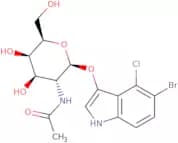
CAS:Chromogenic substrate to visualize the activity of alpha-D-mannopyranoside; red color producedFórmula:C16H17BrO6Pureza:Min. 95%Forma y color:PowderPeso molecular:385.21 g/mol5-Bromo-4-chloro-3-indoxyl-N-acetyl-beta-D-galactosaminide
CAS:5-Bromo-4-Chloro-3-Indoxyl-N-Acetyl-Beta-D-Galactosaminide is a chromogenic substrate for detecting beta-galactosidase and GalNAc-transferase enzymes. Upon hydrolysis by the enzyme, it produces a blue-green colored compound that can be detected visually or measured spectrophotometrically. This substrate is useful in characterizing the activity of Beta-Galactosidase and GalNAc-transferase enzymes involved in glycobiology research and diagnostic applications.Fórmula:C16H18BrClN2O6Pureza:Min. 98 Area-%Forma y color:Crystalline PowderPeso molecular:449.68 g/mol4-Methylumbelliferyl phosphate, bis(2-amino-2-methyl-1,3-propanediol) salt
CAS:Sensitive fluorogenic substrate for fluorometric and UV-spectrophotometric assays of phosphatases.Fórmula:C18H31N2O10PPureza:Min. 98.0 Area-%Peso molecular:466.43 g/mol4-Nitrocatechol sulfate dipotassium salt
CAS:Chromogenic sulfatase substrateFórmula:C6H3NO7SK2Pureza:Min. 98 Area-%Forma y color:PowderPeso molecular:311.35 g/mol3-(7-Hydroxycoumarin-3-carboxamido)propyl 4-O-(b-D-galactopyranosyl)-b-D-glucopyranoside
3-(7-Hydroxycoumarin-3-carboxamido)propyl 4-O-(b-D-galactopyranosyl)-b-D-glucopyranoside is a fluorogenic substrate that is used for the detection of beta-galactosidase. It has been shown to be an efficient substrate for the enzyme beta galactosidase and can be used to detect this enzyme in cell culture media and other diagnostic applications. 3-(7-Hydroxycoumarin-3-carboxamido)propyl 4-O-(b-D-galactopyranosyl)-b-D-glucopyranoside can also be used as a chromogenic substrate, which is added to a reaction mixture containing beta galactosidase, where it is hydrolyzed by the enzyme to produce a blue color. This product also has food testing and environmental testing applications.Pureza:Min. 95%4-Methylumbelliferyl-beta-D-glucopyranoside
CAS:Fluorogenic substrate for beta-glucosidase yielding a blue fluorescent solution. Used for the detection of beta-glucosidase as an indicator of Enterococci.Fórmula:C16H18O8Pureza:Min. 99 Area-%Peso molecular:338.32 g/mol4-Methylumbelliferyl-β-L-fucopyranoside
CAS:4-Methylumbelliferyl-beta-L-fucopyranoside is a fluorogenic substrate that is used in food testing. It also has uses as a chromogenic substrate and a ligand for biological studies. 4-Methylumbelliferyl-beta-L-fucopyranoside is a conjugate of 4-methylumbelliferone and beta-D-fucopyranosyl ester, which is an enzyme substrate for the detection of phosphatases. This product can be used to detect the activity of phosphatase enzymes in various media, including culture media, environmental testing, and staining. 4MUFBPY also has chemiluminescent properties that can be used for bioluminescence assays.Fórmula:C16H18O7Peso molecular:322.31 g/molRef: 3D-M-5541
1gA consultar5gA consultar250mgA consultar500mgA consultar2500mgA consultar-Unit-ggA consultar


![2,5-dioxabicyclo[2.2.1]heptan-7-one](/_next/image/?url=https%3A%2Fstatic.cymitquimica.com%2Fproducts%2F3D%2Fthumb-webp%2FKAA21803.webp&w=3840&q=75)