Sustratos de enzimas
Los sustratos enzimáticos son moléculas sobre las cuales actúan las enzimas para catalizar reacciones químicas. El sustrato se une al sitio activo de la enzima, donde sufre una transformación específica para formar el producto de la reacción. Los sustratos enzimáticos son herramientas esenciales en la investigación para estudiar la cinética enzimática, la especificidad y el mecanismo de acción. También se utilizan en ensayos diagnósticos y estudios bioquímicos. En CymitQuimica, ofrecemos una selección diversa de sustratos enzimáticos de alta calidad para apoyar su investigación en enzimología y bioquímica.
Subcategorías de "Sustratos de enzimas"
Se han encontrado 1529 productos de "Sustratos de enzimas"
Ordenar por
Pureza (%)
0
100
|
0
|
50
|
90
|
95
|
100
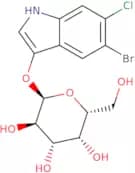
5-Bromo-6-chloro-3-indolyl a-D-galactopyranoside
CAS:5-Bromo-6-chloro-3-indolyl a-D-galactopyranoside is a chromogenic substrate that yields a magenta-colored product after cleavage. The chromophore 5-bromo-6-chloro-indoxyl is released, generating the observable color. It is used in glycolipid metabolism studies.Fórmula:C14H15BrClNO6Forma y color:White to off-white solid.Peso molecular:408.63 g/mol4-(Bromomethyl)phenyl-β-D-triacetylglucuronic acid methyl ester
<p>4-(Bromomethyl)phenyl-beta-D-triacetylglucuronic acid methyl ester, also known as 4-bromo-4'-(N,N-dimethylamino)biphenyl, is a bioluminescent substrate. It is used for the detection of beta-glucuronidase activity in biological samples and for the detection of bacterial β-glucuronidase activity in culture media. Beta-glucuronidase catalyzes the hydrolysis of glucuronic acid by breaking down a conjugate molecule into two smaller molecules, which can be detected using bioluminescence. 4-(Bromomethyl)phenyl-beta-D-triacetylglucuronic acid methyl ester is a chromogenic substrate that has been shown to be an excellent ligand in biomolecular research because it reacts with many different enzymes. This product is highly pure and</p>Fórmula:C20H23BrO10Pureza:Min. 95 Area-%Peso molecular:503.29 g/molResorufin b-D-xylobioside
Resorufin b-D-xylobioside is a fluorogenic substrate for xylanases useful for xylanase activity assays.Pureza:Min. 95%Forma y color:PowderPeso molecular:477.42 g/mol2-Nitrophenyl b-D-fucopyranoside
CAS:<p>2-Nitrophenyl b-D-fucopyranoside is a chromogenic substrate used in various enzymatic assays to detect the presence of fucosidase enzymes. It consists of a nitrophenyl group attached to a fucose sugar molecule. When acted upon by enzymes such as fucosidases, it releases the colored nitrophenyl group, which can be detected using spectrophotometry.</p>Fórmula:C12H15NO7Pureza:Min. 95%Forma y color:White Off-White PowderPeso molecular:285.25 g/mol2-Chloro-4-nitrophenyl β-D-maltotrioside
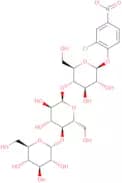
CAS:2-Chloro-4-nitrophenyl beta-D-maltotrioside, often abbreviated as CNP-G3, is a chromogenic substrate to detect and mesaure alpha-amylase activity. Evaluation and monitoring of alpha-amylase activity is important to help diagnose certain diseases such as pancreatitis.Fórmula:C24H34ClNO18Pureza:Min. 95%Forma y color:PowderPeso molecular:659.98 g/mol5-Bromo-4-chloro-3-indolyl b-D-fucopyranoside
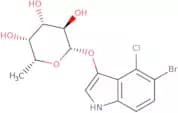
CAS:<p>5-Bromo-4-chloro-3-indolyl b-D-fucopyranoside is a chromogenic substrate used is for the enzyme beta-fucosidase.</p>Fórmula:C14H15BrClNO5Pureza:Min. 98 Area-%Forma y color:PowderPeso molecular:392.63 g/molAc-Abu-Tle-Leu-Gln-AMC TFA salt
<p>A fluorogenic substrate for detection of enzymatic activity of the SARS-CoV-2 Mpro protease. The fluorophore 7-Amino-4-methylcoumarin (AMC) is linked to the tetrapeptide via a peptide bond at the C-terminal of the glutamine residue. Following the hydrolytic activity of the Mpro protease, the fluorogenic AMC group get released from the substrate, generating a fluorescent signal (Ex 380 nm / Em 455 nm).</p>Fórmula:C33H48N6O8(freebase)Pureza:Min. 95.0 Area-%Peso molecular:656.77 g/mol6-Bromo-2-naphthyl b-D-glucopyranoside
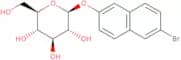
CAS:6-Bromo-2-naphthyl b-D-glucopyranoside is an enzyme substrate used in chromogenic assays with beta-glucosidases. It has been used in culture media for the identification of Legionella pneumophila.Fórmula:C16H17BrO6Pureza:Min. 98 Area-%Forma y color:PowderPeso molecular:385.21 g/mol4-Methylumbelliferyl 2-deoxy-2-sulfamino-a-D-glucopyranoside sodium salt - Moscerdam™ biochemical purity
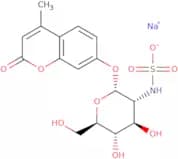
CAS:<p>4-Methylumbelliferyl 2-deoxy-2-sulfamino-a-D-glucopyranoside sodium salt (M3A or MU-GlcNS) is a fluorogenic substrate of heparin sulfamidase, used in the diagnosis of Mucopolysaccharidosis III type A (MPS III A). MPS III A, also known as Sanfilippo syndrome type A, is caused by the deficiency of heparan N-sulfatase. Heparin sulfamidase in the assay desulfates MU-GlcNS to 4-methylumbelliferyl 2-amino-2-deoxy-α-D-glucopyranoside (MU-GlcNH2). To release fluorometrically measurable 4-methylumbelliferone (MU) and by-product glucosamine, MU-GlcNH2 is further hydrolysed by an enzyme such as yeast α-glucosidase during a second incubation.</p>Fórmula:C16H18NO10SNaPureza:Min. 95 Area-%Forma y color:White PowderPeso molecular:439.37 g/mol4-Methylumbelliferyl a-D-glucosaminide
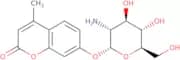
CAS:4-Methylumbelliferyl alpha-D-glucosaminide is a fluorogenic substrate for alpha-N-acetylglucosaminidase. After enzymatic cleaveage, free 4-methylumbelliferone (also known as hymecromone) is released, exhibiting blue fluorescence upon excitation with UV light. The strongest fluorescence of 4-methylumbelliferone requires deprotonation of the hydroxyl group (thus requires alkaline pH), with a maximal fluorescence intensity obtained with excitation at 350 to 370 nm and emission at 440 to 470 nm. The use of 4-methylumbelliferyl alpha-D-glucosaminideas a substrate for measuring the alpha-N-acetylglucosaminidase activity is used for Sanfilippo syndrome B and Mucopolysaccharidosis IIIB (MPS IIIB) diagnosis.Fórmula:C16H19NO7Pureza:Min. 90 Area-%Forma y color:White PowderPeso molecular:337.32 g/mol2-Nitrophenyl-beta-D-cellobioside
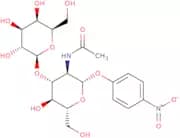
CAS:<p>Chromogenic substrate for β-D-Cellobiosidase yielding a yellow solution upon cleavage.</p>Fórmula:C18H25NO13Pureza:Min. 98.0 Area-%Peso molecular:463.4 g/mol4-Nitrophenyl 2-acetamido-2-deoxy-3-O-(b-D-galactopyranosyl)-b-D-glucopyranoside
CAS:Chromogenic substrate for fucosyltransferasesFórmula:C20H28N2O13Pureza:Min. 98 Area-%Forma y color:White PowderPeso molecular:504.44 g/mol5-Bromo-4-chloro-3-indoxyl oleate
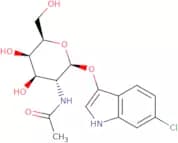
CAS:<p>5-Bromo-4-chloro-3-indoxyl oleate is a chromogenic substrate used to detect the specific enzymatic activity of lipase. After cleavage, 5-bromo-4-chloro-indoxyl is released, resulting in a blue to blue-green color change in bacterial colonies or media. 5-Bromo-4-chloro-3-indoxyl oleate is used in lipid metabolism disorder screening.</p>Fórmula:C26H37BrClNO2Pureza:Min. 95%Forma y color:PowderPeso molecular:510.93 g/mol6-Chloro-3-indolyl 2-acetamido-2-deoxy-b-D-galactopyranoside
CAS:<p>6-Chloro-3-indolyl 2-acetamido-2-deoxy-b-D-galactopyranoside is a chromogenic substrate for N-acetyl-beta-galactosaminidase. It produces a salmon-pink color after enzymatic cleavage.</p>Pureza:Min. 95%Forma y color:White PowderPeso molecular:370.78 g/mol5-Bromo-4-chloro-1-methyl-3-indolyl-β-D-glucopyranoside
CAS:5-Bromo-4-chloro-1-methyl-3-indolyl-β-D-glucopyranoside is a fluorescent substrate used for the detection of β-glucuronidase. It can be used in several enzyme substrates, such as 5,5'-dithiobis(2-nitrobenzoic acid), 5,5'-dithiobis(3,4,5,-trimethoxybenzoic acid), and 4-(p-[N-(7-(2,7'-dimethyl -2H -chromenyl)-2H -indazolium)]phenylazo)benzoic acid. This product is used for diagnostics and culture media as well as food testing. The product has an extremely high purity and a CAS number.Fórmula:C15H17BrClNO6Pureza:Min. 99.0 Area-%Peso molecular:422.66 g/mol4-Nitrophenyl decanoate
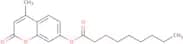
CAS:<p>4-Nitrophenyl decanoate is a chromogenic substrate for lipase. Upon hydrolysis, para-nitrophenol is released yielding a yellowish colour. 4-Nitrophenyl decanoate is used in different applications such as the Pancreatic insufficiency diagnosis, lipid metabolism studies</p>Fórmula:C16H23NO4Pureza:Min. 97 Area-%Forma y color:PowderPeso molecular:293.36 g/mol4-Methylumbelliferyl nonanoate
CAS:<p>4-Methylumbelliferyl nonanoate is a synthetic fluorogenic substrate for lipase. It is used to measure the activity of lipases in vitro. 4-Methylumbelliferyl nonanoate reacts with a lipid substrate, such as sodium taurocholate, to produce 4-methylumbelliferone and dodecanol. The fluorescent product can be detected by fluorimetric or spectrophotometric methods. This compound is activated by an enzyme preparation, such as proteolytic enzymes, and can be used to measure the activity of these enzymes in vitro.</p>Fórmula:C19H24O4Pureza:Min. 99 Area-%Peso molecular:316.40 g/molRUG ®, Resorufin-beta-D-glucuronic acid methyl ester, Biosynth Patent: EP 2718458 and US 9127303
CAS:<p>Living cells of Escherichia coli can be reliably detected with media that contain a chromogenic or fluorogenic substrate for beta-glucuronidase (also termed β-D-glucuronidase), an enzyme that occurs almost exclusively in E. coli. RUG®, Resorufin-beta-D-glucuronic acid methyl ester is a highly sensitive chromogenic and fluorogenic indicator for E. coli. After removal of the methyl ester group by unspecific hydrolysis, orange colored product is cleaved by beta-glucuronidase in liquid media or on agar plates and yields an intense pink color. Red fluorescence is obtained upon excitation at 560-570 nm.Formally ER175455.</p>Fórmula:C19H17NO9Pureza:Min. 90.0 Area-%Peso molecular:403.34 g/mol4-Methylumbelliferyl palmitate
CAS:<p>Fluorogenic substrate for esterase yielding a blue fluorescent solution upon cleavage.</p>Fórmula:C26H38O4Pureza:Min. 99 Area-%Peso molecular:414.59 g/molRef: 3D-M-5750
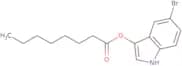
1gA consultar5gA consultar250mgA consultar500mgA consultar2500mgA consultar-Unit-ggA consultar5-Bromo-3-indoxyl caprylate
CAS:Also known as Lapis-caprylate; targeting esterase with C8 activity; Blue colorFórmula:C16H20BrNO2Pureza:Min. 98 Area-%Forma y color:PowderPeso molecular:338.24 g/mol