Sustratos de enzimas
Los sustratos enzimáticos son moléculas sobre las cuales actúan las enzimas para catalizar reacciones químicas. El sustrato se une al sitio activo de la enzima, donde sufre una transformación específica para formar el producto de la reacción. Los sustratos enzimáticos son herramientas esenciales en la investigación para estudiar la cinética enzimática, la especificidad y el mecanismo de acción. También se utilizan en ensayos diagnósticos y estudios bioquímicos. En CymitQuimica, ofrecemos una selección diversa de sustratos enzimáticos de alta calidad para apoyar su investigación en enzimología y bioquímica.
Subcategorías de "Sustratos de enzimas"
Se han encontrado 1529 productos de "Sustratos de enzimas"
Ordenar por
Pureza (%)
0
100
|
0
|
50
|
90
|
95
|
100
6-Bromo-2-naphthyl-α-D-galactopyranoside
CAS:6-Bromo-2-naphthyl-alpha-D-galactopyranoside is a bioluminescent substrate for the enzyme luciferase that has been shown to be useful in detection of phenazines, antibiotics and other compounds in environmental testing. 6-Bromo-2-naphthyl-alpha-D-galactopyranoside can also be used for measurements of total microbial counts and for the measurement of the activity of enzymes such as beta galactosidase. It is also a ligand for the peroxidase enzyme, which makes it useful in staining techniques. 6BARG can be used as a fluorogenic substrate or as an indicator in chromogenic substrates. It is an important reagent for chemiluminescence and can also be used to measure the concentration of various substances.Fórmula:C16H17BrO6Pureza:Min. 98 Area-%Peso molecular:385.22 g/mol3,4-Cyclohexenoesculetine phosphate disodium
<p>Please enquire for more information about 3,4-Cyclohexenoesculetine phosphate disodium including the price, delivery time and more detailed product information at the technical inquiry form on this page</p>5-Bromo-3-indoxyl nonanoate
CAS:<p>Chromogenic substrate for esterase with C9 activity yielding a lapis colored precipitate upon cleavage.</p>Fórmula:C17H22BrNO2Pureza:Min. 99 Area-%Peso molecular:352.28 g/mol5-Bromo-6-chloro-3-indoxyl choline phosphate
CAS:<p>Please enquire for more information about 5-Bromo-6-chloro-3-indoxyl choline phosphate including the price, delivery time and more detailed product information at the technical inquiry form on this page</p>Fórmula:C13H17BrClN2O4PPureza:Min. 99 Area-%Peso molecular:411.63 g/mol3,4-Cyclohexenoesculetine-N-acetyl-glucosamine
<p>Please enquire for more information about 3,4-Cyclohexenoesculetine-N-acetyl-glucosamine including the price, delivery time and more detailed product information at the technical inquiry form on this page</p>Bronze-Gal
<p>Bronze-Gal (Bronze-beta-D-galactopyranoside) is a chromogenic indicator for beta-galactosidase activity. The colorless product is cleaved by lactose-utilizing bacteria in liquid media or on agar plates and yields a bronze colored precipitate. Bronze-Gal can also be used as detecting agent for beta-galactosidase activity in reporter gene assays or for identification of positive transformants on agar plates when using the α-complementation approach. Read more in the Application Notes.</p>Peso molecular:443.57 g/mol6-Chloro-3-indoxyl butyrate
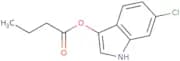
CAS:<p>6-Chloro-3-indoxyl butyrate is a chemiluminescent substrate that is used in diagnostics and research. It has been shown to be an excellent ligand for the detection of DNA and protein. 6-Chloro-3-indoxyl butyrate can also be used as a chromogenic substrate for the detection of alkaline phosphatase, acid phosphatase, or beta-galactosidase. This product is also used in food testing, enzyme substrates, and fluorogenic substrates.</p>Fórmula:C12H12ClNO2Pureza:Min. 99.0 Area-%Peso molecular:237.69 g/molAquaSpark® caprylate, 10 mM in DMSO, Ramot at Tel-Aviv University Ltd. Patent family WO 2017/130191
CAS:<p>Esterases and lipases enzymes are widespread in all living cells, serving as important players in energy metabolism and in the recycling of cellular components. In microbiology C8-esterase activity can be used to detect Salmonella strains and more specifically, it also allows to distinguish them from other enteric bacteria. Likewise, Pseudomonas species can be detected as these organisms produce extracellular lipases. AquaSpark™ caprylate is a dioxetane-based chemiluminescent substrate forC8-esterase (C8E) and lipase activity. Upon hydrolytic cleavage byC8-esterase or lipase, AquaSpark™ caprylate spontaneously emits a strong green light. AquaSpark™ caprylate (A-8167_P00) is the firstsingle-compound chemiluminescent substrate commercially available for highly sensitive esterase and lipase assays in vitro and in vivo. The AquaSpark™ probes are superior probes for research and diagnostic applications. They offer unique advantages as they can work as single agents, they have a higher efficiency and sensitivity, and they do not need expensive additive when used in water.</p>Fórmula:C36H43ClO8Peso molecular:639.18 g/molFLsharp™ - Phosphate, disodium salt
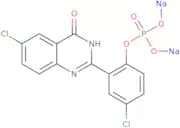
CAS:<p>FLsharp™ - Phosphate, disodium salt is a fluorogenic water soluble substrate for phosphatase enzymes. After cleavage of the substrate by phosphatase activity an insoluble product is formed that is highly fluorescent in the solid state. Upon UV irradiation this very stable fluorophore emits green light in the 530 nm range for an extended period of time. FLsharp™ - Phosphate is a unique substrate - optimized for the detection of phosphatase activity in solid matrices such as agar media, tissuesections or microscopic preparations. FLsharp™ - Phosphate, disodium salt is used in microbiology as asubstrate for bacterial phosphatases. The substrate is suitable to detect the specific phosphatase activity of S. aureus or C. perfringensin food samples or clinical samples. Colonies growing on plating media supplemented with FLsharp™ emit green light upon UV light excitation(Excitation max: 365 nm; emission max: 530 nm). The enzyme product formed from FLsharp™ in agar plating media enables high precision for the localization of the relevant colonies on the plate. As a result small bacteria colonies of phosphatase-positive bacteria can be detected already after a short incubation time. In cytochemical and histochemical imaging FLsharp™ - Phosphate, disodiumsalt can be used as a substrate for Alkaline Phosphatase (AP)-coupled antibodies. The fluorophore that is released from FLsharp™ - Phosphateby phosphatase activity will precipitate. This insoluble fluorophoreen ables a precise localization of the antibody-bound epitope in cells or tissues under a fluorescence microscope or fluorescence imaging system. The green fluorescence of FLsharp™ can be clearly differentiated from autofluorescence or counterstainings such as (blue) DAPI or (red) Alexafluorophores.</p>Fórmula:C14H7Cl2N2Na2O5PPureza:Min. 95.0 Area-%Peso molecular:431.08 g/mol4-(Hydroxymethyl)phenyl-α-D-galactopyranoside tetraacetate
CAS:4-(Hydroxymethyl)phenyl-alpha-D-galactopyranoside tetraacetate is a substrate for enzymes that catalyze the hydroxylation of carbohydrates. It can be used as a substrate for peroxidase and beta-glucosidase, which are important in the production of natural products such as resveratrol, catechins, and lignin. 4-(Hydroxymethyl)phenyl-alpha-D-galactopyranoside tetraacetate is also a chromogenic substrate for chemiluminescence reactions. The product is available as a powder and can be used in diagnostic kits to detect the presence of enzymes or other substances in food or environmental samples.Fórmula:C21H26O11Peso molecular:454.43 g/mol5-Bromo-3-indoxyl caprylate
CAS:<p>5-Bromo-3-indoxyl caprylate is a fluorogenic substrate that can be used for the detection of β-galactosidase. It is an enzyme substrate that can be used to measure β-galactosidase activity in cell culture media. It has a high purity and high quality. 5-Bromo-3-indoxyl caprylate is also used as a chromogenic substrate for the detection of β-galactosidase. This product has a CAS number of 133950-69-3.</p>Fórmula:C16H20BrNO2Pureza:Min. 99 Area-%Peso molecular:338.24 g/molAc-DEVD-6-amino-D-luciferin
<p>Ac-DEVD-6-amino-D-luciferin is a bioluminescence substrate for protease enzymes (eg caspase-3 protease).</p>Fórmula:C31H37N7O13S2Pureza:Min. 95%Forma y color:PowderPeso molecular:779.79 g/molAquaSpark® H2S probe, TFA salt, Ramot at Tel-Aviv University Ltd. Patent family WO 2017/130191
<p>AquaSpark® H2S probe is a chemiluminescent probe for the detection of hydrogen sulfide (H2S), with excellent selectivity for sulfide over thiols. The AquaSpark® H2S probe is ~760-fold more selective for Na2S than to L-cysteine, and ~380-fold more selective for Na2S than for glutathione. AquaSpark® H2S probe was used in a study identifying antibiotic-resistant bacterial strains by detecting the beta-lactamase-driven hydrolysis of beta-lactam antibiotics, where hydrogen sulfide is a biodegradation metabolite (Popat Gholap et al, 2021).</p>Fórmula:C35H31ClF3NO9SSePureza:Min. 85 Area-%Peso molecular:813.1 g/mol3-Indoxyl choline phosphate
CAS:<p>Please enquire for more information about 3-Indoxyl choline phosphate including the price, delivery time and more detailed product information at the technical inquiry form on this page</p>Fórmula:C13H19N2O4PPureza:Min. 99 Area-%Peso molecular:298.28 g/molRef: 3D-I-5696
1gA consultar5gA consultar10gA consultar500mgA consultar2500mgA consultar-Unit-ggA consultarAquaSpark® 510 acetate, 10 mM in DMSO, Ramot at Tel-Aviv University Ltd. Patent family WO 2017/130191
CAS:<p>AquaSpark® 510 acetate is a dioxetane-based luminogenic substrate for C2-esterase (acetyl esterase) activity. Upon hydrolytic cleavage by the enzyme AquaSpark® 510 acetate spontaneously emits green light. Esterases occur in all domains of life and fulfill important tasks in energy metabolism and recycling of cellular components. In microbiology C2-esterase activity can be used to detect specific microorganisms such as Bacillus cereus, Pseudomonas aeruginosa, Campylobacter jejuni and Candida albicans.</p>Fórmula:C30H31ClO8Peso molecular:554.17 g/mol5-Bromo-4-chloro-3-indoxyl-beta-D-galactopyranoside
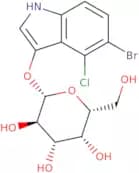
CAS:<p>X-Gal is a chromogenic substrate for β-galactosidase, yielding a blue precipitate. X-Gal is an indicator for coliforms in culture media, as well as for the detection of coliforms (E. coli) in municipal water supplies and food products. X-Gal can be used in conjunction with the inducer IPTG, which binds and inhibits the lac repressor thus inducing β-galactosidase expression. X-Gal is the substrate of choice for blue-white selection of recombinant bacterial colonies with the lac+ genotype.<br>Upon hydrolysis, X-Gal yields a localized, insoluble, blue precipitate, making it exceptionally useful in blotting, immunocytochemical, and ELISA assays. 5-Bromo-4-chloro-3-indoxyl-beta-D-galactopyranoside (X-beta-D-galactoside, X-Gal) is a chromogenic indicator for beta-galactosidase activity. The colorless product is cleaved by lactose-utilizing bacteria in liquid media or on agar plates and yields a blue-green colored precipitate.<br>X-Gal can also be used as a detecting agent for beta-galactosidase activity in reporter gene assays or for identification of positive transformants on agar plates when using the &alpha;-complementation approach. Color formation is due to dimerization and oxidation of 5-bromo-4-chloro-3-hydroxyindole which results from enzymatic cleavage of X-Gal. The reaction proceeds only in the presence of oxygen, i.e. in aerobic cultures. Well detectable color bacterial colonies or liquid cultures is obtained within 16-48 h. In the presence of purified beta-galactosidase, color develops within minutes to a few hours.</p>Fórmula:C14H15BrClNO6Pureza:Min. 99.0 Area-%Peso molecular:408.64 g/molAquaSpark® β-D-galactoside, 10 mM in DMSO, Ramot at Tel-Aviv University Ltd. Patent family WO 2017/130191
CAS:AquaSpark™ β-D-galactoside is a dioxetane-based luminogenic substrate for β-galactosidase activity. β-galactosidase assays are frequently used in molecular biology as reporter gene assays. AquaSpark™beta-D-galactoside can be used to replace X-gal (Cymit Quimica Cat. No.B-7150) that is frequently used in genetically modified bacteria, in the yeast two-hybrid system, or in mouse models to indicate lacZ gene activity. Furthermore, native β-galactosidase activity can be used to detect coliform bacteria, which is important in microbial diagnostics and hygiene monitoring.Fórmula:C34H39ClO12Peso molecular:675.12 g/molAquaSpark® 510 Calibration Probe, Ramot at Tel-Aviv University Ltd. Patent family WO 2017/130191
CAS:<p>AquaSpark® Calibration Probe is a water-soluble dioxetane-based chemiluminescent probe. Deprotonation of the free phenol group of the calibration probe under mild basic conditions results in an emissive decomposition process. No addition of enhancer or sensitizing agent is required to produce the bright green light emission in aqueous solutions.<br>AquaSpark® Calibration Probe is used for:</p>Fórmula:C21H23ClO6Pureza:Min. 95.0 Area-%Peso molecular:406.12 g/mol5-Bromo-4-chloro-3-indoxyl choline phosphate
CAS:<p>5-Bromo-4-chloro-3-indoxyl choline phosphate is a synthetic enzyme substrate for detecting phosphatidylcholine-specific phospholipase C.</p>Fórmula:C13H17BrClN2O4PPureza:Min. 99 Area-%Peso molecular:411.63 g/mol6-Chloro-3-indoxyl-α-D-mannopyranoside
CAS:Chromogenic substrate for α-mannosidase yielding a salmon colored precipitate upon cleavage.Fórmula:C14H16ClNO6Pureza:Min. 98.0 Area-%Peso molecular:329.74 g/mol