


Sustratos de enzimas
Los sustratos enzimáticos son moléculas sobre las cuales actúan las enzimas para catalizar reacciones químicas. El sustrato se une al sitio activo de la enzima, donde sufre una transformación específica para formar el producto de la reacción. Los sustratos enzimáticos son herramientas esenciales en la investigación para estudiar la cinética enzimática, la especificidad y el mecanismo de acción. También se utilizan en ensayos diagnósticos y estudios bioquímicos. En CymitQuimica, ofrecemos una selección diversa de sustratos enzimáticos de alta calidad para apoyar su investigación en enzimología y bioquímica.
Subcategorías de "Sustratos de enzimas"
Se han encontrado 1527 productos de "Sustratos de enzimas"
Ordenar por
Pureza (%)
0
100
|
0
|
50
|
90
|
95
|
100
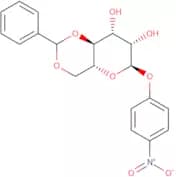
4-Nitrophenyl 4,6-O-benzylidene-a-D-mannopyranoside
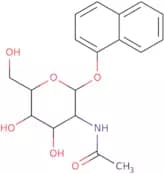
CAS:<p>4-Nitrophenyl 4,6-O-benzylidene-a-D-mannopyranoside is a chromogenic substrate for alpha-mannosidase and beta-glucosidase. It is used as a diagnostic tool for identifying the presence of these enzymes in certain bacteria. This product is also used in food testing, environmental testing, and bioluminescence.</p>Pureza:Min. 95%Peso molecular:389.36 g/mol1-Naphthyl 2-acetamido-2-deoxy-b-D-galactopyranoside
CAS:<p>1-Naphthyl 2-acetamido-2-deoxy-b-D-galactopyranoside (1NADG) is a fluorogenic substrate that reacts with an enzyme to produce light. It is used in diagnostic tests for the detection of bacteria, and can be used as a chromogenic substrate in biochemical assays. 1NADG has also been shown to be useful in staining bacterial cells grown on agar plates. Additionally, this compound is used as a bioluminescent probe for detecting bacteria with luciferase activity.<br>br>br></p>Pureza:Min. 95%Peso molecular:347.4 g/molAldol® 518 β-D-cellobioside, Biosynth Patent: EP 2427431 and US 8940909
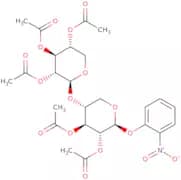
CAS:<p>Aldol® 518 beta-D-cellobioside is a chromogenic substrate for the detection of glycosidases. Aldol® 518 beta-D-cellobioside reacts with enzymes such as alpha-amylase, beta-galactosidase, and alpha-glucosidase to produce a fluorescent product. This product is detected by spectrophotometer, fluorometer, or luminometer. The fluorescence intensity is proportional to the concentration of the enzyme in the sample.<br>It has been shown that Aldol® 518 beta-D-cellobioside can be used as a substitute for conventional substrates in food testing and diagnostics, such as staining and culture media. It also has applications in environmental testing and enzyme substrate assays.</p>Fórmula:C35H39ClN2O12Pureza:Min. 95 Area-%Peso molecular:715.15 g/mol2-Nitrophenyl 2,2',3,3',4'-penta-O-acetyl-b-D-xylobioside
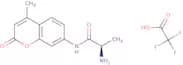
CAS:<p>2-Nitrophenyl 2,2',3,3',4'-penta-O-acetyl-b-D-xylobioside is an oligosaccharide that is used as a substrate for the transport of nucleic acid molecules. It can be used to study the function of membrane transport proteins and their homologues. This compound has been shown to inhibit the growth of corynebacterium glutamicum and trisaccharide emissions.</p>Pureza:Min. 95%Peso molecular:613.52 g/molD-Alanine 7-amido-4-methylcoumarin trifluoroacetate salt
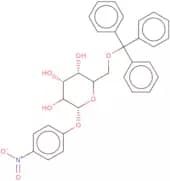
CAS:<p>D-Alanine 7-amido-4-methylcoumarin trifluoroacetate salt is a chromogenic substrate for the enzyme Beta-galactosidase. It is used as a diagnostic tool in the detection of certain bacteria, such as Enterobacteriaceae and Clostridium perfringens. It can also be used to detect the presence of beta galactosidase in food products and environmental samples. D-Alanine 7-amido-4-methylcoumarin trifluoroacetate salt has an applications in chemiluminescence, bioluminescence, and fluorescence. This product is not intended for use as a drug or food additive.</p>Fórmula:C15H15F3N2O5Pureza:Min. 95%Forma y color:White/Off-White SolidPeso molecular:360.29 g/mol4-Nitrophenyl 6-O-trityl-a-D-glucopyranoside
CAS:<p>4-Nitrophenyl 6-O-trityl-a-D-glucopyranoside is a high-quality trityl pNP substrate that performs excellently in various enzymatic assays. Containing a trityl-protected sugar moiety, this substrate is perfect for investigating alpha-D-glucopyranoside-specific enzymes and providing precise data for your experiments.</p>Pureza:Min. 95%Peso molecular:543.56 g/mol4-Methylumbelliferyl 2,3,6-tri-O-benzoyl-b-D-galactopyranoside
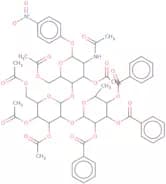
CAS:<p>4-Methylumbelliferyl 2,3,6-tri-O-benzoyl-b-D-galactopyranoside is a fluorogenic substrate that can be used in food testing. This compound is also a chromogenic substrate that can be used for environmental testing. This product is a ligand and chemiluminescent reagent that can be used in diagnostics. It is also an enzyme substrate that has high purity and high quality.</p>Pureza:Min. 95%Peso molecular:650.63 g/mol4-Nitrophenyl 2-acetamido-3,6-di-O-acetyl-4-O-[2-O-(2,3,4-tri-O-benzoyl-a-L-fucopyranosyl)-3,4,6-tri-O-acetyl-b-D-galactopyranosyl]- 2-deoxy-b-D-glucopyranoside
<p>This chemical is a ligand that can bind to the enzyme luciferase. In a bioluminescence reaction, this chemical reacts with oxygen and ATP to produce light. This product has been tested for purity and quality and is suitable for use in culture media, environmental testing, or diagnostics. It has also been shown to be an excellent fluorescent substrate for fluorogenic or chromogenic substrates in enzyme substrate assays.</p>Pureza:Min. 95%Peso molecular:1,173.08 g/mol4-Nitrophenyl b-D-glucuronide sodium salt
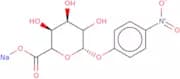
CAS:<p>4-Nitrophenyl b-D-glucuronide sodium salt is a high-quality chromogenic substrate specifically designed for the colorimetric detection and measurement of β-glucuronidase activity. Upon enzymatic cleavage, it releases the yellow 4-nitrophenol, enabling quantitative analysis via spectroscopy. This compound is conveniently provided as a sodium salt to ensure enhanced solubility, stability, and shelf life. It is an ideal choice for biochemical, research, and diagnostic applications requiring a reliable and efficient b-D-glucuronide substrate.</p>Pureza:Min. 95%Peso molecular:337.21 g/molD-Alanine 7-amido-4-methylcoumarin free base
CAS:<p>D-Alanine 7-amido-4-methylcoumarin free base is a chromogenic substrate that is used in diagnostic testing. It is used to identify the presence of beta-lactamase, which catalyzes the hydrolysis of penicillin and cephalosporin antibiotics, by turning the substrate into a bright blue color. D-Alanine 7-amido-4-methylcoumarin free base can also be used as a fluorescent substrate for bioluminescence or chemiluminescence reactions. This product is high quality and has CAS number 201847-51-0.</p>Fórmula:C13H14N2O3Pureza:Min. 95%Peso molecular:246.26 g/mol5-Bromo-3-indoxyl-β-D-galactopyranoside-6-sulfate sodium salt
CAS:<p>5-Bromo-3-indoxyl-beta-D-galactopyranoside (5BIG) is a fluorogenic substrate that has been shown to be an effective enzyme substrate. It is used in the chemiluminescence, bioluminescence, and fluorescence detection of enzymes. 5BIG is also a chromogenic substrate for nucleic acid staining and can be used in food testing as well as diagnostics. 5BIG is highly pure and high quality with a CAS number of 1301706-59-1.</p>Fórmula:C14H15BrNNaO9SPureza:Min. 98 Area-%Peso molecular:476.24 g/mol3-Carboxyumbelliferyl b-D-galactoside BSA conjugate
<p>3-Carboxyumbelliferyl b-D-galactoside BSA conjugate is a fluorogenic substrate that is used in chemiluminescent enzyme assays. The reaction of this compound with the enzyme β-galactosidase leads to an increase in the intensity of light emitted by the compound, which can be measured using a luminometer. This product is often used in diagnostics, such as food testing and environmental testing, as well as high quality research.</p>Pureza:Min. 95%4-Nitrophenyl 2,3,4,6-tetra-O-acetyl-b-D-thiogalactopyranoside
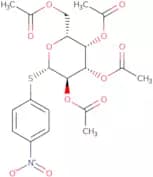
CAS:<p>4-Nitrophenyl 2,3,4,6-tetra-O-acetyl-b-D-thiogalactopyranoside (NPG) is a fluorogenic substrate that can be used in the detection of beta-galactosidase activity. It reacts with 4-nitrophenol to form an orange product at pH 6.0. The fluorescence intensity increases with increasing concentrations of the substrate and enzyme. The reaction is inhibited by borax, which competes for the enzyme active site. This product has been used as a chromogenic substrate for beta-galactosidase and as an enzyme substrate for beta-galactosidase in diagnostic tests for galactosemia and other carbohydrate metabolism disorders. NPG has also been used in chemiluminescent assays to detect beta-galactosidase activity in culture media and as a bioluminescence substrate in the detection of bacterial</p>Pureza:Min. 95%Peso molecular:485.47 g/molNaphthol AS-BI b-D-glucopyranoside
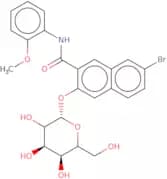
CAS:<p>Naphthol AS-BI b-D-glucopyranoside is a substrate for enzymes such as β-glucosidase and β-glycosidase. It has been used in diagnostic tests to detect the presence of amylase, lipase, α-amylase, or maltase in urine and feces. In biochemistry, naphthol AS-BI b-D-glucopyranoside is often used as a chromogenic or fluorogenic substrate for the detection of β-galactosidases and other glycosidases. This product has also been used in the detection of bacteria in culture media. Naphthol AS-BI b-D-glucopyranoside is a high quality reagent that can be used for chemiluminescence experiments, food testing, and environmental testing.</p>Pureza:Min. 95%Peso molecular:534.35 g/molN-(4,4-Difluoro-5,7-dimethyl-4-bora-3a,4a-diaza-s-indacene-3-dodecanoyl)sphingosyl 1-b-D-galactopyranoside
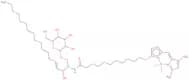
<p>N-(4,4-Difluoro-5,7-dimethyl-4-bora-3a,4a-diaza-s-indacene-3-dodecanoyl)sphingosyl 1bDgalactopyranoside is a fluorescent reagent. It has been used to detect the presence of boron in biological samples and as a substrate for enzymes. This product is also used in the diagnosis of tuberculosis and other bacterial infections. N-(4,4-Difluoro-5,7-dimethyl-4bora3a,4adiazasindacene 3dodecanoyl)sphingosyl 1bDgalactopyranoside is not intended for use in humans or animals and should be handled with care. This product is not available for sale in the state of California.</p>Pureza:Min. 95%Peso molecular:861.95 g/molN-Benzoyl-Val-Gly-Arg p-nitroanilide hydrochloride
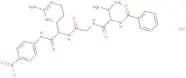
CAS:<p>N-Benzoyl-Val-Gly-Arg p-nitroanilide hydrochloride is a fluorogenic substrate that can be used for the detection of β-glucuronidase. It has been shown to have high purity and quality, which makes it an excellent choice for use in food testing and staining.</p>Fórmula:C26H34N8O6•HClPureza:Min. 95%Peso molecular:591.06 g/mol4-Methylumbelliferyl 2,3,4-tri-O-benzoyl-b-D-galactopyranoside-6-sulfate
<p>4-Methylumbelliferyl 2,3,4-tri-O-benzoyl-b-D-galactopyranoside-6-sulfate is a fluorogenic substrate for β-galactosidase and a chromogenic substrate for β-glucuronidase. It is used in food testing, environmental testing, and diagnostics.</p>Pureza:Min. 95%Peso molecular:730.69 g/molPhenytoin sodium
CAS:Producto controlado<p>Please enquire for more information about Phenytoin sodium including the price, delivery time and more detailed product information at the technical inquiry form on this page</p>Fórmula:C15H11N2O2NaPeso molecular:274.25 g/mol5-Bromo-6-chloro-3-indoxyl choline phosphate
CAS:<p>5-Bromo-6-chloro-3-indoxyl choline phosphate is a chemiluminescent substrate for the detection of bacterial activity. It reacts with an enzyme, luciferase, which is present in a variety of living cells. The reaction produces light. This product has been tested for environmental and food safety by the manufacturer. 5-Bromo-6-chloro-3-indoxyl choline phosphate is used as a diagnostic tool to determine the presence of bacteria in humans, animals, and plants. It can be used to measure levels of bacteria in culture media, water samples, and food products. 5-Bromo-6-chloro-3-indoxyl choline phosphate can also be used as a substrate for enzymes such as phosphatases or esterases that catalyze reactions with substrates with brominated or chlorinated groups.</p>Fórmula:C13H17BrClN2O4PPureza:Min. 95%Peso molecular:411.63 g/mol4-Nitrophenyl 2,3,4-tri-O-acetyl-6-O-(2,3,4,6-tetra-O-[4-methoxybenzyl]-a-D-glucopyranosyl)-a-D-glucopyranoside
<p>Introducing our 4-Nitrophenyl 2,3,4-tri-O-acetyl-6-O-(2,3,4,6-tetra-O-[4-methoxybenzyl]-a-D-glucopyranosyl)-a-D-glucopyranoside, an advanced chromogenic pNP enzyme substrate designed for high performance and superior results. This cutting-edge substrate ensures excellent outcomes in various enzymatic assays, including glycosidase and glycosyltransferase, due to its unique composition and significant sensitivity. Offering rapid color development and clear visualization, this substrate is perfect for research or industrial applications.</p>Pureza:Min. 95%Peso molecular:1,126.03 g/mol






![4-Nitrophenyl 2,3,4-tri-O-acetyl-6-O-(2,3,4,6-tetra-O-[4-methoxybenzyl]-a-D-glucopyranosyl)-a-D-gl…](/_next/image/?url=https%3A%2Fstatic.cymitquimica.com%2Fproducts%2F3D%2Fthumb-webp%2FEN04817.webp&w=3840&q=75)