Sustratos de enzimas
Los sustratos enzimáticos son moléculas sobre las cuales actúan las enzimas para catalizar reacciones químicas. El sustrato se une al sitio activo de la enzima, donde sufre una transformación específica para formar el producto de la reacción. Los sustratos enzimáticos son herramientas esenciales en la investigación para estudiar la cinética enzimática, la especificidad y el mecanismo de acción. También se utilizan en ensayos diagnósticos y estudios bioquímicos. En CymitQuimica, ofrecemos una selección diversa de sustratos enzimáticos de alta calidad para apoyar su investigación en enzimología y bioquímica.
Subcategorías de "Sustratos de enzimas"
Se han encontrado 1527 productos de "Sustratos de enzimas"
Ordenar por
Pureza (%)
0
100
|
0
|
50
|
90
|
95
|
100
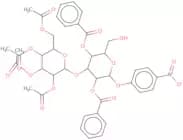
4-Nitrophenyl 3-O-(2,3,4,6-tetra-O-acetyl-a-D-mannopyranosyl)-2,4-di-O-benzoyl-b-D-mannopyranoside
CAS:<p>4-Nitrophenyl 3-O-(2,3,4,6-tetra-O-acetyl-a-D-mannopyranosyl)-2,4-di-O-benzoyl-b-D-mannopyranoside is a bioactive metabolite that can be found in the gene expression profile of a human genome. It has been shown to have an effect on gene expression levels and cellular function. This metabolite is found in the environment and has been shown to be mediated by environmental factors. The high level of gene expression has been shown to be due to its ability to bind to DNA.</p>Pureza:Min. 95%Peso molecular:839.75 g/mol4-Nitrophenyl hepta-O-acetyl-b-lactoside
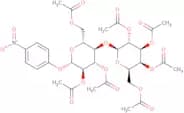
CAS:<p>4-Nitrophenyl hepta-O-acetyl-b-lactoside is a high-quality chromogenic pNP enzyme substrate that exhibits excellent sensitivity and specificity in enzyme assays. This synthetic compound is designed to react with β-galactosidase enzymes, generating a yellow product (4-nitrophenol) upon cleavage. The resulting color change allows for quantitative measurement of enzyme activity, providing valuable insights in various research applications including enzyme kinetics, screening of inhibitors, drug discovery, and molecular diagnostics. Our product ensures consistent results with minimal interference, making it a reliable choice for a wide range of biochemical applications.</p>Pureza:Min. 95%Peso molecular:757.65 g/mol4-Nitrophenyl 2-O-(a-L-fucopyranosyl)-a-D-galactopyranoside
CAS:<p>4-Nitrophenyl 2-O-(a-L-fucopyranosyl)-a-D-galactopyranoside is a chromogenic pNP enzyme substrate consisting of a fucose and galactose moieties. Upon enzymatic hydrolysis by specific fucosidases or galactosidases, it releases the highly chromogenic molecule 4-nitrophenol, which exhibits a distinct yellow color that can be monitored spectrophotometrically. This substrate is frequently used to study enzyme specificity, kinetics, and inhibition, and it plays a critical role in the investigation of carbohydrate active enzymes (CAZymes), the screening of enzyme inhibitors, and the development of novel analytical methods for the detection and quantitation of enzyme activities.</p>Pureza:Min. 95%Peso molecular:447.39 g/mol5-Bromo-4-chloro-3-indolyl b-D-galactopyranoside-6-sulphate
CAS:<p>5-Bromo-4-chloro-3-indolyl b-D-galactopyranoside 6-sulphate (BCIGS) is a chemiluminescent substrate that reacts with an enzyme to produce light. It has been used for the detection of various substances, including 5'-nucleotidase, 5'-adenosine monophosphate phosphohydrolases, and alkaline phosphatase. BCIGS can be used as a chromogenic substrate in the fluorometric assay of glucose oxidase and galactose oxidase. BCIGS is also used as a ligand in immunological reactions such as immunodiffusion, immunoelectrophoresis, and radioimmunoassay.</p>Fórmula:C14H15BrClNO9SPureza:Min. 95%Peso molecular:488.69 g/molLuc-phosphate Na enhanced
<p>Luc-phosphate Na enhanced is a chemiluminescent substrate that is used to detect the presence of an enzyme or a protein. This substrate is formed by the combination of luciferin and phosphate, which react with each other to produce light. Luc-phosphate Na enhanced is stable in solution and can be stored at room temperature for up to three months. It has been shown to be particularly effective in detecting the presence of DNAase, an enzyme that breaks down DNA. Luc-phosphate Na enhanced has also been used as a fluorogenic substrate in diagnostics, chromogenic substrate in enzymatic reactions, and conjugate for food testing.</p>Pureza:Min. 95%rac-7-(3',4'-Dihydroxybutyloxy)coumarin-4'-phosphate disodium salt
CAS:<p>This Clips-O substrate rac-7-(3',4'-Dihydroxybutyloxy)coumarin-4'-phosphate allows the detection of single and dual enzymatic activity (phosphatase and oxidation of 4-amino-3-hydroxybutyloxy spacer either enzymatically or by exposure to sodium periodate) with a single substrate resulting in a fluorescent signal. The main virtues of Clips-O substrates are an increased stability towards non-enzymatic hydrolysis that results in a reduced background and high sensitivity.</p>Fórmula:C13H13Na2O8PPureza:Min. 95%Forma y color:PowderPeso molecular:374.2 g/mol4-Nitrophenyl D-maltopentaoside
CAS:<p>Chromogenic substrate targeting amylase and maltase</p>Fórmula:C36H55NO28Pureza:Min. 95%Peso molecular:949.81 g/mol6-Amino-D-luciferin
CAS:<p>Substrate for synthesis of proluminescent bioconjugates</p>Fórmula:C11H9N3O2S2Pureza:Min. 95%Forma y color:Clear LiquidPeso molecular:279.34 g/molButyl 4-nitrophenyl hexyl phosphonate
CAS:<p>Butyl 4-nitrophenyl hexyl phosphonate is a lipase suicide inhibitor that is a chromogenic substrate for lipases which upon enzymatic action, binds irreversibly to the lipase and inactivates it. The substrate can be used for the determination of active sites in lipases, especially in lipases preferring long chain leaving groups.</p>Pureza:Min. 95%Peso molecular:343.364-Nitrophenyl 2-O-(2,3,4,6-tri-O-acetyl-a-D-mannopyranosyl)-4,6-O-benzylidene-a-D-mannopyranoside
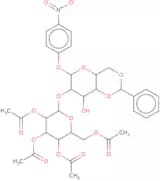
<p>4-Nitrophenyl 2-O-(2,3,4,6-tri-O-acetyl-a-D-mannopyranosyl)-4,6-O-benzylidene-a-D-mannopyranoside is a fluorogenic substrate that is used for the detection of alpha amylase activity in food testing. It is also used as a chromogenic substrate for the detection of beta amylase activity. 4NP2ODM is a conjugate that can be used for the detection of alpha or beta amylases in environmental testing. This compound has high purity and quality and CAS No. 90105037.</p>Pureza:Min. 95%Peso molecular:719.64 g/mol4-Methylumbelliferyl N-acetyl-4,7,8,9-tetra-O-acetyl-a-D-neuraminic acid methyl ester
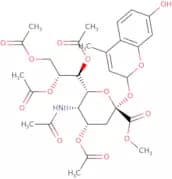
CAS:<p>4-Methylumbelliferyl N-acetyl-4,7,8,9-tetra-O-acetyl-a-D-neuraminic acid methyl ester (4MU) is a chemiluminescence substrate. It is used in the detection of an enzyme involved in the synthesis of glycoproteins and glycolipids. The enzyme conjugates 4MU with a sugar molecule to form a fluorescent product. This product can be detected by its emission of light at 560 nm when illuminated with light at 450 nm.</p>Pureza:Min. 95%Peso molecular:649.6 g/mol[2-Methoxy-4-(2-nitrovinyl)phenyl] b-D-galactopyranoside
CAS:<p>[2-Methoxy-4-(2-nitrovinyl)phenyl] b-D-galactopyranoside (MNVP-gal) is a chromogenic enzyme substrate that is commonly used to detect the activity of beta-galactosidase in biological samples. MNVP-gal produces a distinctive magenta color when hydrolyzed by beta-galactosidase, making it particularly useful for applications where visual detection is necessary. This substrate is also resistant to endogenous proteases, making it well-suited for use in cellular and tissue preparations.</p>Pureza:Min. 95%Peso molecular:357.31 g/mol4-Nitrophenyl 2-acetamido-3,6-di-O-acetyl-2-deoxy-b-D-glucopyranoside
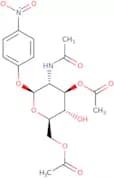
CAS:<p>4-Nitrophenyl 2-acetamido-3,6-di-O-acetyl-2-deoxy-b-D-glucopyranoside is a versatile chromogenic pNP enzyme substrate designed to offer superior results for detecting enzyme activity in research and diagnostic applications. This substrate enables faster, more accurate, and reliable detection of hydrolase enzymes, making it ideal for various research and testing needs, such as studying enzyme kinetics, screening inhibitors, and profiling enzyme specificity.</p>Pureza:Min. 95%Peso molecular:426.37 g/mol4-Nitrophenyl O-(N-acetyl-a-neuraminosyl)-(2-3)-b-D-galactopyranosyl-(1-4)-2-acetamido-2-deoxy-b-D-glucopyranoside
CAS:<p>4-Nitrophenyl O-(N-acetyl-a-neuraminosyl)-(2-3)-b-D-galactopyranosyl-(1-4)-2-acetamido-2-deoxybDglucopyranoside is a fluorescent compound that has been used as a substrate in enzyme assays. It has been shown to be an effective ligand for the enzyme beta galactosidase, which hydrolyzes the substrate to produce 4nitrophenol and o-(Nacetyl)a-neuraminic acid. This product is CAS No. 501427-92-5 and can be used as a high purity, high quality reagent for conjugation.</p>Pureza:Min. 95%Peso molecular:795.7 g/mol4-Methyl-2-nitrophenyl b-D-galactopyranoside
<p>4-Methyl-2-nitrophenyl b-D-galactopyranoside is a fluorogenic substrate for β-galactosidase. It has a high purity and is of high quality. 4-Methyl-2-nitrophenyl b-D-galactopyranoside is used as an enzyme substrate in diagnostics, as a chromogenic substrate in staining, and as a conjugate in chemiluminescence. It can be used for the detection of β-galactosidase in culture media and for the detection of β-galactosidase in environmental testing. This chemical also has bioluminescent properties that make it useful for food testing.</p>Pureza:Min. 95%Peso molecular:315.28 g/molDnp-pyaywmr trifluoroacetate
CAS:<p>Dnp-pyaywmr trifluoroacetate is a fluorogenic substrate that can be used in the detection of enzymes. It has a CAS number of 135662-06-5 and an EC number of 231-610-7. This chemical is not intended for human or animal use, but it can be used to detect the presence of specific enzymes in food testing, environmental testing, and diagnostics. Dnp-pyaywmr trifluoroacetate is also used as a ligand for fluorescent probes. Chemiluminescence and bioluminescence are two forms of light emission that can occur when this chemical is added to a solution containing a living cell.</p>Fórmula:C56H66F3N13O16SPureza:Min. 95%Peso molecular:1,266.3 g/mol4-Methylumbelliferyl b-L-arabinopyranoside
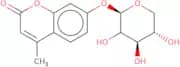
<p>4-Methylumbelliferyl b-L-arabinopyranoside is a chemiluminescent substrate that is used in the detection of various enzymes and other proteins. It can be used as a fluorogenic substrate, chromogenic substrate, or enzyme substrate. 4-Methylumbelliferyl b-L-arabinopyranoside has been shown to be an effective probe for detecting catalase, cytochrome c oxidase, and peroxidase activity. This product also has applications in diagnostics and food testing.</p>Pureza:Min. 95%Peso molecular:308.28 g/molN-(12-Aminododecyl)-1-deoxynojirimycin dihydrochloride
CAS:<p>N-(12-Aminododecyl)-1-deoxynojirimycin dihydrochloride is a human 12-aminododecanoic acid derivative of the antibiotic najomycin. It has been shown to have an inhibitory effect on the growth of bacteria and fungi, but its exact mechanism of action is unknown. N-(12-Aminododecyl)-1-deoxynojirimycin dihydrochloride can be used as a reagent in the study of polypeptides and other biological molecules. This compound also has potential applications in the diagnosis, prevention, or treatment of human diseases such as cancer, bacterial infections, or fungal infections.</p>Fórmula:C18H38N2O4·2HClPureza:Min. 95%Forma y color:Yellow SolidPeso molecular:419.43 g/mol4-Nitrophenyl 2-O-(2,3,4-tri-O-acetyl-b-L-fucopyranosyl)-6-O-benzoyl-a-D-galactopyranoside
CAS:<p>4-Nitrophenyl 2-O-(2,3,4-tri-O-acetyl-b-L-fucopyranosyl)-6-O-benzoyl-a-D-galactopyranoside is a chemiluminescent substrate with a CAS number of 104341548. It is used as a fluorescent probe for the detection of alpha amylase, beta amylase and glucose oxidase. It can be used to detect bacteria in food. This substrate can be used in the diagnostic industry and is an important component for the production of various enzymes.</p>Pureza:Min. 95%Peso molecular:677.61 g/mol2,4-Dinitrophenyl b-L-arabinofuranoside
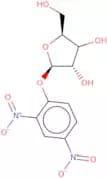
<p>2,4-Dinitrophenyl b-L-arabinofuranoside is a high quality chromogenic substrate for dinitrophenylase. It is a ligand that reacts with an enzyme to form a product that can be detected by various methods, including colorimetry and fluorimetry. 2,4-Dinitrophenyl b-L-arabinofuranoside has shown to be useful for the detection of organic contaminants in water and air. 2,4-Dinitrophenyl b-L-arabinofuranoside is also used as a reagent for the preparation of conjugates for immunoassays.</p>Pureza:Min. 95%Peso molecular:628.54 g/mol






![[2-Methoxy-4-(2-nitrovinyl)phenyl] b-D-galactopyranoside](/_next/image/?url=https%3A%2Fstatic.cymitquimica.com%2Fproducts%2F3D%2Fthumb-webp%2FEM06779.webp&w=3840&q=75)