


Sustratos de enzimas
Los sustratos enzimáticos son moléculas sobre las cuales actúan las enzimas para catalizar reacciones químicas. El sustrato se une al sitio activo de la enzima, donde sufre una transformación específica para formar el producto de la reacción. Los sustratos enzimáticos son herramientas esenciales en la investigación para estudiar la cinética enzimática, la especificidad y el mecanismo de acción. También se utilizan en ensayos diagnósticos y estudios bioquímicos. En CymitQuimica, ofrecemos una selección diversa de sustratos enzimáticos de alta calidad para apoyar su investigación en enzimología y bioquímica.
Subcategorías de "Sustratos de enzimas"
Se han encontrado 1527 productos de "Sustratos de enzimas"
Ordenar por
Pureza (%)
0
100
|
0
|
50
|
90
|
95
|
100
5-Bromo-6-chloro-1H-indol-3-yl-a-D-mannopyranoside
CAS:<p>5-Bromo-6-chloro-1H-indol-3-yl-a-D-mannopyranoside is a chromogenic substrate that yields a magenta-colored product after cleavage. The chromophore 5-bromo-6-chloro-indoxyl is released, generating the observable color. It is used in lysosomal storage disorder screening.</p>Fórmula:C14H15BrClNO6Pureza:Min. 95 Area-%Forma y color:White Off-White PowderPeso molecular:408.63 g/molAldol® 470 L-alanine ester, hydrochloride, Biosynth Patent: EP 2427431 and US 8940909
CAS:Producto controlado<p>Aldol® 470 L-alanine ester, hydrochloride is a chromogenic substrate that is used as a food testing reagent and enzyme substrate in diagnostics. It is also used to detect the presence of ligands in an environment. Aldol® 470 L-alanine ester, hydrochloride is used in chemiluminescence and bioluminescence reactions.</p>Fórmula:C26H25ClN2O5Pureza:Min. 95.0 Area-%Peso molecular:480.95 g/molAldol® 495 phosphate, disodium salt, Biosynth Patent: EP 2427431 and US 8940909
CAS:Aldol® 495 phosphate is a chromogenic and fluorogenic enzyme substrate used for detection of phosphatase activity. The colorless enzyme substrate is cleaved by acid and alkaline phosphatases secreted by bacteria in liquid or solid media, yielding orange color and green fluorescence. Aldol® 495 phosphate can also be used in Western blots and other immunoassay applications with phosphatase-coupled secondary antibodies. Aldol® 495 phosphate can be used under aerobic and anaerobic conditions.Fórmula:C20H14ClN2Na2O5PPureza:Min. 98.0 Area-%Peso molecular:474.74 g/mol4-Nitrophenyl 2-acetamido-3-O-(2-O-a-L-fucopyranosyl-b-D-galactopyranosyl)-2-deoxy-a-D-galactopyranoside
CAS:<p>4-Nitrophenyl 2-acetamido-3-O-(2-O-a-L-fucopyranosyl-b-D-galactopyranosyl)-2,6,8,10,12-pentaoxoheptaacetic acid is a chemiluminescent substrate that is used for the detection of peroxidase and other enzymes. The reaction product is a yellow fluorescent product which can be measured using a fluorometer. It is sold as an aqueous solution at 1mg/mL in phosphate buffer at pH 7.4.</p>Pureza:Min. 95%Peso molecular:650.58 g/molEspresso-Gal
<p>Espresso-Gal (Espresso-beta-D-galactopyranoside) is a chromogenic indicator for beta-galactosidase activity. The colorless product is cleaved by lactose-utilizing bacteria in liquid media or on agar plates and yields an espresso brown colored precipitate. Espresso-Gal can also be used as detecting agent for beta-galactosidase activity in reporter gene assays or for identification of positive transformants on agar plates when using the α-complementation approach. Read more in the Application Notes.</p>Peso molecular:495.6 g/mol4-Nitrophenyl 2,3,4,6-tetra-O-acetyl-a-D-glucopyranoside
CAS:<p>4-Nitrophenyl 2,3,4,6-tetra-O-acetyl-a-D-glucopyranoside is a useful substrate for enzymatic assays. This high-sensitivity chromogenic pNP substrate offers enhanced selectivity and increased detection ability, allowing for a broad range of applications in the field of glycosidase research. Featuring rapid colorimetric readouts with easily detectable endpoint determination, this substrate delivers clear and accurate results every time.</p>Pureza:Min. 95%Peso molecular:469.4 g/mol4-Methylumbelliferyl 2-acetamido-3-O-(2,3,4-tri-O-acetyl-a-L-fucopyranosyl)-4-O-(2,3,4,6-tetra-O-acetyl-b-D-galactopyranosyl)-6-O-ac etyl-2-deoxy-b-D-glucopyranoside
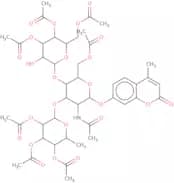
<p>4-Methylumbelliferyl 2-acetamido-3-O-(2,3,4-tri-O-acetyl-a-L-fucopyranosyl)-4-O-(2,3,4,6 -tetra-O-acetylbDgalactopyranosyl)-6-O-acetyldEoxybDglucopyranoside is a chemiluminescent substrate that has been used in the detection of beta galactosidase activity. It is a ligand for beta galactosidases and can be used for the study of enzyme kinetics. This compound also exhibits high purity and is available in CAS number: 916071. 4MUFAGAALF is suitable for use in culture media and environmental testing as well as diagnostics (e.g., bioluminescence), staining (fluorogenic substrate), and chromogenic substrates</p>Pureza:Min. 95%Peso molecular:1,023.94 g/mol4-Nitrophenyl phosphate potassium salt
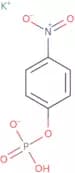
CAS:<p>4-Nitrophenyl phosphate potassium salt is a high quality, non-radioactive chemiluminescence substrate that is used in the detection of oxidase activity. This product can be used to measure the activity of peroxidase and catalase enzymes, as well as the accumulation of hydrogen peroxide. It also has been shown to be a ligand for some sulfhydryl groups and an inhibitor of phosphatases. 4-Nitrophenyl phosphate potassium salt has been tested for its ability to inhibit bacterial growth and fluorescence by staining cells. This product has also been shown to have bioluminescent properties and can be used for diagnostics or culture media.</p>Pureza:Min. 95%Peso molecular:257.18 g/mol5-Bromo-4-chloro-3-indolyl a-L-arabinopyranoside
<p>This product is a fluorogenic substrate that reacts with the enzyme beta-galactosidase to produce a fluorescent product. It can be used in food testing, environmental testing, and diagnostics. The CAS number for this product is 609-33-2. This product is available in high purity and high quality.</p>Fórmula:C13H13BrClNO5Forma y color:PowderPeso molecular:378.6 g/mol4-Methylumbelliferyl 4-deoxy-b-D-chitobiose peracetate
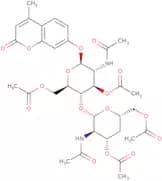
CAS:<p>4-Methylumbelliferyl 4-deoxy-b-D-chitobiose peracetate is a chromogenic substrate used for the detection of β-galactosidase activity. It is an analog of 4-methylumbelliferone that can be hydrolyzed by β-galactosidase to produce fluorescence. This product is supplied as a white crystalline solid and can be stored at room temperature. This substrate has been shown to work well in culture media, food testing, and environmental testing.</p>Pureza:Min. 95%Forma y color:Off-White PowderPeso molecular:734.7 g/mol6-Chloro-1H-indol-3-yl b-D-mannopyranoside
CAS:<p>6-Chloro-1H-indol-3-yl b-D-mannopyranoside is an enzyme substrate that is used in the fluorogenic and chromogenic assays for detecting indoleamines. This compound has a conjugate, which is a fluorescent molecule that can be attached to an antibody to target specific proteins or cells. 6-Chloro-1H-indol-3-yl b-D-mannopyranoside is used as a diagnostic agent in the detection of bacterial and fungal infections. It is also used as an indicator of cell growth in culture media.</p>Pureza:Min. 95%Peso molecular:329.73 g/molAldol® 515 palmitate, Biosynth Patent: EP 2427431 and US 8940909
CAS:<p>Aldol® 515 palmitate is a high quality, non-toxic and water soluble chromogenic substrate for enzymes. It is used to detect the presence of lipase activity due to yielding a red color.</p>Fórmula:C39H50N2O3Pureza:Min. 95%Forma y color:PowderPeso molecular:594.83 g/molAquaSpark® 510 Nitroreductase/NADH Probe, lyophilized, Ramot at Tel-Aviv University Ltd. Patent family WO 2017/130191
CAS:<p>The AquaSpark® 510 Nitroreductase/NADH Probe (CL-NTR) is a water-soluble probe for the selective chemiluminescent detection of nitroreductase (NTR) activity. It is a versatile tool for monitoring a number of biological processes.</p>Fórmula:C28H28ClNO8Peso molecular:541.15 g/mol1-Naphthyl a-D-glucopyranoside
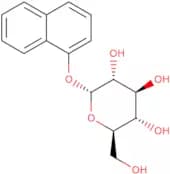
CAS:<p>1-Naphthyl a-D-glucopyranoside is a chromogenic substrate used to detect the presence of enzymes that catalyze the hydrolysis of glycosidic bonds, such as alpha-glucosidase. When the substrate is cleaved by the enzyme, it produces a colored product that can be visualized and quantified.</p>Pureza:Min. 95%Peso molecular:306.31 g/mol4-Methylumbelliferyl N-acetyl-a-D-neuraminic acid ammonium
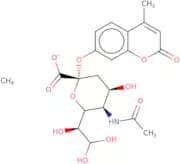
CAS:<p>4-Methylumbelliferyl N-acetyl-alpha-D-neuraminic acid ammonium is a fluorogenic substrate for neuraminidase. After enzymatic cleaveage, free 4-methylumbelliferone (also known as hymecromone) is released, exhibiting blue fluorescence upon excitation with UV light. The strongest fluorescence of 4-methylumbelliferone requires deprotonation of the hydroxyl group (thus requires alkaline pH), with a maximal fluorescence intensity obtained with excitation at 350 to 370 nm and emission at 440 to 470 nm. The use of 4-methylumbelliferyl N-acetyl-alpha-D-neuraminic acid ammoniumas a substrate for measuring the neuraminidase activity is used for detecting the glycoproteins on the surface of influenza A and B viruses, as well as for sialidosis diagnosis.</p>Fórmula:C21H28N2O11Pureza:Min. 95%Forma y color:PowderPeso molecular:471.44 g/molAldol® 458 phosphate, disodium salt, Biosynth Patent: EP 2427431 and US 8940909
CAS:<p>Aldol® 458 phosphate is a chromogenic and fluorogenic enzyme substrate used for detection of phosphatase activity. The colorless enzyme substrate is cleaved by phosphatases secreted by bacteria grown in liquid media, yielding yellow color and green fluorescence. Aldol® 458 phosphate can also be used in assays involving phosphatase-coupled antibodies in immunoassay applications (ELISA). Aldol® 458 phosphate can be used under aerobic and anaerobic conditions.</p>Fórmula:C16H12NNa2O6PPureza:Min. 95.0 Area-%Peso molecular:391.22 g/molAldol® 484 acetate, Biosynth Patent: EP 2427431 and US 8940909
CAS:Producto controlado<p>Aldol® 484 acetate is a chromogenic substrate for carboxylesterases yielding a red precipitate. In contrast to classical indoxyl substrates, Aldol substrates work not only under aerobic but also under anaerobic conditions</p>Fórmula:C22H16ClFN2O3Pureza:Min. 95.0 Area-%Peso molecular:410.83 g/mol2-Chloro-4-nitrophenyl b-D-xylobioside
<p>2-Chloro-4-nitrophenyl b-D-xylobioside is a chemiluminescent substrate that is used as a diagnostic agent. It has been used in the identification of gram positive and gram negative bacteria, which are differentiated by the color of the reaction. This substrate has also been used to detect the presence of certain enzymes produced by bacteria. 2-Chloro-4-nitrophenyl b-D-xylobioside has shown to be an effective enzyme substrate for detecting bacterial growth in culture media and is often used as a fluorogenic substrate in food testing.</p>Pureza:Min. 95%Resorufin a-D-mannopyranoside
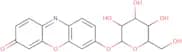
CAS:<p>Resorufin alpha-D-glucopyranoside is a sensitive fluorogenic substrate that generates a red fluorescent product (resorufin) upon interaction with alpha-glucosidase.</p>Pureza:Min. 95%Forma y color:Brown PowderPeso molecular:375.33 g/mol4-Nitrophenyl 2-acetamido-2-deoxy-4-O-[2-O-(a-L-fucopyranosyl)-b-D-galactopyranosyl]-b-D-glucopyranoside
CAS:<p>The 4-Nitrophenyl 2-acetamido-2-deoxy-4-O-[2-O-(a-L-fucopyranosyl)-b-D-galactopyranosyl]-b-D-glucopyranoside is a specialized pNP enzyme substrate designed to study fucosyl-galactose-dependent enzymes. This chromogenic substrate is valuable for researchers investigating glycosyltransferase activity, structure-function relationships of glycan-binding proteins, and regulation of cellular signaling pathways involving fucose modifications. Its high specificity and sensitivity ensure accurate measurements in diverse experimental setups, and its chromogenic detection system facilitates rapid and reliable analysis.</p>Pureza:Min. 95%Peso molecular:650.58 g/mol







![4-Nitrophenyl 2-acetamido-2-deoxy-4-O-[2-O-(a-L-fucopyranosyl)-b-D-galactopyranosyl]-b-D-glucopyra…](/_next/image/?url=https%3A%2Fstatic.cymitquimica.com%2Fproducts%2F3D%2Fthumb-webp%2FEN04931.webp&w=3840&q=75)