Sustratos de enzimas
Los sustratos enzimáticos son moléculas sobre las cuales actúan las enzimas para catalizar reacciones químicas. El sustrato se une al sitio activo de la enzima, donde sufre una transformación específica para formar el producto de la reacción. Los sustratos enzimáticos son herramientas esenciales en la investigación para estudiar la cinética enzimática, la especificidad y el mecanismo de acción. También se utilizan en ensayos diagnósticos y estudios bioquímicos. En CymitQuimica, ofrecemos una selección diversa de sustratos enzimáticos de alta calidad para apoyar su investigación en enzimología y bioquímica.
Subcategorías de "Sustratos de enzimas"
Se han encontrado 1527 productos de "Sustratos de enzimas"
Ordenar por
Pureza (%)
0
100
|
0
|
50
|
90
|
95
|
100
7-((4'-L-Alaninamido)-rac-(3'-octanoyloxy)butyloxy) coumarin trifluoroacetate salt
CAS:<p>This Clips-O substrate 7-(4'-L-Alaninamido)-rac-(3'-octanoyloxy)butyloxy) coumarin allows the detection of three enzymatic activities (L-alanine aminopeptidase, C8-esterase and oxidation of 4-amino-3-hydroxybutyloxy either enzymatically or by exposure to sodium periodate) with one single substrate and give a positive fluorescent signal only in presence of all activities. The main virtues of Clips-O substrates are an increased stability towards non-enzymatic hydrolysis that results in a reduced background and high sensitivity.</p>Fórmula:C26H35F3N2O8Pureza:Min. 95.0 Area-%Peso molecular:560.56 g/mol4-Nitrophenyl 2,4,6-tri-O-acetyl-3-O (2,3,4,6-tetra-O-acetyl-b-D-glucopyranosyl)-a-D-glucopyranoside
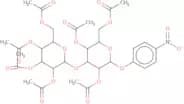
<p>4-Nitrophenyl 2,4,6-tri-O-acetyl-3-O (2,3,4,6-tetra-O-acetyl-b-D-glucopyranosyl)-a-D-glucopyranoside is a chemiluminescent substrate that can be used for the detection of aminoglycosides in biological fluids. It is a high purity and high quality product with CAS No. 482743. The product has been tested for safety and purity using culture media and environmental testing. This product may be used as a bioluminescence substrate to detect the presence of aminoglycosides in samples such as urine, serum or plasma. 4NTPAGDG is also useful as a fluorogenic substrate for diagnostics and enzyme substrates for food testing.</p>Pureza:Min. 95%Peso molecular:757.65 g/molN-a-Boc-N-ε-cbz-L-lysine 4-nitroanilide
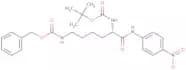
CAS:<p>N-a-Boc-N-epsilon-cbz-L-lysine 4-nitroanilide is a compound that has been shown to regulate the production of angiotensin. It also acts as an inhibitor for the production of fibronectin, which is key in the regulation of inflammation and wound healing. N-a-Boc-N-epsilon-cbz-L-lysine 4 nitroanilide has been shown to be a trifunctional molecule and can yield three different products: oxychlorides, hydrated and solvates. This molecule also regulates phosphorus levels. There are many functions that this molecule performs, including binding with amino acids and regulating their function, which is why it is so important to study this molecule more closely.</p>Pureza:Min. 95%Peso molecular:500.54 g/mol4-Nitrophenyl b-D-galactopyranosiduronic acid
CAS:<p>4-Nitrophenyl b-D-galactopyranosiduronic acid is a chemiluminescent substrate for the detection of β-galactosidase. It is used for the determination of α-galactosidase activity in urine, feces, and blood. This product can be used as a chromogenic substrate for the detection of β-galactosidase in tissue culture medium. 4-Nitrophenyl b-D-galactopyranosiduronic acid is also a fluorogenic substrate which can be conjugated to an enzyme such as horseradish peroxidase or alkaline phosphatase.</p>Pureza:Min. 95%Peso molecular:315.23 g/mol5-Acetamidofluorescein-di-(b-D-galactopyranoside)
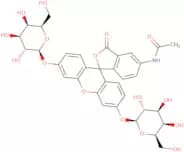
CAS:<p>5-Acetamidofluorescein-di-(b-D-galactopyranoside), also known as C2FDG, is a fluorogenic substrate for beta-galactosidase that generates a green fluorescence after cleavage (Em ~520 nm). It is used in enzyme activity assays and in flow cytometry in animal, bacterial, and yeast cells.</p>Fórmula:C34H35NO16Pureza:Min. 95%Forma y color:Yellow PowderPeso molecular:713.65 g/mol4-Nitrophenyl lacto-N-tetraoside
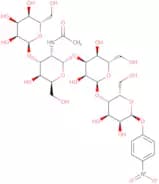
CAS:<p>4-Nitrophenyl lacto-N-tetraoside is a chromogenic substrate for enzymes that cleave lactose-specific linkages, such as beta-galactosidases. Upon enzyme cleavage, the pNP group is released, resulting in a yellow-colored solution that can be spectrophotometrically quantified at 405 nm. This substrate is commonly used in detecting lactose hydrolysis activity, such as in dairy industry for production optimization studies, or in microbiology for bacterial lactose fermentation assays. Its tetrasaccharide structure resembles that of lactose and makes it a specific substrate for lactose-utilizing enzymes. The properties of 4-nitrophenyl lacto-N-tetraoside make it a useful tool in enzyme kinetics studies and screening of new lactose-utilizing microorganisms.</p>Pureza:Min. 95%Peso molecular:828.72 g/mol5-Bromo-6-chloro-3-indoxyl nonanoate
CAS:<p>5-Bromo-6-chloro-3-indoxyl nonanoate is a chemical compound that is used in the detection of bioluminescence. It is a substrate for enzymes, such as luciferase, and can be used to measure the amount of light emitted during the reaction. The CAS number for this molecule is 682802-80-8.</p>Pureza:Min. 95%Peso molecular:386.71 g/molAquaSpark® α-D-galactoside, 10 mM in DMSO, Ramot at Tel-Aviv University Ltd. Patent family WO 2017/130191
CAS:<p>Substrate for alpha-galactosidase</p>Fórmula:C34H39ClO12Pureza:Min. 95%Forma y color:Clear LiquidPeso molecular:675.12 g/mol4-Nitrophenyl 2,3,4-tri-O-acetyl-b-D-glucuronide methyl ester
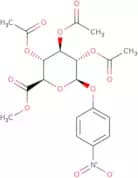
CAS:<p>4-Nitrophenyl 2,3,4-tri-O-acetyl-b-D-glucuronide methyl ester is a fluorescent substrate for the beta-glucuronidase enzyme. It can be used to detect the presence of this enzyme in bacteria and other microorganisms by means of fluorometric or colorimetric assays. It has been shown to have an excellent stability in a variety of culture media and food testing applications. This product is available in high purity and quality, with a CAS number of 18472-49-6.</p>Pureza:Min. 95%Peso molecular:455.37 g/molAldol® 457 β-D-galactopyranoside, Biosynth Patent: EP 2427431 and US 8940909
CAS:<p>Aldol 457 Beta-D-galactopyranoside is a chromogenic substrate for beta-galactosidase, which is an enzyme that catalyzes the hydrolysis of the terminal galactose residue in D-galactose to form D-galactitol and D-glucose. Aldol 457 Beta-D-galactopyranoside is used as a reagent for the detection of beta-galactosidase activity in biological samples, such as cultured cells or tissues, and has been shown to be a ligand in binding studies with Galectin 1. This product is also used in diagnostic applications such as food testing, culture media, fluorogenic substrates, environmental testing and more.</p>Fórmula:C24H28N2O8Pureza:Min. 95.0 Area-%Peso molecular:472.49 g/molLuciferin-myo-inositol-1-phosphate, sodium salt
<p>Luciferin-myo-inositol-1-phosphate, sodium salt is a conjugate of luciferin and myo-inositol. It is used as a substrate for certain enzymes, such as the enzyme that catalyzes the oxidation of luciferin to oxyluciferin. This product can be used in environmental testing, food testing, and diagnostics. Luciferin-myo-inositol-1-phosphate, sodium salt is available in high purity and high quality.</p>Fórmula:C17H18N2NaO11PS2Pureza:Min. 94 Area-%Peso molecular:544.42 g/mol4-Nitrophenyl 2,3,4,6-tetra-O-acetyl-a-D-galactopyranoside
CAS:<p>4-Nitrophenyl 2,3,4,6-tetra-O-acetyl-a-D-galactopyranoside is a chemiluminescent substrate that is used as a fluorescence indicator for the detection of β-galactosidase activities. This substrate has been shown to be useful for the detection of β-galactosidase in various types of samples such as culture media, environmental testing and food testing. 4NPTAG can also be used to detect β-galactosidase activity using fluorogenic substrates or chromogenic substrates. The enzyme activity can be detected by measuring the change in absorbance at 410 nm and the increase in luminescence at 460 nm.</p>Fórmula:C20H23NO12Pureza:Min. 95%Forma y color:PowderPeso molecular:469.4 g/mol4-Nitrophenyl 2-O-(2,3,4,6-tetra-O-acetyl-b-D-glucopyranosyl)-b-D-glucopyranoside
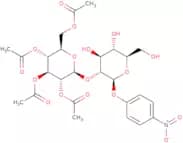
CAS:<p>4-Nitrophenyl 2-O-(2,3,4,6-tetra-O-acetyl-b-D-glucopyranosyl)-b-D-glucopyranoside is a state-of-the-art chromogenic substrate designed for rapid and sensitive enzyme activity detection. As a versatile pNP substrate, it produces a noticeable color change upon enzyme-catalyzed hydrolysis, facilitating easy monitoring and quantification of enzyme levels in research and diagnostic applications. The substrate's acetylated glucose moiety ensures specificity and stability, allowing for precise and reliable results across a range of experimental conditions.</p>Pureza:Min. 95%Peso molecular:631.54 g/molMethyl 4-nitrophenyl hexyl phosphonate
CAS:<p>Methyl 4-nitrophenyl hexyl phosphonate is a lipase suicide inhibitor that is a chromogenic substrate for lipases which upon enzymatic action, binds irreversibly to the lipase and inactivates it. The substrate can be used for the determination of active sites in lipases.</p>Pureza:Min. 95%Peso molecular:301.284-Chloro-2-nitrophenyl b-D-galactopyranoside
<p>4-Chloro-2-nitrophenyl b-D-galactopyranoside is a fluorogenic substrate that is used in diagnostic testing, such as food and environmental testing. 4-Chloro-2-nitrophenyl b-D-galactopyranoside is an enzyme substrate that can be used to measure the activity of beta galactosidase. This substrate is also chromogenic, which means that it will change color when exposed to the enzyme. 4CNPGalA has been shown to be an excellent ligand for beta galactosidase and can be used in conjugation reactions with other molecules.</p>Pureza:Min. 95%Peso molecular:335.69 g/mol5-Bromo-4-chloro-3-indoxyl-α-D-xylopyranoside
CAS:<p>5-Bromo-4-chloro-3-indoxyl-alpha-D-xylopyranoside is an enzyme substrate that can be used in the detection of β-galactosidase activity. This product has been shown to be a good ligand for various xanthine oxidoreductases, including xanthine dehydrogenase and uricase. 5BBIX is also a chromogenic substrate for horseradish peroxidase and can be used to detect hydrogen peroxide in the presence of osmium tetroxide or potassium permanganate. 5BBIX has been extensively tested for use in diagnostics, food, and environmental testing.</p>Fórmula:C13H13BrClNO5Pureza:Min. 98.0 Area-%Peso molecular:378.61 g/mol4-Nitrophenyl 6-O-benzoyl-3,4-O-isopropylidene-a-D-galactopyranoside
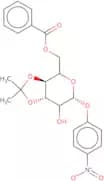
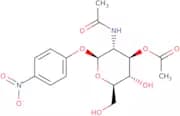
CAS:<p>4-Nitrophenyl 6-O-benzoyl-3,4-O-isopropylidene-a-D-galactopyranoside (4NBP) is a fluorogenic substrate for β-galactosidase. It has been used as an enzyme substrate in the detection of β-galactosidase activity. 4NBP is also used to detect the presence of galactose in culture media and as a chromogenic substrate in diagnostics.</p>Pureza:Min. 95%Peso molecular:445.42 g/mol4-Nitrophenyl 2-acetamido-3-O-acetyl-2-deoxy-b-D-glucopyranoside
CAS:<p>4-Nitrophenyl 2-acetamido-3-O-acetyl-2-deoxy-b-D-glucopyranoside is a fluorogenic substrate for the enzyme acetylcholinesterase. It can be used in food testing, environmental testing and diagnostics. 4NP2A2DGBG is a high purity, high quality product with a CAS number of 23262-57-9.</p>Pureza:Min. 95%Peso molecular:384.34 g/molAldol® 518 myo-inositol-1-phosphate, Biosynth Patent: EP 2427431 and US 8940909
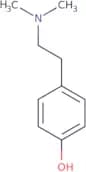
CAS:<p>Aldol® 518 myo-inositol-1-phosphate is a chromogenic and fluorogenic enzyme substrate used for detection of phosphatidyl-inositol specific phospholipase C activity (PI-PLC, EC 4.6.1.13). The colorless enzyme substrate is cleaved by PI-PLC or PI-PLC-positive microorganisms grown in liquid or solid media, yielding an intense red coloration. In combination with Aldol® 355 fluorescence enhancer, red fluorescence can also obtained. Aldol® 518 myo-inositol-1-phosphate is suitable for use in liquid and solid media, under aerobic as well as anaerobic conditions.</p>Fórmula:C29H30ClN2O10PPureza:Min. 95.0 Area-%Peso molecular:632.98 g/molHordenine
CAS:<p>Produces a fluorogenic signal in the presence of peroxidase</p>Fórmula:C10H15NOPureza:Min. 95%Forma y color:Brown PowderPeso molecular:165.23 g/mol