Sustratos cromogénicos
Los sustratos cromogénicos son compuestos que producen un cambio de color visible cuando son metabolizados por enzimas específicas. Estos sustratos se utilizan ampliamente en ensayos diagnósticos, investigaciones bioquímicas y ensayos de inmunoabsorción enzimática (ELISA) para detectar y cuantificar la actividad enzimática. El cambio de color permite una identificación visual rápida y sencilla de las reacciones enzimáticas, lo que convierte a los sustratos cromogénicos en herramientas esenciales en el análisis de laboratorio. En CymitQuimica, ofrecemos una amplia selección de sustratos cromogénicos de alta calidad para apoyar sus aplicaciones de investigación y diagnóstico.
Se han encontrado 712 productos de "Sustratos cromogénicos"
Ordenar por
Pureza (%)
0
100
|
0
|
50
|
90
|
95
|
100
2-Nitrophenyl b-D-xylopyranoside
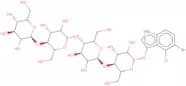
CAS:<p>Chromogenic substrates targeting beta-xylosidase</p>Pureza:Min. 95%Forma y color:PowderPeso molecular:271.22 g/mol5-Bromo-4-chloro-1H-indol-3-yl-β-D-cellotetraoside
<p>5-Bromo-4-chloro-1H-indol-3-yl-b-D-cellotetraoside is a chromogenic substrate used to detect the specific enzymatic activity of cellulase. After cleavage, 5-bromo-4-chloro-indoxyl is released, resulting in a blue to blue-green color change in bacterial colonies or media. 5-Bromo-4-chloro-1H-indol-3-yl-b-D-cellotetraoside is used in bacterial cellulase detection and biomass conversion research.</p>Fórmula:C32H45BrClNO21Pureza:Min. 95%Forma y color:PowderPeso molecular:895.05 g/mol2-Chloro-4-nitrophenyl α-D-mannopyranoside
CAS:<p>2-Chloro-4-nitrophenyl alpha-D-mannopyranoside is a substrate used to measure the alpha-mannosidase activity. This enzyme plays a crucial role in the lysosomal degradation of asparagine-linked carbohydrate cores of glycoproteinsis. The use of 2-Chloro-4-nitrophenyl alpha-D-mannopyranoside in diagnostic assays is important as a deficiency in alpha-mannosidase leads to the accumulation of mannose-rich oligosaccharides in lysosomes, causing a range of health problems collectively known as alpha-mannosidosis.</p>Fórmula:C12H14ClNO8Pureza:Min. 98 Area-%Forma y color:White PowderPeso molecular:335.69 g/mol2-Nitrophenyl-β-D-thiogalactopyranoside
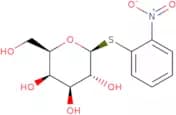
CAS:<p>2-Nitrophenyl-beta-D-thiogalactopyranoside is a chromogenic substrate used to detect the presence of galactosidase enzymes in various biological and biochemical assays. It consists of a nitrophenyl group attached to a galactose sugar molecule through a thioglycosidic bond. When acted upon by enzymes such as galactosidases, it releases the colored nitrophenyl group, which can be detected using spectrophotometry. This substrate is commonly used in assays for the detection of LacZ activity in bacterial cultures, as lacZ encodes for β-galactosidase.</p>Fórmula:C12H15NO7SPureza:Min. 98 Area-%Forma y color:Yellow PowderPeso molecular:317.32 g/mol5-Bromo-4-chloro-3-indolyl b-D-mannopyranoside
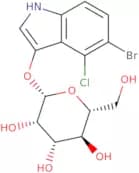
CAS:<p>5-Bromo-4-Chloro-3-Indolyl b-D-Mannopyranoside, also known as X-Man, is an enzyme substrate commonly used for detecting mannosidase enzymes. Upon hydrolysis by the enzyme, it produces a blue-green colored compound that can be detected visually or measured spectrophotometrically. This substrate is useful in characterizing the activity of mannosidases involved in glycoprotein processing and quality control.</p>Fórmula:C14H15BrClNO6Forma y color:White Off-White PowderPeso molecular:408.63 g/mol6-Chloro-3-indolyl b-D-glucuronide sodium salt
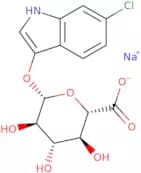
CAS:<p>6-Chloro-3-indolyl b-D-glucuronide sodium salt is a chromogenic substrate for beta-glucuronidase, a reporter gene used to monitor gene expression by detecting the enzyme's activity. It yields a salmon colored precipitate upon cleavage.</p>Pureza:Min. 95%Forma y color:PowderPeso molecular:365.7 g/molNaphthol AS-BI b-D-glucuronide
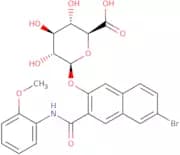
CAS:<p>Chromogenic substrate to visualize beta-glucuronidase activity; produces a red color</p>Fórmula:C24H22BrNO9Pureza:Min. 98 Area-%Forma y color:White PowderPeso molecular:548.34 g/mol2-Chloro-4-nitrophenyl β-D-glucopyranoside
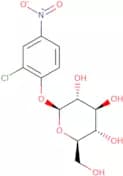
CAS:<p>2-Chloro-4-nitrophenyl β-D-glucopyranoside is a chromogenic substrate for beta-glucosidases. In biochemical enzyme assays and in vitro diagnostics analysis, the substrate is used to monitor the glycosyltransferase activity. When 2-chloro-4-nitrophenyl β-D-glucopyranoside is cleaved by beta-glucosidase, 2-chloro-4-nitrophenol is released and quantified.</p>Fórmula:C12H14ClNO8Pureza:Min. 95%Forma y color:White PowderPeso molecular:335.69 g/molNaphthol AS-BI β-L-fucopyranoside
CAS:<p>Substrate for the detection of beta-D-fucosidase</p>Fórmula:C24H24BrNO7Pureza:Min. 95%Peso molecular:518.35 g/mol6-Bromo-2-naphthyl 2-acetamido-2-deoxy-b-D-glucopyranoside
CAS:<p>6-Bromo-2-naphthyl 2-acetamido-2-deoxy-b-D-glucopyranoside is a chromogenic substrate used for the detection of chitinase activity. Upon hydrolysis by chitinase, it releases a yellow-brown color, which is easily detected by spectrophotometry. This substrate has been used to study chitinases in various organisms, including bacteria, fungi, and insects. It can also be used to quantitate chitinase activity in various biological samples.</p>Fórmula:C18H20BrNO6Pureza:Min 97%Forma y color:White PowderPeso molecular:426.26 g/mol4-Nitrophenyl 2-acetamido-2-deoxy-a-D-galactopyranoside
CAS:<p>4-Nitrophenyl 2-acetamido-2-deoxy-alpha-D-galactopyranoside is a chromogenic substrate for alpha-N-acetylgalactosaminidase. Upon hydrolysis, para-nitrophenol is released yielding a yellowish colour. 4-Nitrophenyl 2-acetamido-2-deoxy-alpha-D-galactopyranoside is used in different applications such as the diagnosis of Schindler-Kanzaki disease and other lysosomal storage disorders.</p>Fórmula:C14H18N2O8Pureza:Min. 98%Forma y color:White PowderPeso molecular:342.3 g/molSalmon-pal
CAS:<p>6-Chloro-1H-indol-3-yl hexadecanoate is a chromogenic substrate for an enzyme that oxidizes it to produce a blue color. It can be used in the diagnosis of bacterial infections, such as tuberculosis and leprosy. 6CHIH is a ligand for various enzymes, including lactate dehydrogenase, which catalyzes the conversion of pyruvate to lactic acid. This compound reacts with oxygen to produce light in the presence of a catalyst. 6CHIH is also used as a fluorescent tag for protein labeling and detection.<br>6CHIH has been shown to be effective in detecting bacteria in food products and water samples using bioluminescence techniques. The high purity and quality of this compound make it suitable for use in diagnostics, culture media, and environmental testing.</p>Pureza:Min. 95%Peso molecular:406 g/mol5-Bromo-4-chloro-3-indoxyl phosphate, dilithium salt hydrate
<p>5-Bromo-4-chloro-3-indoxyl phosphate, dilithium salt hydrate is a chromogenic substrate used to detect the specific enzymatic activity of alkaline phosphatase. After cleavage, 5-bromo-4-chloro-indoxyl is released, resulting in a blue to blue-green color change in bacterial colonies or media. 5-Bromo-4-chloro-3-indoxyl phosphate, dilithium salt hydrate is used in ELISA and molecular biology assays such as lacZ reporter systems.</p>Fórmula:C8H4BrClLi2NO4P(anhydrousbasis)Pureza:Min. 98 Area-%Forma y color:PowderPeso molecular:338.34 g/molAldol® 484 α-D-glucopyranoside, Biosynth Patent: EP 2427431 and US 8940909
CAS:<p>Aldol® 484 alpha-D-glucopyranoside is a chromogenic and fluorogenic enzyme substrate for alpha-glucosidase activity (EC 3.2.1.20, alpha-1,4-glucosidase, also known as maltase). The colorless enzyme substrate is cleaved by bacteria producing this enzyme in liquid or solid media, yielding orange color. Green fluorescence is also generated if a suitable matrix is present such as: cellulose acetate filters, polypropylene tubes or microplates and polyethylene vials. Aldol® 484 alpha-D-glucopyranoside can be used under aerobic and anaerobic conditions.</p>Fórmula:C26H24ClFN2O7Pureza:Min. 95%Forma y color:PowderPeso molecular:530.93 g/mol6-Chloro-3-indolyl β-D-cellobioside
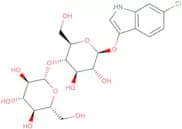
CAS:<p>6-Chloro-3-indolyl b-D-cellobioside is a chromogenic substrate that produces a salmon-pink color after enzymatic cleavage. It is used for detecting the activity of beta-D-cellobiosidase in enzyme assays.</p>Pureza:Min. 95%Forma y color:White To Off-White SolidPeso molecular:491.87 g/mol8-Hydroxyquinoline-beta-D-glucuronic acid, sodium salt
CAS:<p>8-Hydroxyquinoline-beta-D-glucuronic acid, sodium salt is a fluorogenic substrate that can be used for enzymatic detection of peroxidase. The substrate is available in a variety of forms, including powder and liquid. This product has been tested for environmental and bioluminescence activity, as well as food safety. It has also been shown to be a useful ligand in immunoassays.</p>Fórmula:C15H14NNaO7Pureza:Min. 98 Area-%Forma y color:White PowderPeso molecular:343.26 g/mol4-Nitrophenyl b-D-thiogalactopyranoside
CAS:<p>4-Nitrophenyl b-D-thiogalactopyranoside is a specialized chromogenic substrate designed for measuring the activity of thio-β-galactosidase enzymes. Upon cleavage by thio-β-galactosidase, it releases the intensely colored 4-nitrophenolate ion, providing a straightforward, sensitive, and quantitative detection method. This substrate is easily incorporated into enzyme-coupled assays, making it a reliable and convenient choice for research and diagnostic applications. With its rapid color development and high signal-to-background ratio, 4-Nitrophenyl b-D-thiogalactopyranoside is ideal for monitoring enzyme kinetics, substrate specificity evaluation, and inhibitor screening in a range of scientific and biotechnological settings.</p>Fórmula:C12H15NO7SPureza:Min. 98 Area-%Forma y color:PowderPeso molecular:317.32 g/mol2-Chloro-4-nitrophenyl a-D-glucopyranoside
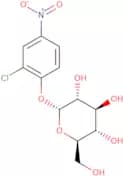
CAS:<p>2-Chloro-4-nitrophenyl a-D-glucopyranoside is an an enzyme-activated irreversible inhibitor of alpha-glucosidase. The substrate 2-Chloro-4-nitrophenyl a-D-glucopyranoside is covalently attached to the enzyme enabling mechanistic studies of glycosidase activity, especificallyt in carbohydrate metabolism studies.</p>Pureza:Max. 97 Area-%Forma y color:White Off-White PowderPeso molecular:335.69 g/molNaphthol AS-BI β-D-glucopyranoside
CAS:<p>Substrate detecting beta-glucosidase activity</p>Forma y color:PowderPeso molecular:534.35 g/mol6-Chloro-3-indolyl 2-acetamido-2-deoxy-β-D-glucopyranoside
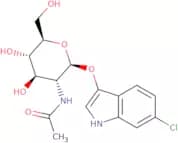
CAS:<p>6-Chloro-3-indolyl 2-acetamido-2-deoxy-b-D-glucopyranoside is a pink enzyme substrate commonly used in biochemical research and diagnostic applications. This compound is a derivative of indolyl glucopyranoside, which is known for its ability to produce a colored product upon enzymatic hydrolysis. 6-Chloro-3-indolyl 2-acetamido-2-deoxy-b-D-glucopyranoside is particularly useful for studying glycosidases, enzymes that cleave glycosidic bonds in complex carbohydrates. Its pink coloration makes it an ideal choice for colorimetric assays, enabling researchers to monitor enzyme activity in real-time and facilitating the development of new diagnostic tools and therapeutic strategies.</p>Fórmula:C16H19ClN2O6Pureza:Min. 95%Forma y color:White to off-white solid.Peso molecular:370.78 g/mol