Sustratos cromogénicos
Los sustratos cromogénicos son compuestos que producen un cambio de color visible cuando son metabolizados por enzimas específicas. Estos sustratos se utilizan ampliamente en ensayos diagnósticos, investigaciones bioquímicas y ensayos de inmunoabsorción enzimática (ELISA) para detectar y cuantificar la actividad enzimática. El cambio de color permite una identificación visual rápida y sencilla de las reacciones enzimáticas, lo que convierte a los sustratos cromogénicos en herramientas esenciales en el análisis de laboratorio. En CymitQuimica, ofrecemos una amplia selección de sustratos cromogénicos de alta calidad para apoyar sus aplicaciones de investigación y diagnóstico.
Se han encontrado 712 productos de "Sustratos cromogénicos"
Ordenar por
Pureza (%)
0
100
|
0
|
50
|
90
|
95
|
100
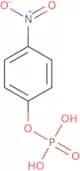
Phosphoric acid, mono(4-nitrophenyl) ester
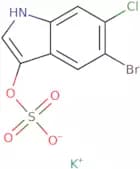
CAS:<p>Phosphatase substrate</p>Fórmula:C6H6NO6PPureza:Min. 95%Forma y color:White PowderPeso molecular:219.09 g/mol5-Bromo-6-chloro-3-indolyl sulfate potassium salt
CAS:<p>5-Bromo-6-chloro-3-indolyl sulfate potassium salt is a fluorogenic substrate that can be used for food testing. It is a conjugate of 5-bromo-6-chloroindolylsulfate and potassium, which is dissolved in buffer solution. This product can also be used as a chromogenic substrate in environmental testing, an enzyme substrate in diagnostics, and a ligand for bioluminescence. It has high purity and quality, and can be used for chemiluminescence or bioluminescence. The CAS number for this product is 6581-24-4.</p>Fórmula:C8H4BrClNO4S·KPureza:Min. 95%Forma y color:PowderPeso molecular:364.64 g/mol5-Bromo-4-chloro-3-indolyl a-L-rhamnoside
<p>5-Bromo-4-chloro-3-indolyl a-L-rhamnoside is a chromogenic substrate used to detect the specific enzymatic activity of alpha-L-rhamnosidase. After cleavage, 5-bromo-4-chloro-indoxyl is released, resulting in a blue to blue-green color change in bacterial colonies or media. 5-Bromo-4-chloro-3-indolyl a-L-rhamnoside is used in bacterial rhamnose metabolism studies (e.g. E. coli).</p>Fórmula:C14H15BrClNO5Pureza:Min. 95%Forma y color:SolidPeso molecular:392.63 g/mol4-Nitrophenyl 2-O-trans-feruloyl-a-L-arabinofuranoside
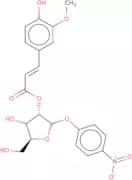
CAS:<p>4-Nitrophenyl 2-O-trans-feruloyl-alpha-L-arabinofuranoside is a chromogenic substrate for alpha-L-arabinofuranosidase. Upon hydrolysis, para-nitrophenol is released yielding a yellowish colour. 4-Nitrophenyl 2-O-trans-feruloyl-alpha-L-arabinofuranoside is used in different applications such as the Plant biomass analysis, bacterial arabinan degradation assays</p>Fórmula:C21H21NO10Pureza:Min. 95%Forma y color:PowderPeso molecular:447.39 g/mol5-Bromo-4-chloro-3-indolyl b-L-fucopyranoside
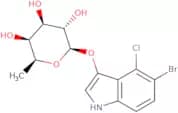
CAS:<p>5-Bromo-4-chloro-3-indolyl β-L-fucopyranoside (X-Fuc) is a chromogenic substrate specifically designed for the identification and detection of fucosidase enzyme activity. Upon cleavage by fucosidase, it generates a blue-colored 5-Bromo-4-chloro-3-hydroxy-indole precipitate, which can be easily observed under a microscope or spectrophotometer. This feature makes X-Fuc an invaluable tool across various applications, such as biochemical analysis, histochemical staining, cell biology, and enzyme kinetic assays. By providing a fast, sensitive, and reliable readout for fucosidase activity, 5-Bromo-4-chloro-3-indolyl β-L-fucopyranoside facilitates essential research in the understanding of biological processes and the development of therapeutic interventions.</p>Fórmula:C14H15BrClNO5Pureza:Min. 95%Forma y color:White PowderPeso molecular:392.63 g/molN-Acetyl-glycine p-nitroanilide
CAS:<p>Substrate for hydrolases</p>Fórmula:C10H10N2O5Pureza:Min. 95%Forma y color:Yellow powder.Peso molecular:238.2 g/mol2-Chloro-4-nitrophenyl-α-L-fucopyranoside
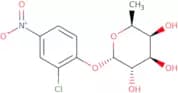
CAS:<p>Alternative chromogenic substrate for alpha-D-galactosidase</p>Fórmula:C12H14ClNO7Pureza:Min. 98 Area-%Forma y color:White PowderPeso molecular:319.69 g/mol1-Methyl 2-(4-methyl-2-oxo-2H-1-benzopyran-7-yl)ethanedioate
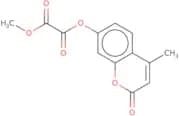
CAS:<p>Inorganic phosphate targeted colorimetric probe</p>Fórmula:C13H10O6Pureza:Min. 95%Peso molecular:822.35 g/mol5-Bromo-6-chloro-3-indoxyl butyrate
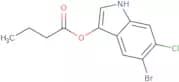
CAS:<p>5-Bromo-6-chloro-3-indoxyl butyrate is a chromogenic substrate that yields a magenta-colored product after cleavage. The chromophore 5-bromo-6-chloro-indoxyl is released, generating the observable color. It is used in lipid digestion assays.</p>Fórmula:C12H11BrClNO2Pureza:Min. 95%Forma y color:PowderPeso molecular:316.58 g/mol5-Bromo-3-indoxyl caprylate
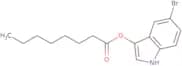
CAS:<p>Also known as Lapis-caprylate; targeting esterase with C8 activity; Blue color</p>Fórmula:C16H20BrNO2Pureza:Min. 98 Area-%Forma y color:PowderPeso molecular:338.24 g/mol1-Naphthyl β-D-mannopyranoside
CAS:<p>1-Naphthyl β-D-mannopyranoside is a chromogenic (also fluorogenic) substrate. After cleavage, 1-naphthol is released and is used to quantify beta-mannosidase activity.</p>Fórmula:C16H18O6Pureza:Min. 95%Forma y color:PowderPeso molecular:306.31 g/molN-(3-Sulfopropyl)-3,3',5,5'-tetramethylbenzidine sodium salt
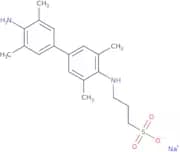
CAS:<p>N-(3-Sulfopropyl)-3,3',5,5'-tetramethylbenzidine (TMB) sodium salt is a highly sensitive chromogenic substrate used for the detection and quantification of peroxidase enzyme activity. This water-soluble substrate undergoes a color change from colorless to blue upon oxidation by peroxidase enzymes in the presence of hydrogen peroxide. The reaction can be stopped by adding an acid, resulting in a yellow color that can be measured spectrophotometrically. TMB sodium salt is widely used in various applications, including enzyme-linked immunosorbent assays (ELISA), immunohistochemistry, and other diagnostic tests, due to its high sensitivity, low background signal, and excellent stability.</p>Pureza:Min. 95%Forma y color:PowderPeso molecular:384.47 g/mol4-Nitrophenyl 2-acetamido-3-O-(2-acetamido-2-deoxy-b-D-glucopyranosyl)-2-deoxy-a-D-galactopyranoside
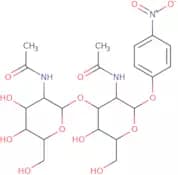
CAS:<p>4-Nitrophenyl 2-acetamido-3-O-(2-acetamido-2-deoxy-beta-D-glucopyranosyl)-2-deoxy-alpha-D-galactopyranoside is a chromogenic substrate for alpha-galactosidase. Upon hydrolysis, para-nitrophenol is released yielding a yellowish colour. 4-Nitrophenyl 2-acetamido-3-O-(2-acetamido-2-deoxy-beta-D-glucopyranosyl)-2-deoxy-alpha-D-galactopyranoside is used in different applications such as the Fabry disease diagnosis, glycolipid metabolism studies</p>Pureza:Min. 98 Area-%Forma y color:White PowderPeso molecular:545.49 g/molAldol® 495 nonanoate solution, 0.75 M in DMSO, Biosynth Patent: EP 2427431 and US 8940909
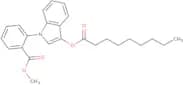
CAS:Producto controlado<p>Aldol® 495 nonanoate is a chromogenic and fluorogenic enzyme substrate used for detection of lipase activity. The colorless enzyme substrate is cleaved by C9 esterases, yielding development of an orange coloration. In addition, green fluorescence is generated when Aldol® 355 fluorescence enhancer or a suitable matrix is present. Aldol® 495 nonanoate can be used in enzyme assays and live bacterial cultures. Aldol® 495 nonanoate is suitable for use in liquid and solid media, under aerobic as well as anaerobic conditions.</p>Fórmula:C29H31ClN2O3Pureza:Min. 95%Peso molecular:491.02 g/molAldol® 458 nonanoate solution, 0.75 M in DMSO, Biosynth Patent: EP 2427431 and US 8940909
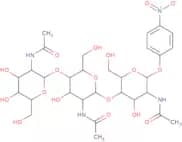
CAS:Producto controlado<p>Aldol 458 nonanoate solution (0.75 M) is a substrate for enzymes and ligands, which is used in various applications such as food testing, staining, fluorogenic substrate, environmental testing, chromogenic substrate and conjugate. Aldol 458 nonanoate solution (0.75 M) has high purity and is highly stable at pH 2-12. This product can be used as a chemiluminescence or bioluminescence substrate. The CAS number for this product is 2484873-15-4.</p>Fórmula:C25H29NO4Pureza:Min. 95%Forma y color:Clear LiquidPeso molecular:407.51 g/mol4-Nitrophenyl N,N',N''-triacetyl-b-D-chitotriose
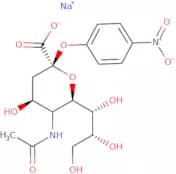
CAS:<p>Substrate for determining hydrolytic activity of chitinase</p>Pureza:Min. 95%Forma y color:White PowderPeso molecular:748.69 g/mol2-O-(4-Nitrophenyl)-a-D-N-acetylneuraminic acid sodium salt
CAS:<p>2-O-(4-Nitrophenyl)-alpha-D-N-acetylneuraminic acid sodium salt is a chromogenic substrate used to detect the enzymatic activity of neuraminidase or sialidase. After cleavage, the nitrophenyl moiety is released exhibiting a light yellowish color. 2-O-(4-Nitrophenyl)-alpha-D-N-acetylneuraminic acid sodium salt is used in bacterial neuraminidase activity assays.</p>Pureza:Min. 95%Forma y color:Yellow PowderPeso molecular:452.35 g/molAldol® 470 acetate, Biosynth Patent: EP 2427431 and US 8940909
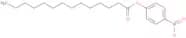
CAS:Producto controlado<p>Aldol® 470 acetate is a Fluorogenic substrate that is used in enzymatic reactions to produce a fluorescent product. Aldol® 470 acetate can be used as a ligand or a chromogenic substrate. This product is also used in diagnostic tests, such as conjugates and chemiluminescence, to detect the presence of certain enzymes or microorganisms. It can be used in culture media to measure the amount of certain enzymes, such as phosphatases or proteases, and has been shown to have high purity and quality. This product has CAS No. 1318785-37-3, 1318785-38-4, 1318785-39-5, 1318785-40-6 and 1318785-41-7.</p>Fórmula:C25H21NO5Pureza:Min. 95%Forma y color:PowderPeso molecular:415.44 g/mol4-Nitrophenyl myristate
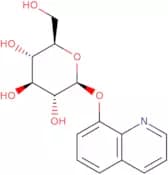
CAS:<p>4-Nitrophenyl myristate (NphOMy) is a chromogenic enzyme substrate used as a diagnosis tool for detection of β-lactamase hydrolysis activities. In the presence of certain drugs, 4-nitrophenyl myristate HSA-Tyr411-catalyzed hydrolysis seems to be inhibited.</p>Fórmula:C20H31NO4Pureza:Min. 95 Area-%Forma y color:White PowderPeso molecular:349.46 g/mol8-Hydroxyquinoline b-D-glucopyranoside
CAS:<p>8-Hydroxyquinoline b-D-glucopyranoside (8-OHG-glu) is a chromogenic enzyme substrate commonly used to detect the presence of beta-glucosidase in biological samples. When hydrolyzed by beta-glucosidase, 8-OHG-glu produces a yellow-orange color, indicating the presence of the enzyme. This substrate is particularly useful for measuring beta-glucosidase activity in soil and plant samples.</p>Fórmula:C15H17NO6Pureza:Min. 95%Forma y color:PowderPeso molecular:307.3 g/mol