CAS 100306-33-0
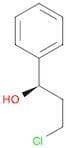
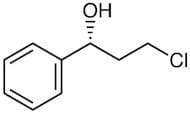
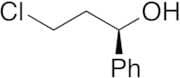
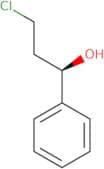
:(R)-(+)-3-chloro-1-phényl-1-propanol
Description :
(R)-(+)-3-chloro-1-phényl-1-propanol est un composé organique caractérisé par sa nature chirale, indiquée par la configuration (R). Ce composé présente une structure de propanol avec un groupe phényle et un substituant chlore à la troisième position du carbone. Il s'agit généralement d'un liquide incolore à jaune pâle avec une odeur caractéristique. La présence de l'atome de chlore introduit des caractéristiques polaires, influençant sa solubilité dans divers solvants ; il est généralement plus soluble dans les solvants organiques que dans l'eau. La chiralité du composé peut entraîner différentes activités biologiques selon l'énantiomère, ce qui le rend intéressant pour les applications pharmaceutiques. Sa synthèse implique souvent des stratégies de pool chiral ou des méthodes de synthèse asymétrique. De plus, (R)-(+)-3-chloro-1-phényl-1-propanol peut participer à diverses réactions chimiques, y compris des substitutions nucléophiles et des réductions, ce qui en fait un intermédiaire polyvalent dans la synthèse organique. Les données de sécurité doivent être consultées pour la manipulation et le stockage, comme pour toute substance chimique, afin de garantir que les précautions appropriées soient prises.
Formule :C9H11ClO
InChI :InChI=1/C9H11ClO/c10-7-6-9(11)8-4-2-1-3-5-8/h1-5,9,11H,6-7H2/t9-/m1/s1
SMILES :c1ccc(cc1)[C@@H](CCCl)O
Synonymes :- (1R)-3-Chloro-1-phenyl-propan-1-ol
- 3-Chloro-1-Phenylpropan-1-Ol
- (R)-(+)-3-Chloro-1-phenylpropanol
- (R)-(+)-3-Chloro-1-phenyl-1-propanol
- (r)-(+)-α-(2-chloroethyl)benzyl alcohol
- α-(2-chloroethyl)benzyl alcohol
- (R)-3-CHLORO-1-PHENYL-PROPAN-1-OL
- R(+)-ALPHA-(2-CHLOROETHYL)BENZYL ALCOHOL
- α-(2-Chloroethyl)benzyl alcohol, (R)-(+)-α-(2-Chloroethyl)benzyl alcohol, (R)-(+)-3-Chloro-1-phenylpropanol
- ALPHA-(2-CHLOROETHYL)-BENZYL ALCOHOL
- (R)-(+)-3-CHLORO-1-PHENYL-1-PROPANOL, 98 % (99% EE/GLC)
Trier par
Degré de pureté (%)
0
100
|
0
|
50
|
90
|
95
|
100
9 produits concernés.
Benzenemethanol, α-(2-chloroethyl)-, (αR)-
CAS :Formule :C9H11ClODegré de pureté :98%Couleur et forme :SolidMasse moléculaire :170.6360(R)-(+)-3-Chloro-1-phenyl-1-propanol
CAS :(R)-(+)-3-Chloro-1-phenyl-1-propanolDegré de pureté :98%Masse moléculaire :170.64g/mol(R)-(+)-3-Chloro-1-phenyl-1-propanol
CAS :Formule :C9H11ClODegré de pureté :>98.0%(GC)Couleur et forme :White to Almost white powder to crystalMasse moléculaire :170.64(R)-(+)-3-Chloro-1-phenyl-1-propanol
CAS :Applications Intermediate in the preparation of (S)-Norfluoxetine
References Zhang, P., et al.: Bioorg. Med. Chem. Lett., 18, 6067 (2008), Graves, A., et al.: J. Mol. Biol., 377, 914 (2008), Cashman, J., et al.: Bioorg. Med. Chem., 17, 337 (2009),Formule :C9H11ClOCouleur et forme :Off White PowderMasse moléculaire :170.64(R)-(+)-3-Chloro-1-phenylpropanol
CAS :Formule :C9H11ClODegré de pureté :97%Couleur et forme :SolidMasse moléculaire :170.64(R)-(+)-3-Chloro-1-phenyl-1-propanol
CAS :(R)-(+)-3-Chloro-1-phenyl-1-propanol is a substrate for the lactamase of bacteria. The immobilized lipase catalyzes the hydrolysis reaction in which the lactam ring is broken, yielding a propiophenone intermediate. This intermediate can be converted to (S)-(+)-3-chloro-1-phenylpropanol by treatment with an alcohol oxidase or by hydrolysis with hydrogen peroxide. The product has been shown to have antidepressant activity and may modulate the dry weight of bacteria. In vivo studies show that this compound has a high concentration in rats and mice, but it is not active in humans.Formule :C9H11ClODegré de pureté :Min. 95%Couleur et forme :White To Yellow SolidMasse moléculaire :170.64 g/mol