CAS 101-39-3
:α-Méthylcinnamaldéhyde
Description :
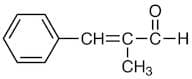
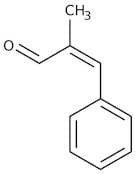
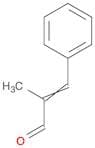
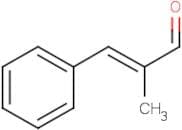
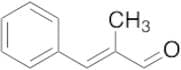
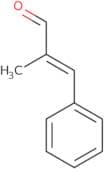
α-Méthylcinnamaldéhyde, avec le numéro CAS 101-39-3, est un composé organique qui appartient à la classe des aldéhydes. Il se caractérise par sa structure aromatique, avec un groupe méthyle adjacent à une partie de cinnamaldéhyde. Ce composé apparaît généralement sous la forme d'un liquide incolore à jaune pâle avec une odeur douce, florale et légèrement épicée, ce qui le rend précieux dans les industries de la parfumerie et des arômes. Sa formule moléculaire est C10H10O, et il a un point d'ébullition relativement bas, ce qui indique qu'il peut s'évaporer facilement à température ambiante. α-Méthylcinnamaldéhyde est connu pour ses applications potentielles en parfumerie, ainsi que dans la synthèse de divers composés organiques. De plus, il présente certaines propriétés antimicrobiennes, qui peuvent contribuer à son utilisation dans la conservation des aliments et les formulations cosmétiques. Cependant, comme de nombreux composés organiques, il doit être manipulé avec précaution en raison des effets irritants potentiels sur la peau et le système respiratoire. Dans l'ensemble, α-Méthylcinnamaldéhyde est un composé polyvalent d'une importance industrielle significative.
Formule :C10H10O
InChI :InChI=1S/C10H10O/c1-9(8-11)7-10-5-3-2-4-6-10/h2-8H,1H3
Code InChI :InChIKey=VLUMOWNVWOXZAU-UHFFFAOYSA-N
SMILES :C(=C(C=O)C)C1=CC=CC=C1
Synonymes :- (2E)-2-methyl-3-phenylprop-2-enal
- (2Z)-2-methyl-3-phenylprop-2-enal
- 2-Methyl-3-Phenylprop-2-Enal
- 2-Methyl-3-phenyl-2-propen-1-al
- 2-Methyl-3-phenyl-2-propenal
- 2-Methyl-3-phenylacrolein
- 2-Methyl-3-phenylacrylaldehyde
- 2-Methyl-3-phenylpropenal
- 2-Methylcinnamic aldehyde
- 2-Propenal, 2-methyl-3-phenyl-
- Cinnamaldehyde, α-methyl-
- Methyl Cinnamic Aldehyde
- Methylcinnamaldehyde
- NSC 22283
- NSC 49286
- α-Methylcinnamaldehyde
- Voir plus de synonymes
Trier par
Degré de pureté (%)
0
100
|
0
|
50
|
90
|
95
|
100
9 produits concernés.
α-Methylcinnamaldehyde
CAS :Formule :C10H10ODegré de pureté :>95.0%(GC)Couleur et forme :Colorless to Yellow to Yellow green clear liquidMasse moléculaire :146.19α-Methylcinnamaldehyde, predominantly (E), 97%
CAS :This Thermo Scientific Chemicals brand product was originally part of the Alfa Aesar product portfolio. Some documentation and label information may refer to the legacy brand. The original Alfa Aesar product / item code or SKU reference has not changed as a part of the brand transition to Thermo SciFormule :C10H10ODegré de pureté :97%Couleur et forme :Clear pale yellow to yellow, LiquidMasse moléculaire :146.192-Methyl-3-phenylacrylaldehyde
CAS :Formule :C10H10ODegré de pureté :95%Couleur et forme :LiquidMasse moléculaire :146.1858a-Methylcinnamaldehyde
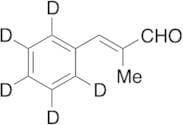
CAS :Formule :C10H10ODegré de pureté :95%Couleur et forme :LiquidMasse moléculaire :146.189α-Methyl-trans-cinnamaldehyde-d5
CAS :Produit contrôléApplications α-Methylcinnamaldehyde-d5 is an isotope labelled intermediate in the synthesis of Epalrestat (E565300), an aldose reductase inhibitor. It is used in treatment of diabetic neuropathy.
References Sarigol, D., et al.: Bioorg. Med. Chem., 23, 2518 (2015);Formule :C10H5D5OCouleur et forme :NeatMasse moléculaire :151.22α-Methylcinnamaldehyde
CAS :Produit contrôléApplications (cas# 15174-47-7) is a useful research chemical.
Formule :C10H10OCouleur et forme :NeatMasse moléculaire :146.19α-Methylcinnamic aldehyde
CAS :Methyl anthranilate is a chiral compound with the chemical formula C9H7NO3. It has been shown to have cancer-detecting properties in vitro, as well as anti-cancer activity in laboratory animals. Methyl anthranilate has also been shown to inhibit the growth of tumor cells and induce apoptosis. The methyl anthranilate molecule is found in urine samples of patients with bladder cancer. This chemical can be synthesized by reacting phenol with formaldehyde followed by condensation with methylamine. Methyl anthranilate can be used as a test compound for cancer diagnosis. Methyl anthranilate reacts with diphenolase (a type of enzyme) to produce a blue product, which can be detected using an assay that measures absorbance at 545 nm wavelength. The reaction between methyl anthranilate and tyrosinase produces a yellow product that can be measured at 600 nm wavelength.Formule :C10H10ODegré de pureté :Min. 95%Couleur et forme :Clear LiquidMasse moléculaire :146.19 g/mol