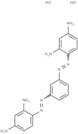
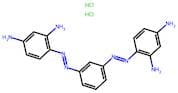
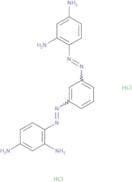
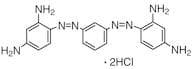
![1,3-Benzenediamine, 4,4′-[1,3-phenylenebis(2,1-diazenediyl)]bis-, hydrochloride (1:2)](/_next/image/?url=https%3A%2Fstatic.cymitquimica.com%2Fcas-image%2Fthumb-webp%2F305156-13-benzenediamine-44-13-phenylenebis-21-diazenediyl-bis-hydrochloride-1-2.webp&w=3840&q=75)
CAS 10114-58-6
:1,3-Benzènediamine, 4,4′-[1,3-phénylènobis(2,1-diazènediyl)]bis-, chlorhydrate (1:2)
Description :
1,3-Benzènediamine, 4,4′-[1,3-phénylènobis(2,1-diazènediyl)]bis-, chlorhydrate (1:2), communément connu comme un composé diazo, se caractérise par sa structure complexe qui comprend plusieurs groupes d'amines aromatiques et des liaisons azo. Ce composé apparaît généralement sous forme solide, souvent de couleur sombre en raison de la présence de systèmes conjugués qui absorbent la lumière visible. Il est soluble dans l'eau et divers solvants organiques, ce qui indique la présence de ses groupes fonctionnels polaires. La présence de groupes amines suggère qu'il peut participer à des liaisons hydrogène, influençant sa réactivité et sa solubilité. En tant que sel de chlorhydrate, il est stabilisé par l'ion chlorure, ce qui peut affecter son interaction avec d'autres substances. Ce composé est principalement utilisé dans la synthèse de colorants et comme intermédiaire dans des réactions organiques. Cependant, il est important de le manipuler avec précaution en raison de la toxicité potentielle et des préoccupations environnementales associées aux composés azo. Des mesures de sécurité appropriées doivent être observées lors du travail avec cette substance dans des environnements de laboratoire.
Formule :C18H18N8·2ClH
InChI :InChI=1S/C18H18N8.2ClH/c19-11-4-6-17(15(21)8-11)25-23-13-2-1-3-14(10-13)24-26-18-7-5-12(20)9-16(18)22;;/h1-10H,19-22H2;2*1H
Code InChI :InChIKey=MCZVRBLCRZWFJH-UHFFFAOYSA-N
SMILES :N(=NC1=CC(N=NC2=C(N)C=C(N)C=C2)=CC=C1)C3=C(N)C=C(N)C=C3.Cl
Synonymes :- 1,3-Benzenediamine, 4,4′-[1,3-phenylenebis(2,1-diazenediyl)]bis-, hydrochloride (1:2)
- 1,3-Benzenediamine, 4,4′-[1,3-phenylenebis(azo)]bis-, dihydrochloride
- 4,4'-[(4-methylbenzene-1,3-diyl)di(E)diazene-2,1-diyl]bis(5-amino-2-methylanilinium) dichloride
- 4,4'-[benzene-1,3-diyldi(E)diazene-2,1-diyl]dibenzene-1,3-diamine
- 4,4'-[benzene-1,3-diyldi(E)diazene-2,1-diyl]dibenzene-1,3-diamine dihydrochloride
- 4-[(E)-{3-[(Z)-(2,4-diaminophenyl)diazenyl]phenyl}diazenyl]benzene-1,3-diamine dihydrochloride
- Basic Brown 1
- Basic Brown1
- Bismark Brown Y
- C.I. Basic Brown 1, dihydrochloride
Trier par
Degré de pureté (%)
0
100
|
0
|
50
|
90
|
95
|
100
7 produits concernés.
Bismarck Brown
CAS :Formule :C18H18N8·2HClCouleur et forme :Yellow to Dark green to Black powder to crystalMasse moléculaire :419.31Bismarck Brown Y
CAS :Plasma stain for mucins, cartilage and goblet cellsBismarck Brown Y is used for staining mucine, cartilage and goblet cells. This Thermo Scientific Chemicals brand product was originally part of the Alfa Aesar product portfolio. Some documentation and label information may refer to the legacy brandFormule :C18H20Cl2N8Couleur et forme :Powder, Red-brown to dark brown or blackMasse moléculaire :419.311,3-Benzenediamine, 4,4'-[1,3-phenylenebis(2,1-diazenediyl)]bis-, hydrochloride (1:2)
CAS :Formule :C18H20Cl2N8Degré de pureté :99%Couleur et forme :SolidMasse moléculaire :419.3110Bismark Brown Y
CAS :Bismark Brown Y is a brown dye.Formule :C18H20Cl2N8Couleur et forme :Physical Description Odorless Dark Purple To Blackish-Brown Powder (Ntp 1992)Masse moléculaire :419.31Bismarck Brown Y (C.I. 21000)
CAS :Formule :C18H18N8·2HClCouleur et forme :Light brown to reddish brown or maroon powderMasse moléculaire :419.32Basic Brown 1 dihydrochloride
CAS :Basic Brown 1 is a dye that has the chemical formula of C 18 H 22 ClN 2 O 3 S. It is water soluble and can be used as a stain in biological samples, such as urine or feces, to provide color contrast. Basic Brown 1 is also used as an experimental model for wastewater treatment and biological sample detection. Basic Brown 1 has been shown to be activated by hydrochloric acid and copper complex in an aqueous solution. The dye has low water permeability, which may cause it to accumulate at the surface of the bacterial strain, including gram-positive bacteria. The dye's adsorption properties are determined by thermodynamic data and kinetic values obtained from surface methodology experiments using electrochemical impedance spectroscopy (EIS).Formule :C18H20Cl2N8Couleur et forme :PowderMasse moléculaire :419.31 g/mol


![1,3-Benzenediamine, 4,4'-[1,3-phenylenebis(2,1-diazenediyl)]bis-, hydrochloride (1:2)](/_next/image/?url=https%3A%2Fstatic.cymitquimica.com%2Fproducts%2FIN%2Fthumb%2FDA0003UM.jpg&w=3840&q=75)