CAS 10125-07-2
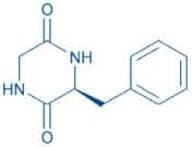
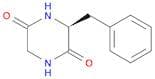
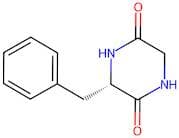
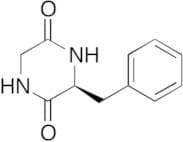
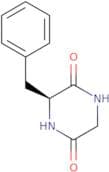
:Cyclo(-Gly-Phe)
Cyclo(-Gly-Phe)
CAS :Bachem ID: 4028308.
Formule :C11H12N2O2Degré de pureté :> 99%Couleur et forme :White PowderMasse moléculaire :204.232,5-Piperazinedione, 3-(phenylmethyl)-, (3S)-
CAS :Formule :C11H12N2O2Degré de pureté :98%Couleur et forme :SolidMasse moléculaire :204.2252(S)-3-Benzylpiperazine-2,5-dione
CAS :(S)-3-Benzylpiperazine-2,5-dioneDegré de pureté :98%Masse moléculaire :204.23g/molCyclo(-Gly-Phe)
CAS :Produit contrôléApplications Cyclo(-Gly-Phe) is used to study the thermodynamics of protein unfolding. It is also able to cause gelation in a wide variety of organic fluids, including edible oils, glyceryl esters, alcohols, and aromatic molecules.
References Murphy, K., et al.: J. Mol. Biol., 222, 699 (1991); Hanabusa, K., et al.: J. Colloid Interface Sci., 224, 231 (2000)Formule :C11H12N2O2Couleur et forme :WhiteMasse moléculaire :204.23(S)-3-Benzylpiperazine-2,5-dione
CAS :Formule :C11H12N2O2Degré de pureté :98%Couleur et forme :SolidMasse moléculaire :204.229Cyclo(-Gly-L-Phe)
CAS :Cyclo(-Gly-L-Phe) is a cyclic peptide with hydroxyl group at the C-terminal. It has been shown to have high uptake and cytotoxicity in intestinal cells. The uptake of Cyclo(-Gly-L-Phe) was found to be reversed phase high performance liquid chromatography (RP-HPLC). Cyclo(-Gly-L-Phe) is also cytotoxic to coryneform, caco2, and HeLa cells and inhibits cellular protein synthesis through inhibition of ribosome function.
Formule :C11H12N2O2Degré de pureté :Min. 95%Couleur et forme :PowderMasse moléculaire :204.23 g/mol