CAS 103129-81-3
:(+)-Amlodipine
Description :
(+)-Amlodipine est un bloqueur des canaux calciques dihydropyridinique principalement utilisé dans le traitement de l'hypertension et de l'angine. Il se caractérise par sa capacité à inhiber sélectivement l'entrée des ions calcium dans le muscle lisse vasculaire et le muscle cardiaque, entraînant une vasodilatation et une réduction de la pression artérielle. Le composé est une molécule chirale, avec la désignation (+) indiquant son activité optique spécifique. Sa formule moléculaire se compose généralement d'atomes de carbone, d'hydrogène, d'azote et d'oxygène, contribuant à ses propriétés pharmacologiques. (+)-Amlodipine est connu pour sa longue demi-vie, permettant une posologie une fois par jour, ce qui améliore l'observance du patient. Il est généralement bien toléré, avec des effets secondaires courants tels que l'œdème périphérique, les maux de tête et la fatigue. La substance est souvent formulée sous forme de sel, comme le bézilate d'amlodipine, pour améliorer sa solubilité et sa biodisponibilité. En tant que membre de la classe des bloqueurs des canaux calciques, il joue un rôle crucial dans la thérapie cardiovasculaire, aidant à gérer les conditions liées à l'hypertension et à la douleur thoracique.
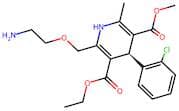
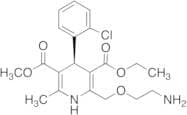
Formule :C20H25ClN2O5
InChI :InChI=1S/C20H25ClN2O5/c1-4-28-20(25)18-15(11-27-10-9-22)23-12(2)16(19(24)26-3)17(18)13-7-5-6-8-14(13)21/h5-8,17,23H,4,9-11,22H2,1-3H3/t17-/m1/s1
Code InChI :InChIKey=HTIQEAQVCYTUBX-QGZVFWFLSA-N
SMILES :C(OCC)(=O)C=1[C@@H](C(C(OC)=O)=C(C)NC1COCCN)C2=C(Cl)C=CC=C2
Synonymes :- (+)-Amlodipine
- (R)-(+)-Amlodipine
- (R)-3-Ethyl 5-methyl 2-((2-aminoethoxy)methyl)-4-(2-chlorophenyl)-6-methyl-1,4-dihydropyridine-3,5-dicarboxylate
- 3,5-Pyridinedicarboxylic acid, 2-[(2-aminoethoxy)methyl]-4-(2-chlorophenyl)-1,4-dihydro-6-methyl-, 3-ethyl 5-methyl ester, (4R)-
- 3,5-Pyridinedicarboxylic acid, 2-[(2-aminoethoxy)methyl]-4-(2-chlorophenyl)-1,4-dihydro-6-methyl-, 3-ethyl 5-methyl ester, (R)-
- 3-ethyl 5-methyl (4R)-2-[(2-aminoethoxy)methyl]-4-(2-chlorophenyl)-6-methyl-1,4-dihydropyridine-3,5-dicarboxylate
Trier par
Degré de pureté (%)
0
100
|
0
|
50
|
90
|
95
|
100
6 produits concernés.
(R)-3-Ethyl 5-methyl 2-((2-aminoethoxy)methyl)-4-(2-chlorophenyl)-6-methyl-1,4-dihydropyridine-3,5-dicarboxylate
CAS :(R)-3-Ethyl 5-methyl 2-((2-aminoethoxy)methyl)-4-(2-chlorophenyl)-6-methyl-1,4-dihydropyridine-3,5-dicarboxylateDegré de pureté :97%Masse moléculaire :408.88g/mol(R)-Amlodipine
CAS :Formule :C20H25ClN2O5Couleur et forme :White To Off-White SolidMasse moléculaire :408.88(R)-Amlodipine
CAS :Produit contrôléApplications (R)-Enantiomer of Amlodipine (A633495). A dihydropyridine calcium channel blocker; activity resides mainly in the (-)-isomer.
References Arrowsmith, J.E., et al.: J. Med. Chem., 29, 1696 (1986), Burges, R.A., et al.: J. Cardiovasc. Pharmacol., 9, 110 (1987), Haria, M., et al.: Drugs, 50, 560 (1995),Formule :C20H25ClN2O5Couleur et forme :NeatMasse moléculaire :408.88(R)-Amlodipine
CAS :(R)-Amlodipine is the R-enantiomer of Amlodipine and functions as an orally active dihydropyridine calcium channel blocker with antianginal properties.Formule :C20H25ClN2O5Degré de pureté :99.977%Couleur et forme :SolidMasse moléculaire :408.88(R)-Amlodipine
CAS :(R)-Amlodipine is a calcium channel blocker that binds to the L-type calcium channels and inhibits the influx of cytosolic calcium, thereby reducing the excitation of ventricular myocytes and decreasing blood pressure. It is also used for the treatment of endometriosis. The (S)-enantiomer has no pharmacological activity and is not used clinically. The mechanism of action for amlodipine involves binding to the cytosolic Ca2+-ATPase pumps, which are responsible for recycling cytosolic Ca2+ back into the intracellular space. As a result, there is an increase in cytosolic Ca2+, which leads to a decrease in excitability of cardiac myocytes, vasoconstriction, and decreased blood pressure. Amlodipine has been shown to be effective against angiotensin II-induced hypertension in rats by blocking efflux pump activity at the blood-brain barrier.Formule :C20H25ClN2O5Degré de pureté :Min. 95%Masse moléculaire :408.88 g/mol(R)-Amlodipine (3-ethyl 5-methyl (R)-2-((2-aminoethoxy)methyl)-4-(2-chlorophenyl)-6-methyl-1,4-dihydropyridine-3,5-dicarboxylate)
CAS :Compounds containing an unfused pyridine ring in the structure, nesoiFormule :C20H25ClN2O5Couleur et forme :Off-White SolidMasse moléculaire :408.1452