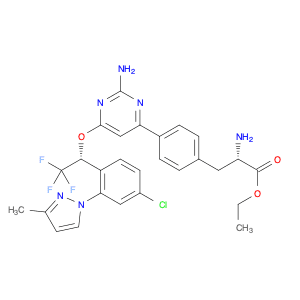
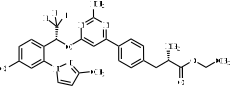
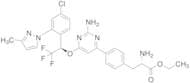
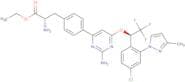
![4-[2-Amino-6-[(1R)-1-[4-chloro-2-(3-methyl-1H-pyrazol-1-yl)phenyl]-2,2,2-trifluoroethoxy]-4-pyrimi…](/_next/image/?url=https%3A%2Fstatic.cymitquimica.com%2Fcas-image%2Fthumb-webp%2F40746-4-2-amino-6-1r-1-4-chloro-2-3-methyl-1h-pyrazol-1-yl-phenyl-222-trifluoroethoxy-4-pyrimidinyl-l-phenylalanine-ethyl-ester.webp&w=3840&q=75)
CAS 1033805-22-9
:4-[2-Amino-6-[(1R)-1-[4-chloro-2-(3-méthyl-1H-pyrazol-1-yl)phényl]-2,2,2-trifluoroéthoxy]-4-pyrimidinyl]-L-phénylalanine éthyl ester
Description :
La substance chimique connue sous le nom de 4-[2-Amino-6-[(1R)-1-[4-chloro-2-(3-méthyl-1H-pyrazol-1-yl)phényl]-2,2,2-trifluoroéthoxy]-4-pyrimidinyl]-L-phénylalanine éthyl ester, avec le numéro CAS 1033805-22-9, est un composé organique complexe caractérisé par sa structure multifonctionnelle. Elle présente un cycle pyrimidine, qui est un hétérocycle aromatique à six membres contenant des atomes d'azote, et un groupe acide aminé, spécifiquement la L-phénylalanine, qui contribue à son activité biologique. La présence d'un groupe trifluoroéthoxy et d'un cycle phényle chloré indique un potentiel d'interactions significatives dans les systèmes biologiques, influençant peut-être ses propriétés pharmacologiques. De plus, le composé contient un groupe pyrazole, connu pour ses diverses activités biologiques, y compris des effets anti-inflammatoires et anticancéreux. Le groupe fonctionnel ester éthylique suggère que le composé pourrait présenter une lipophilie accrue, affectant potentiellement son absorption et sa distribution dans les systèmes biologiques. Dans l'ensemble, la structure complexe de ce composé suggère qu'il pourrait être d'un intérêt dans la chimie médicinale et le développement de médicaments.
Formule :C27H26ClF3N6O3
InChI :InChI=1S/C27H26ClF3N6O3/c1-3-39-25(38)20(32)12-16-4-6-17(7-5-16)21-14-23(35-26(33)34-21)40-24(27(29,30)31)19-9-8-18(28)13-22(19)37-11-10-15(2)36-37/h4-11,13-14,20,24H,3,12,32H2,1-2H3,(H2,33,34,35)/t20-,24+/m0/s1
Code InChI :InChIKey=MDSQOJYHHZBZKA-GBXCKJPGSA-N
SMILES :[C@H](OC=1C=C(N=C(N)N1)C2=CC=C(C[C@@H](C(OCC)=O)N)C=C2)(C(F)(F)F)C3=C(C=C(Cl)C=C3)N4C=CC(C)=N4
Synonymes :- (2S)-2-Amino-3-[4-[2-amino-6-[[(1R)-1-[4-chloro-2-(3-methylpyrazol-1-yl)phenyl]-2,2,2-trifluoroethyl]oxy]pyrimidin-4-yl]phenyl]propionic acid ethyl ester
- 4-[2-Amino-6-[(1R)-1-[4-chloro-2-(3-methyl-1H-pyrazol-1-yl)phenyl]-2,2,2-trifluoroethoxy]-4-pyrimidinyl]-<span class="text-smallcaps">L</span>-phenylalanine ethyl ester
- <span class="text-smallcaps">L</span>-Phenylalanine, 4-[2-amino-6-[(1R)-1-[4-chloro-2-(3-methyl-1H-pyrazol-1-yl)phenyl]-2,2,2-trifluoroethoxy]-4-pyrimidinyl]-, ethyl ester
- Lx 1032
- Lx 1606
- Lx1032
- Telotristat ethyl
- Xermelo
- 4-[2-Amino-6-[(1R)-1-[4-chloro-2-(3-methyl-1H-pyrazol-1-yl)phenyl]-2,2,2-trifluoroethoxy]-4-pyrimidinyl]-L-phenylalanine ethyl ester
- L-Phenylalanine, 4-[2-amino-6-[(1R)-1-[4-chloro-2-(3-methyl-1H-pyrazol-1-yl)phenyl]-2,2,2-trifluoroethoxy]-4-pyrimidinyl]-, ethyl ester
Trier par
Degré de pureté (%)
0
100
|
0
|
50
|
90
|
95
|
100
8 produits concernés.
LX-1606 Hippurate
CAS :Formule :C27H26ClF3N6O3Degré de pureté :%Couleur et forme :SolidMasse moléculaire :574.9819Telotristat ethyl
CAS :Telotristat ethyl (LX1606) is a orally-delivered inhibitor of tryptophan hydroxylase that reduces serotonin production.Formule :C27H26ClF3N6O3Degré de pureté :98% - 99.89%Couleur et forme :White SolidMasse moléculaire :574.98Telotristat Ethyl
CAS :Produit contrôléApplications Telotristat Ethyl can be used in biological study of serotonin biosynthesis as a predictive marker of serotonin pharmacodynamics and disease-induced dysregulation.
References Welford, R. W. D., et al.: Scientific Reports, 6, 30059 (2016)Formule :C27H26ClF3N6O3Couleur et forme :NeatMasse moléculaire :574.98(S)-Ethyl2-amino-3-(4-(2-amino-6-((R)-1-(4-chloro-2-(3-methyl-1H-pyrazol-1-yl)phenyl)-2,2,2-trifluoroethoxy)pyrimidin-4-yl)phenyl)pr opanoate
CAS :Telotristat ethyl is a pharmacological treatment for carcinoid syndrome, which is caused by the release of serotonin from enterochromaffin cells in the intestine. Telotristat ethyl inhibits serotonin release by reversibly inhibiting serotonin release from enterochromaffin cells and other cell types that express 5-HT4 receptors. This drug has no effect on the release of histamine or acetylcholine and does not cross the blood-brain barrier. Telotristat ethyl has shown long-term efficacy in people with carcinoid syndrome and minimal toxicity profiles. The most common side effects are diarrhoea, nausea, vomiting, abdominal pain, headache, and dizziness.Formule :C27H26ClF3N6O3Degré de pureté :Min. 95%Masse moléculaire :574.98 g/mol