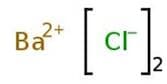
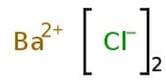
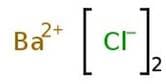
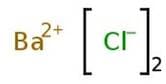
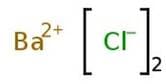
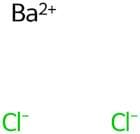
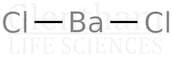
CAS 10361-37-2
:Chlorure de baryum
- Ba 0108E
- Barium Chloride A.R.
- Barium chloride (BaCl2)
- Barium chloride (BaCl<sub>2</sub>)
- Barium chloride,anhydrous
- Barium dichloride
- Bariumchlorid
- Chlorure de baryum
- Cloruro De Bario
- Nsc 146181
- Barium chloride
Barium chloride, ultra dry, 99.998% (metals basis)
CAS :This Thermo Scientific Chemicals brand product was originally part of the Alfa Aesar product portfolio. Some documentation and label information may refer to the legacy brand. The original Alfa Aesar product / item code or SKU reference has not changed as a part of the brand transition to Thermo SciFormule :BaCl2Degré de pureté :99.998%Couleur et forme :White, BeadsMasse moléculaire :208.23Barium chloride, 0.1N Standardized Solution
CAS :This Thermo Scientific Chemicals brand product was originally part of the Alfa Aesar product portfolio. Some documentation and label information may refer to the legacy brand. The original Alfa Aesar product / item code or SKU reference has not changed as a part of the brand transition to Thermo Sci
Formule :BaCl2Couleur et forme :Colorless, LiquidMasse moléculaire :208.23Barium chloride, anhydrous, 99.998% (metals basis)
CAS :Barium chloride is used in manufacture of pigments, fire works, other barium salts, fireworks , hardening of steel, heat treatment salts, purification of brine solution in caustic chlorine plants, lubrication oil additive, textile dye, pigments, white leather, aluminum refining, boiling water treatFormule :BaCl2Degré de pureté :99.998%Couleur et forme :White, Powder, may contain small lumpsMasse moléculaire :208.23Barium chloride, 0.5N Standardized Solution
CAS :This Thermo Scientific Chemicals brand product was originally part of the Alfa Aesar product portfolio. Some documentation and label information may refer to the legacy brand. The original Alfa Aesar product / item code or SKU reference has not changed as a part of the brand transition to Thermo SciFormule :BaCl2Couleur et forme :Colorless, LiquidMasse moléculaire :208.23Barium chloride, 10% w/v aq. soln.
CAS :This Thermo Scientific Chemicals brand product was originally part of the Alfa Aesar product portfolio. Some documentation and label information may refer to the legacy brand. The original Alfa Aesar product / item code or SKU reference has not changed as a part of the brand transition to Thermo SciFormule :BaCl2Couleur et forme :Liquid, ColorlessMasse moléculaire :208.23Barium chloride, anhydrous, 98+%
CAS :Barium chloride, anhydrous, 98+%
Formule :BaCl2Degré de pureté :98+%Couleur et forme :white pwdr.Masse moléculaire :208.24Barium chloride, anhydrous, 99%
CAS :Formule :BaCl2Degré de pureté :≥ 99.0%Couleur et forme :White to off-white powder or crystalsMasse moléculaire :208.24Barium Chloride Anhydrous
CAS :Barium Chloride AnhydrousDegré de pureté :≥95%Couleur et forme :White SolidMasse moléculaire :208.23g/molBarium chloride, anhydrous, 99.9%
CAS :Formule :BaCl2Degré de pureté :≥ 99.9%Couleur et forme :White powderMasse moléculaire :208.24Barium chloride anhydrous
CAS :Barium chloride anhydrous is a chemical compound with the formula BaCl2. It is soluble in water and has been used for wastewater treatment. The solubility of this compound increases as temperature decreases. Barium chloride anhydrous can also be used to measure the levels of calcium ions in cells and tissues, by measuring the fluorescence intensity produced when the compound reacts with Ca2+. This property has been utilized to study neuronal death and Ca2+ overload. Barium chloride anhydrous also exhibits biological properties, such as enzyme activity or the ability to bind coumarin derivatives. X-ray diffraction data have shown that BaCl2 consists of a cubic crystalline structure, with each barium ion coordinated by six chloride ions. In solution, BaCl2 dissociates into Ba2+ and Cl-. Water vapor may cause the formation of anhydrous sodium carbonate on surfaces of objects exposed to it. The structural analysis of this compound has been modeled using particle methods.
Formule :BaCl2Degré de pureté :Min. 95%Masse moléculaire :208.23 g/mol