CAS 104-10-9
:2-(4-Aminophényl)éthanol
Description :
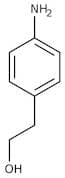
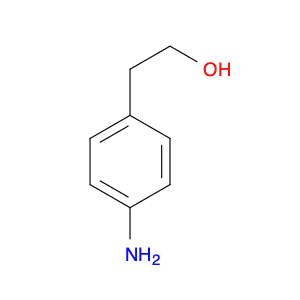
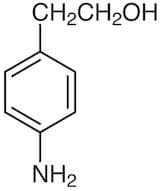
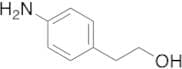
2-(4-Aminophényl)éthanol, également connu sous le nom de para-aminophényléthanol, est un composé organique caractérisé par la présence d'un groupe amino (-NH2) et d'un groupe hydroxyle (-OH) attachés à un anneau phénylique. Ce composé présente une chaîne éthyle de deux carbones reliant le groupe phénylique substitué par un amino au groupe hydroxyle. Il est généralement un solide blanc à blanc cassé à température ambiante et est soluble dans l'eau et les solvants organiques en raison de ses groupes fonctionnels polaires. La présence du groupe amino confère des propriétés basiques, lui permettant de participer à diverses réactions chimiques, y compris l'acylation et l'alkylation. 2-(4-Aminophényl)éthanol est d'un intérêt en chimie médicinale et peut servir de précurseur dans la synthèse de médicaments, en particulier dans le développement d'analgésiques et d'agents anti-inflammatoires. De plus, il peut être utilisé dans la fabrication de colorants et comme réactif dans la synthèse organique. Des précautions de sécurité doivent être observées lors de la manipulation de ce composé, car il peut présenter des risques pour la santé en cas d'exposition.
Formule :C8H11NO
InChI :InChI=1S/C8H11NO/c9-8-3-1-7(2-4-8)5-6-10/h1-4,10H,5-6,9H2
Code InChI :InChIKey=QXHDYMUPPXAMPQ-UHFFFAOYSA-N
SMILES :C(CO)C1=CC=C(N)C=C1
Synonymes :- 2-(4-Amino-phenyl)ethanol
- 2-(4-Aminophenyl) ethanol
- 2-(4-Aminophenyl)-1-ethanol
- 2-(4-Aminophenyl)ethyl alcohol
- 2-(p-Aminophenyl)ethanol
- 4-(2-Hydroxyethyl)aniline
- 4-(2-Hydroxyethyl)phenylamine
- 4-Amino Phenethyl Alcohol
- 4-Aminobenzeneethanol
- 4-Aminophenethyl alcohol
- Benzeneethanol, 4-amino-
- NSC 409780
- P-Amino Phenethyl Alcohol
- P-Aminophenethyl Alcohol
- Phenethyl alcohol, p-amino-
- Voir plus de synonymes
Trier par
Degré de pureté (%)
0
100
|
0
|
50
|
90
|
95
|
100
10 produits concernés.
2-(4-Aminophenyl)ethanol, 97%
CAS :2-(4-Aminophenyl)ethanol is used as nonsymmetric monomer in the preparation of ordered [head-to-head (H-H) or tail-to-tail (T-T)] poly(amide-ester), in the synthesis of 4-aminostyrene and in functionalization of graphene nanoplatelets. This Thermo Scientific Chemicals brand product was originallyFormule :C8H11NODegré de pureté :97%Couleur et forme :Pale cream to cream to yellow to brown, Crystals or powder or crystalline powder or lumps or granulesMasse moléculaire :137.182-(4-Aminophenyl)ethanol
CAS :Formule :C8H11NODegré de pureté :95%Couleur et forme :SolidMasse moléculaire :137.17904-Aminophenethyl alcohol
CAS :4-Aminophenethyl alcoholFormule :C8H11NODegré de pureté :≥95%Couleur et forme : brown crystalline powderMasse moléculaire :137.17903g/mol2-(4-Aminophenyl)ethanol
CAS :Formule :C8H11NODegré de pureté :>98.0%(GC)(T)Couleur et forme :White to Light yellow to Light orange powder to crystalMasse moléculaire :137.184-Aminophenethyl alcohol
CAS :Formule :C8H11NODegré de pureté :95%Couleur et forme :Solid, Chunks or Crystalline PowderMasse moléculaire :137.1824-Aminophenethyl Alcohol
CAS :Produit contrôléApplications 4-Aminophenethyl Alcohol, is a building block that can be used in the synthesis of various compounds, such as in synthesis of 4-aminostyrene, and in functionalization of graphene nanoplatelets.
References Li L, et al.Polymer Journal 33(4), 364-370; Hagiwara T, et al. Macromolecules 24(26), 6856-6858, (1991);Formule :C8H11NOCouleur et forme :NeatMasse moléculaire :137.184-Aminophenethyl alcohol
CAS :4-Aminophenethyl alcohol is a monosubstituted, basic compound that is used in the laboratory as a cell culture medium supplement to promote growth of fibroblasts. This compound has been shown to stimulate human intestinal cells and human peripheral blood mononuclear cells. 4-Aminophenethyl alcohol acts as a hydroxyl group donor, which may be due to its ability to form hydrogen ions when reacted with sodium hydroxide solution. The reaction of this compound with diazonium salt produces an intermediate, which can be hydrolyzed by the addition of sodium hydroxide solution. The resultant chloride ion reacts with the aminophenethyldihydroxylamine (APDA) moiety to produce APDCl. This product has been shown to increase the population growth rate of fibroblasts in culture by causing DNA synthesis and protein synthesis. Linear regression analysis revealed that there was no statistically significant difference between the control and experimental groups for either DNAFormule :C8H11NODegré de pureté :Min. 95%Masse moléculaire :137.18 g/mol