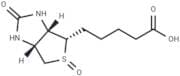
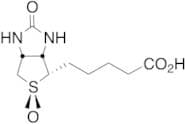
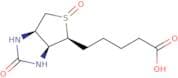
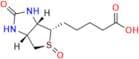
![1H-Thieno[3,4-d]imidazole-4-pentanoic acid, hexahydro-2-oxo-, 5-oxide, (3aS,4S,5S,6aR)-](/_next/image/?url=https%3A%2Fstatic.cymitquimica.com%2Fcas-image%2Fthumb-webp%2F1495-1h-thieno-34-d-imidazole-4-pentanoic-acid-hexahydro-2-oxo-5-oxide-3as-4s-5s-6ar.webp&w=3840&q=75)
CAS 10406-89-0
:Acide 1H-thieno[3,4-d]imidazole-4-pentanoïque, hexahydro-2-oxo-, 5-oxyde, (3aS,4S,5S,6aR)-
Description :
Acide 1H-thieno[3,4-d]imidazole-4-pentanoïque, hexahydro-2-oxo-, 5-oxyde, (3aS,4S,5S,6aR)- est un composé hétérocyclique caractérisé par sa structure unique de thienoimidazole, qui incorpore à la fois du soufre et de l'azote dans son système de cycle. Ce composé présente un groupe acide pentanoïque, contribuant à son potentiel en tant que molécule bioactive. La stéréochimie indiquée par la désignation (3aS,4S,5S,6aR) suggère des arrangements spatiaux spécifiques de ses atomes, qui peuvent influencer de manière significative son activité biologique et ses interactions. La présence du groupe hexahydro-2-oxo indique qu'il peut présenter un tautomérisme céto-enol, ce qui peut affecter sa réactivité et sa stabilité. Ce composé suscite un intérêt en chimie médicinale en raison de ses propriétés pharmacologiques potentielles, agissant peut-être comme un inhibiteur ou un modulateur enzymatique. Sa solubilité, sa stabilité et sa réactivité dépendraient des groupes fonctionnels présents et de la structure moléculaire globale. Comme de nombreux hétérocycles, il peut également présenter des propriétés électroniques intéressantes, ce qui en fait un candidat pour des recherches supplémentaires dans le développement de médicaments et la science des matériaux.
Formule :C10H16N2O4S
InChI :InChI=1S/C10H16N2O4S/c13-8(14)4-2-1-3-7-9-6(5-17(7)16)11-10(15)12-9/h6-7,9H,1-5H2,(H,13,14)(H2,11,12,15)/t6-,7-,9-,17-/m0/s1
Code InChI :InChIKey=KCSKCIQYNAOBNQ-OKPRWBIXSA-N
SMILES :C(CCCC(O)=O)[C@H]1[C@@]2([C@](CS1=O)(NC(=O)N2)[H])[H]
Synonymes :- 1H-Thieno(3,4-d)imidazole-4-pentanoic acid, hexahydro-2-oxo-, 5-oxide, (3aS,4S,5S,6aR)-
- 1H-Thieno(3,4-d)imidazole-4-pentanoic acid, hexahydro-2-oxo-, 5-oxide, (3aS-(3aalpha,4beta,5alpha,6aalpha))-
- 1H-Thieno[3,4-d]imidazole-4-pentanoic acid, hexahydro-2-oxo-, 5-oxide, [3aS-(3aα,4β,5α,6aα)]-
- 5-[(3aS,4S,6aR)-5-oxido-2-oxohexahydro-1H-thieno[3,4-d]imidazol-4-yl]pentanoic acid
- <span class="text-smallcaps">D</span>-Biotin-d-sulfoxide
- Biotin d-sulfoxide
- Biotin sulfoxide
- Biotin, 5-oxide, (+)-
- Biotin, <span class="text-smallcaps">D</span>-S-oxide
- D-Biotin-d-sulfoxide
- Biotin, D-S-oxide
Trier par
Degré de pureté (%)
0
100
|
0
|
50
|
90
|
95
|
100
6 produits concernés.
5-((3aS,4S,5S,6aR)-5-Oxido-2-oxohexahydro-1H-thieno[3,4-d]imidazol-4-yl)pentanoic acid
CAS :Formule :C10H16N2O4SCouleur et forme :SolidMasse moléculaire :260.3100Biotin (S)-sulfoxide
CAS :Biotin (S)-sulfoxide, an inactive E. coli metabolite, is reduced to biotin by its sulfoxide reduction system.Formule :C10H16N2O4SCouleur et forme :SolidMasse moléculaire :260.31Biotin (S)-Sulfoxide
CAS :Formule :C10H16N2O4SCouleur et forme :White To Off-White SolidMasse moléculaire :260.31(+)-Biotin (+)-Sulfoxide
CAS :Produit contrôléStability Hygroscopic
Applications (-)-Biotin Sulfoxide, is a metabolite of Biotin (B389040), which is a growth factor present in minute amounts in every living cell, and plays an indispensable role in numerous naturally occurring carboxylation reactions.
References du Vigneaud, et al.: J. Biol. Chem., 146, 475 (1942), Traub, et al.: Nature, 178, 649 (1956), Siegel, H., et al.: Experienta, 37, 789 (1981), Vesely, D.L., Science, 216, 1329 (1982), Hugues, M., et al.: Biochemistry, 31, 12 (1992),Formule :C10H16N2O4SCouleur et forme :NeatMasse moléculaire :260.31(+)-Biotin sulfoxide
CAS :Biotin sulfoxide is a biotin derivative that can be used to treat a number of human pathogens. This drug has been shown to inhibit the growth of wild-type strains in vivo and in vitro, as well as human pathogens. Biotin sulfoxide is a metal chelate that binds to molybdenum in the bacterial cell wall and prevents the formation of bacterial enzymes, such as reductase and sulfoxide reductase. This binding leads to a decrease in enzyme activities, which results in decreased protein synthesis and cell division. Biotin sulfoxide also has an inhibitory effect on light signal production, which may be due to its inhibition of proteins involved in electron transport. When administered orally, this drug can accumulate in the plasma and tissues, leading to chronic effects.Formule :C10H16N2O4SDegré de pureté :Min. 95%Couleur et forme :PowderMasse moléculaire :260.31 g/mol
![5-((3aS,4S,5S,6aR)-5-Oxido-2-oxohexahydro-1H-thieno[3,4-d]imidazol-4-yl)pentanoic acid](/_next/image/?url=https%3A%2Fstatic.cymitquimica.com%2Fproducts%2FIN%2Fthumb%2FDA007WRY.jpg&w=3840&q=75)