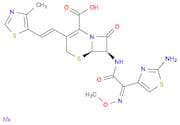
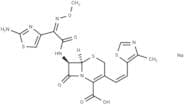
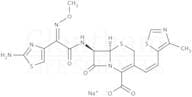
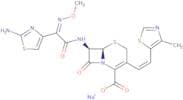
![5-Thia-1-azabicyclo[4.2.0]oct-2-ene-2-carboxylic acid, 7-[[(2Z)-2-(2-amino-4-thiazolyl)-2-(methoxy…](/_next/image/?url=https%3A%2Fstatic.cymitquimica.com%2Fcas-image%2Fthumb-webp%2F313410-5-thia-1-azabicyclo-4-2-0-oct-2-ene-2-carboxylic-acid-7-2z-2-2-amino-4-thiazolyl-2-methoxyimino-acetyl-amino-3-1z-2-4-methyl-5-thiazolyl-ethenyl-8-oxo-sodium-salt-1-1-6r-7r.webp&w=3840&q=75)
CAS 104146-53-4
:Acide 5-thia-1-azabicyclo[4.2.0]oct-2-ène-2-carboxylique, 7-[[(2Z)-2-(2-amino-4-thiazolyl)-2-(méthoxyimino)acétyl]amino]-3-[(1Z)-2-(4-méthyl-5-thiazolyl)éthényl]-8-oxo-, sel de sodium (1:1), (6R,7R)-
Description :
Acide 5-thia-1-azabicyclo[4.2.0]oct-2-ène-2-carboxylique, 7-[[(2Z)-2-(2-amino-4-thiazolyl)-2-(méthoxyimino)acétyl]amino]-3-[(1Z)-2-(4-méthyl-5-thiazolyl)éthényl]-8-oxo-, sel de sodium (1:1), (6R,7R)- est un composé chimique complexe caractérisé par sa structure bicyclique, qui comprend à la fois des moieties de thiazole et de thiazolidine. Ce composé est remarquable pour ses applications pharmacologiques potentielles, en particulier en tant qu'antibiotique, en raison de sa similitude structurelle avec d'autres agents antimicrobiens connus. La présence de plusieurs groupes fonctionnels, y compris des acides carboxyliques et des fonctionnalités amines, contribue à sa réactivité et à sa solubilité dans des environnements aqueux. La forme de sel de sodium améliore sa stabilité et sa biodisponibilité. Sa stéréochimie, indiquée par la configuration (6R,7R), est cruciale pour son activité biologique, influençant la manière dont il interagit avec les enzymes ou les récepteurs cibles. Dans l'ensemble, ce composé illustre la relation complexe entre la structure moléculaire et la fonction biologique, en faisant un sujet d'intérêt en chimie médicinale et en développement de médicaments.
Formule :C19H18N6O5S3·Na
InChI :InChI=1S/C19H18N6O5S3.Na/c1-8-11(33-7-21-8)4-3-9-5-31-17-13(16(27)25(17)14(9)18(28)29)23-15(26)12(24-30-2)10-6-32-19(20)22-10;/h3-4,6-7,13,17H,5H2,1-2H3,(H2,20,22)(H,23,26)(H,28,29);/b4-3-,24-12-;/t13-,17-;/m1./s1
Code InChI :InChIKey=YZHABJAZXAOLGE-WSWQWPGSSA-N
SMILES :C(O)(=O)C=1N2[C@@]([C@H](NC(/C(=N\OC)/C3=CSC(N)=N3)=O)C2=O)(SCC1/C=C\C4=C(C)N=CS4)[H].[Na]
Synonymes :- 5-Thia-1-azabicyclo(4.2.0)oct-2-ene-2-carboxylic acid, 7-(((2-amino-4-thiazolyl)(methoxyimino)acetyl)amino)-3-(2-(4-methyl-5-thiazolyl)ethenyl)-8-oxo-, monosodium salt, (6R-(3(Z),6-alpha,7-beta(Z)))-
- 5-Thia-1-azabicyclo[4.2.0]oct-2-ene-2-carboxylic acid, 7-[[(2-amino-4-thiazolyl)(methoxyimino)acetyl]amino]-3-[2-(4-methyl-5-thiazolyl)ethenyl]-8-oxo-, monosodium salt, [6R-[3(Z),6α,7β(Z)]]-
- 5-Thia-1-azabicyclo[4.2.0]oct-2-ene-2-carboxylic acid, 7-[[(2Z)-(2-amino-4-thiazolyl)(methoxyimino)acetyl]amino]-3-[(1Z)-2-(4-methyl-5-thiazolyl)ethenyl]-8-oxo-, monosodium salt, (6R,7R)-
- 5-Thia-1-azabicyclo[4.2.0]oct-2-ene-2-carboxylic acid, 7-[[(2Z)-2-(2-amino-4-thiazolyl)-2-(methoxyimino)acetyl]amino]-3-[(1Z)-2-(4-methyl-5-thiazolyl)ethenyl]-8-oxo-, sodium salt (1:1), (6R,7R)-
- 5-thia-1-azabicyclo[4.2.0]oct-2-ene-2-carboxylic acid, 7-[[(2E)-2-(2-amino-4-thiazolyl)-2-(methoxyimino)-1-oxoethyl]amino]-3-[(E)-2-(4-methyl-5-thiazolyl)ethenyl]-8-oxo-, sodium salt, (6R,7R)- (1:1)
- Cefditoren sodium
- Me 1206
Trier par
Degré de pureté (%)
0
100
|
0
|
50
|
90
|
95
|
100
5 produits concernés.
Cefditoren Sodium Salt
CAS :Formule :C19H17N6O5S3·NaCouleur et forme :Yellow SolidMasse moléculaire :505.56 22.99Cefditoren sodium
CAS :Cefditoren sodium: cephalosporin antibiotic for bacterial infections; alters Mrp2, Bcrp, Oat2, P-gp, Oct1 mRNA levels.Formule :C19H18N6NaO5S3Couleur et forme :SolidMasse moléculaire :529.57Cefditoren acid sodium
CAS :Cefditoren acid sodium is an antibacterial agent that belongs to the class of third-generation cephalosporins, which is derived from Acremonium fungus and produced through chemical synthesis. This compound acts by inhibiting bacterial cell wall synthesis, leading to cell lysis and death. It achieves this by binding to specific penicillin-binding proteins (PBPs) located inside the bacterial cell wall. The interruption of peptidoglycan synthesis in the cell wall is crucial for maintaining bacterial cell integrity, and its inhibition results in the bactericidal activity of cefditoren acid sodium. It is effective against a range of Gram-positive and Gram-negative bacteria. The key applications of this compound include the treatment of bacterial infections such as respiratory tract infections, skin infections, and other conditions caused by susceptible bacteria. Its spectrum of activity and pharmacokinetic properties make it suitable for situations where third-generation cephalosporins are indicated. Understanding the specific interaction with PBPs and the resistance mechanisms is crucial for optimizing its clinical use and managing antibiotic resistance.Formule :C19H17N6NaO5S3Degré de pureté :94%MinMasse moléculaire :528.56 g/mol