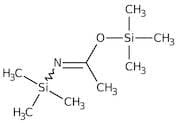
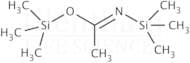
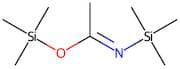
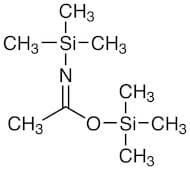
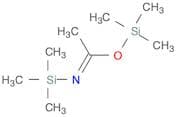
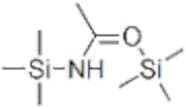
CAS 10416-59-8
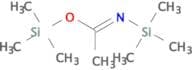
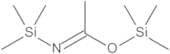
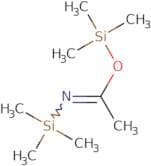
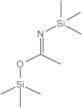
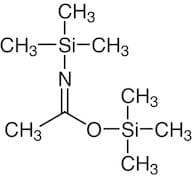
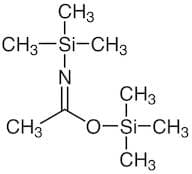
:N,O-Bis(triméthylsilyl)acétamide
- Acetimidic acid, N-(trimethylsilyl)-, trimethylsilyl ester
- BSA
- Bis trimethyl silyl acetamide
- Bis(trimethylsilyl)acetamide
- Bis(trimethylsilyl)acetimidate
- Dynasylan Bsa
- Ethanimidic acid, N-(trimethylsilyl)-, trimethylsilyl ester
- Ls 7270
- N,O-BIS-(Trimethyl silyl)-acetamide
- N,O-Bis(trimethylsilyl)aectamide
- N,O-Bis-trimethylsilylacetoamide
- N,O-Di(trimethylsilyl)acetamide
- N-(Trimethylsilyl)acetimidic acid trimethylsilyl ester
- N-(Trimethylsilyl)ethanimidic acid trimethylsilyl ester
- NO-Bis (trimethylsilyl) acetamide
- O,N-Bis(trimethylsilyl)acetamide
- trimethylsilyl (1E)-N-(trimethylsilyl)ethanimidoate
- trimethylsilyl N-(trimethylsilyl)ethanimidoate
- trimethylsilyl N-trimethylsilylacetamidate
- Voir plus de synonymes
N,O-Bis(trimethylsilyl)acetamide [Trimethylsilylating Agent]
CAS :Formule :C8H21NOSi2Degré de pureté :>80.0%(GC)Couleur et forme :Colorless to Light yellow clear liquidMasse moléculaire :203.43N,O-Bis(trimethylsilyl)acetamide (25% in Acetonitrile) [Trimethylsilylating Reagent, for NH2 compounds]
CAS :Couleur et forme :Colorless to Light yellow clear liquidN,O-Bis(trimethylsilyl)acetamide Kit BSA 1 mL × 8 / Reaction vial, capacity 2 mL × 8
CAS :Degré de pureté :>80.0%(GC)Couleur et forme :Colorless to Light yellow clear liquidBSA [=N,O-Bis(trimethylsilyl)acetamide] [for Gas Chromatography]
CAS :Formule :C8H21NOSi2Degré de pureté :>80.0%(GC)Couleur et forme :Colorless to Light yellow clear liquidMasse moléculaire :203.43TMS-BA [=N,O-Bis(trimethylsilyl)acetamide] (25% in Acetonitrile) [for Gas Chromatography]
CAS :Degré de pureté :No impurity higher than Isopropyl myristate(50 ppm) after 5 min + hold up timeCouleur et forme :Colorless to Light yellow clear liquidN,O-Bis(trimethylsilyl)acetamide, 95%
CAS :N,O-Bis(trimethylsilyl)acetamide is used as a regioselective desulfation reagent as well as a preparatory agent for carbohydrate and alcohol trimethylsilyl ethers. It is also used for the derivatization of polar functional groups such as carboxylic acids, phenols, steroids, amines, alcohols, alkaloiFormule :C8H21NOSi2Degré de pureté :95%Couleur et forme :Clear, colorless to pale yellow, LiquidMasse moléculaire :203.43N,O-Bis(trimethylsilyl)acetamide
CAS :Formule :C8H21NOSi2Degré de pureté :(GC) ≥ 94.0%Couleur et forme :Clear, colourless to light yellow liquidMasse moléculaire :203.43Trimethylsilyl N-(trimethylsilyl)acetimidate
CAS :Trimethylsilyl N-(trimethylsilyl)acetimidateFormule :C8H21NOSi2Degré de pureté :97%Couleur et forme : clear. almost colourless liquidMasse moléculaire :203.42943g/molN,O-Bis(trimethylsilyl)acetamide Kit TMS-BA (25% in Acetonitrile) 1 mL × 8 / Reaction vial, capacity 2 mL × 8 [Trimethylsilylating Reagent, for NH2 compounds]
CAS :Couleur et forme :Colorless to Light yellow clear liquidN,O-Bis(trimethylsilyl)acetamide (BSA)
CAS :S02375 - N,O-Bis(trimethylsilyl)acetamide (BSA)
Formule :C8H21NOSi2Degré de pureté :>97%Couleur et forme :ClearMasse moléculaire :203.432N,O-Bis(trimethylsilyl)acetamide
CAS :Produit contrôléApplications N,O-Bis(trimethylsilyl)acetamide is used as a reagent in the synthesis of 4'-spirocyclic phosphono-nucleosides as potential inhibitors of hepatitis C virus NS5B polymerase. Also used as a reagent in the microwave-assisted synthesis of purine nucleosides as selective cholinesterase inhibitors.
Not a dangerous good if item is equal to or less than 1g/ml and there is less than 100g/ml in the package
References Dang, Q., et al.: Tetrahedron Lett., 55, 4407 (2014); Schwarz, S., et al.: Org. Biomol. Chem., 12, 2446 (2014)Formule :C8H21NOSi2Couleur et forme :NeatMasse moléculaire :203.43N,O-Bis(trimethylsilyl) acetamide
CAS :N,O-Bis(trimethylsilyl) acetamide is a protein that is used as a reagent for the detection of integrin receptors. It can be used to identify human immunoglobulin and human serum proteins. This compound has been shown to be pluripotent in cells, which means that it can differentiate into any type of cell. N,O-Bis(trimethylsilyl) acetamide has been shown to have surfactant properties and can be used as an alternative in toxicity studies. This compound has been shown to be toxic to bowel disease cells when tested with a dose of 3mg/mL. The disulfide bond within this molecule may be important for its biological activity. Synchronous fluorescence spectroscopy and plasma mass spectrometry are two methods that have been used to study the structure of this molecule. Electrochemical impedance spectroscopy is another method that has been used in the structural analysis of this molecule.
Formule :C8H21NOSi2Degré de pureté :Min. 95 Area-%Couleur et forme :Colorless Yellow Clear LiquidMasse moléculaire :203.43 g/molN,O-BIS(TRIMETHYLSILYL)ACETAMIDE
CAS :Trimethylsilyl Blocking Agent
Used as a protecting group for reactive hydrogens in alcohols, amines, thiols, and carboxylic acids. Organosilanes are hydrogen-like, can be introduced in high yield, and can be removed under selective conditions. They are stable over a wide range of reaction conditions and can be removed in the presence of other functional groups, including other protecting groups. The tolerance of silylated alcohols to chemical transformations summary is presented in Table 1 of the Silicon-Based Blocking Agents brochure.
Alkyl Silane - Conventional Surface Bonding
Aliphatic, fluorinated aliphatic or substituted aromatic hydrocarbon substituents are the hydrophobic entities which enable silanes to induce surface hydrophobicity. The organic substitution of the silane must be non-polar. The hydrophobic effect of the organic substitution can be related to the free energy of transfer of hydrocarbon molecules from an aqueous phase to a homogeneous hydrocarbon phase. A successful hydrophobic coating must eliminate or mitigate hydrogen bonding and shield polar surfaces from interaction with water by creating a non-polar interphase. Although silane and silicone derived coatings are in general the most hydrophobic, they maintain a high degree of permeability to water vapor. This allows coatings to breathe and reduce deterioration at the coating interface associated with entrapped water. Since ions are not transported through non-polar silane and silicone coatings, they offer protection to composite structures ranging from pigmented coatings to rebar reinforced concrete. A selection guide for hydrophobic silanes can be found on pages 22-31 of the Hydrophobicity, Hydrophilicity and Silane Surface Modification brochure.
Bis(Trimethylsilyl)acetamide; N,O-Bis(trimethylsilyl)acetamide; Trimethylsilyl-N-Trimethylsilylacetamidate; BSA
More reactive than SIH6110.0Releases neutral acetamide upon reactionBoth silyl groups usedUsed for silylation in analytical applicationsReactions catalyzed by acidForms enol silyl ethers in ionic liquidsNafion SAC-13 has been shown to be a recyclable catalyst for the trimethylsilylation of primary, secondary, and tertiary alcohols in excellent yields and short reaction timesSummary of selective deprotection conditions is provided in Table 7 through Table 20 of the Silicon-Based Blocking Agents brochureFormule :C8H21NOSi2Degré de pureté :95%Couleur et forme :Straw LiquidMasse moléculaire :203.43N,O-Bis(Trimethylsilyl)Acetamide
CAS :Formule :C8H21NOSi2Degré de pureté :95%Couleur et forme :LiquidMasse moléculaire :203.4294N,O-Bis-(Trimethylsilyl) Acetamide (BSA) extrapure, 95%
CAS :Formule :C8H21NOSi2Degré de pureté :min. 95.0%Couleur et forme :Clear, Colourless to pale yellow, LiquidMasse moléculaire :203.43
![N,O-Bis(trimethylsilyl)acetamide [Trimethylsilylating Agent]](/_next/image/?url=https%3A%2Fstatic.cymitquimica.com%2Fproducts%2F3B%2Fthumb%2FB0511.jpg&w=3840&q=75)

![BSA [=N,O-Bis(trimethylsilyl)acetamide] [for Gas Chromatography]](/_next/image/?url=https%3A%2Fstatic.cymitquimica.com%2Fproducts%2F3B%2Fthumb%2FA5601.jpg&w=3840&q=75)
![TMS-BA [=N,O-Bis(trimethylsilyl)acetamide] (25% in Acetonitrile) [for Gas Chromatography]](/_next/image/?url=https%3A%2Fstatic.cymitquimica.com%2Fproducts%2F3B%2Fthumb%2FA5602.jpg&w=3840&q=75)