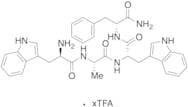
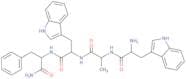
CAS 104180-25-8
:D-trp-ala-trp-D-phe amide
Description :
D-trp-ala-trp-D-phe amide, avec le numéro CAS 104180-25-8, est un peptide synthétique qui présente des caractéristiques typiques des composés peptidiques. Il est composé de quatre acides aminés : D-Tryptophane (D-Trp), Alanine (Ala), Tryptophane (Trp) et D-Phénylalanine (D-Phe), liés par des liaisons peptidiques. Ce composé est remarquable pour son activité biologique potentielle, en particulier dans le contexte de la recherche sur les neuropeptides et la pharmacologie, car il peut interagir avec divers récepteurs dans le système nerveux. La présence d'acides aminés D suggère qu'il pourrait présenter une résistance à la dégradation enzymatique, améliorant ainsi sa stabilité et sa biodisponibilité. De plus, le groupe fonctionnel amide à l'extrémité terminale peut influencer sa solubilité et son interaction avec les membranes biologiques. Dans l'ensemble, D-trp-ala-trp-D-phe amide suscite de l'intérêt en chimie médicinale et en conception de médicaments, en particulier pour ses applications thérapeutiques potentielles dans la modulation des voies de signalisation des neuropeptides.
Formule :C34H37N7O4
Trier par
Degré de pureté (%)
0
100
|
0
|
50
|
90
|
95
|
100
2 produits concernés.
GHRP 4 TFA Salt
CAS :Produit contrôléFormule :C34H37N7O4·xC2HF3O2Couleur et forme :NeatMasse moléculaire :607.7GHRP 4 TFA
CAS :GHRP 4 TFA is a synthetic hexapeptide, which is derived from non-natural amino acids, with a primary function of stimulating the secretion of growth hormone (GH). The source of this peptide is chemical synthesis, using solid-phase peptide synthesis techniques that allow precise chain assembly. The mode of action of GHRP 4 involves binding to growth hormone secretagogue receptors (GHS-R) located in the pituitary gland and hypothalamus. This interaction triggers the release of endogenous growth hormone by mimicking the action of ghrelin, a natural endogenous ligand.In scientific research, GHRP 4 TFA is utilized to explore the physiological and cellular pathways involved in GH release and its systemic effects. Applications include studying metabolic regulation, muscle growth, and cellular proliferation. Additionally, its role in aging and age-related disorders makes it a valuable tool in gerontological studies. The peptide's ability to modulate endocrine responses is of interest for developing therapeutic approaches in GH deficiency and other metabolic disorders. However, research into its full biological effects and potential clinical applications is ongoing, emphasizing its utility in experimental and preclinical settings.Formule :C34H37N7O4Degré de pureté :Min. 95%Masse moléculaire :607.7 g/mol