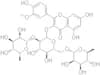
CAS 104472-68-6
:Typhanéoside
Description :
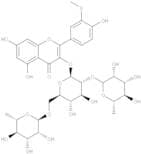
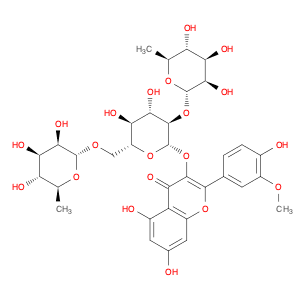
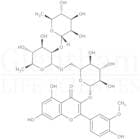
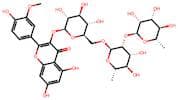
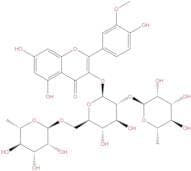
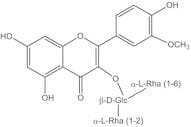
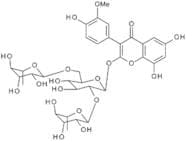
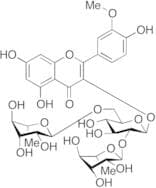
Typhanéoside, avec le numéro CAS 104472-68-6, est un composé chimique qui appartient à la classe des flavonoïdes, spécifiquement des glycosides. Il est dérivé de sources naturelles, souvent trouvé dans les plantes, et se caractérise par sa structure unique qui comprend un squelette de flavonoïde lié à une partie sucrée. Ce composé présente diverses activités biologiques, y compris des propriétés antioxydantes, qui contribuent à ses potentiels bienfaits pour la santé. Typhanéoside a suscité de l'intérêt dans la recherche pharmacologique en raison de ses rôles possibles dans les activités anti-inflammatoires et anticancéreuses. Sa solubilité et sa stabilité peuvent varier en fonction du solvant et des conditions environnementales, ce qui est crucial pour son application tant dans la recherche que dans des contextes thérapeutiques potentiels. Comme beaucoup de flavonoïdes, la présence de groupes hydroxyles dans sa structure est significative pour sa réactivité et son interaction avec les systèmes biologiques. D'autres études sont en cours pour élucider complètement ses mécanismes d'action et ses applications potentielles en médecine et en nutrition.
Formule :C34H42O20
InChI :InChI=1/C34H42O20/c1-10-20(38)24(42)27(45)32(49-10)48-9-18-22(40)26(44)31(54-33-28(46)25(43)21(39)11(2)50-33)34(52-18)53-30-23(41)19-15(37)7-13(35)8-17(19)51-29(30)12-4-5-14(36)16(6-12)47-3/h4-8,10-11,18,20-22,24-28,31-40,42-46H,9H2,1-3H3/t10-,11-,18+,20-,21-,22+,24+,25+,26-,27+,28+,31+,32+,33-,34?/m0/s1
Code InChI :InChIKey=POMAQDQEVHXLGT-QDYYQVSOSA-N
SMILES :O(C1=C(OC=2C(C1=O)=C(O)C=C(O)C2)C3=CC(OC)=C(O)C=C3)[C@H]4[C@H](O[C@H]5[C@H](O)[C@H](O)[C@@H](O)[C@H](C)O5)[C@@H](O)[C@H](O)[C@@H](CO[C@H]6[C@H](O)[C@H](O)[C@@H](O)[C@H](C)O6)O4
Synonymes :- 3-((O-6-Deoxy-alpha-L-mannopyranosyl-(1-2)-O-(6-deoxy-alpha-L-mannopyranosyl-(1-6))-beta-D-glucopyranosyl)oxy)-5,7-dihydroxy-2-(4-hydroxy-3-methoxyphenyl)-4H-1-benzopyran-4-one
- 3-[(3R,4S,5R,6R)-4,5-dihydroxy-3-[(2S,3R,4R,5S,6S)-3,4,5-trihydroxy-6- methyl-oxan-2-yl]oxy-6-[[(2S,3R,4R,5S,6S)-3,4,5-trihydroxy-6-methyl-ox an-2-yl]oxymethyl]oxan-2-yl]oxy-5,7-dihydroxy-2-(4-hydroxy-3-methoxy-p henyl)chromen-4-one
- 3-[(O-6-Deoxy-α-<span class="text-smallcaps">L</smallcap>-mannopyranosyl-(1→2)-O-[6-deoxy-α-<smallcap>L</smallcap>-mannopyranosyl-(1→6)]-β-<smallcap>D</span>-glucopyranosyl)oxy]-5,7-dihydroxy-2-(4-hydroxy-3-methoxyphenyl)-4H-1-benzopyran-4-one
- 4H-1-Benzopyran-4-one, 3-[(O-6-deoxy-α-<span class="text-smallcaps">L</smallcap>-mannopyranosyl-(1→2)-O-[6-deoxy-α-<smallcap>L</smallcap>-mannopyranosyl-(1→6)]-β-<smallcap>D</span>-glucopyranosyl)oxy]-5,7-dihydroxy-2-(4-hydroxy-3-methoxyphenyl)-
- 5,7-dihydroxy-2-(4-hydroxy-3-methoxyphenyl)-4-oxo-4H-chromen-3-yl 6-deoxy-alpha-L-mannopyranosyl-(1->2)-[6-deoxy-alpha-L-mannopyranosyl-(1->6)]-D-glucopyranoside
- Isorhamnetin 3-O-(2′′,6′′-di-O-α-<span class="text-smallcaps">L</smallcap>-rhamnopyranosyl)-β-<smallcap>D</span>-glucopyranoside
- Isorhamnetin 3-O-2<sup>G</sup>-rhamnosylrutinoside
- Isorhamnetin3-O-(2',6'-di-O-α-L-rhamnopyranosyl)- β-D-glucopyranoside
- Typhaneoside
- Isorhamnetin 3-O-2G-rhamnosylrutinoside
- Isorhamnetin 3-O-(2′′,6′′-di-O-α-L-rhamnopyranosyl)-β-D-glucopyranoside
- 3-[(O-6-Deoxy-α-L-mannopyranosyl-(1→2)-O-[6-deoxy-α-L-mannopyranosyl-(1→6)]-β-D-glucopyranosyl)oxy]-5,7-dihydroxy-2-(4-hydroxy-3-methoxyphenyl)-4H-1-benzopyran-4-one
- 4H-1-Benzopyran-4-one, 3-[(O-6-deoxy-α-L-mannopyranosyl-(1→2)-O-[6-deoxy-α-L-mannopyranosyl-(1→6)]-β-D-glucopyranosyl)oxy]-5,7-dihydroxy-2-(4-hydroxy-3-methoxyphenyl)-
- 6)]-b-D-glucopyranosyl)oxy]-5,7-dihydroxy-2-(4-hydroxy-3-methoxyphenyl)-
- Aervitrin
- TYPHANEOSIDE(P)
- 3-[(3R,4S,5S,6R)-4,5-dihydroxy-3-[(2R,3R,4R,5R,6S)-3,4,5-trihydroxy-6-methyloxan-2-yl]oxy-6-[[(2R,3R,4R,5R,6S)-3,4,5-trihydroxy-6-methyloxan-2-yl]oxymethyl]oxan-2-yl]oxy-5,7-dihydroxy-2-(4-hydroxy-3-methoxyphenyl)chromen-4-one
- 3-(((2S,3R,4S,5S,6R)-4,5-Dihydroxy-3-(((2S,3R,4R,5R,6S)-3,4,5-trihydroxy-6-methyltetrahydro-2H-pyran-2-yl)oxy)-6-((((2R,3R,4R,5R,6S)-3,4,5-trihydroxy-6-methyltetrahydro-2H-pyran-2-yl)oxy)methyl)tetrahydro-2H-pyran-2-yl)oxy)-5,7-dihydroxy-2-(4-hydroxy-3-methoxyphenyl)-4H-chromen-4-one
- 4H-1-Benzopyran-4-one,3-[(O-6-deoxy-a-L-mannopyranosyl-(1®
- 3-[(2S,3R,4S,5S,6R)-4,5-dihydroxy-3-[(2R,3R,4R,5R,6S)-3,4,5-trihydroxy-6-methyloxan-2-yl]oxy-6-[[(2R,3R,4R,5R,6S)-3,4,5-trihydroxy-6-methyloxan-2-yl]oxymethyl]oxan-2-yl]oxy-5,7-dihydroxy-2-(4-hydroxy-3-methoxyphenyl)chromen-4-one
- Voir plus de synonymes
Trier par
Degré de pureté (%)
0
100
|
0
|
50
|
90
|
95
|
100
10 produits concernés.
Typhaneoside
CAS :Typhaneoside analytical standard provided with w/w absolute assay, to be used for quantitative titration.Formule :C34H42O20Degré de pureté :(HPLC) ≥98%Couleur et forme :PowderMasse moléculaire :770.7Typhaneoside
CAS :Formule :C34H42O20Degré de pureté :95%Couleur et forme :SolidMasse moléculaire :770.6853Typhaneoside
CAS :Formule :C34H42O20Degré de pureté :≥ 97.0%Couleur et forme :Light-yellow to brown powderMasse moléculaire :770.69Typhaneoside
CAS :Typhaneoside is possibly the main active component in the bioactive fraction of Shaofu Zhuyu decoction, Shaofu Zhuyu decoction may have direct inhibitory effects on the contractility of the mice uterus. It has an inhibitory effect on the proliferation of human umbilical arterial smooth muscle cells(HUASMC) with a wide range of effective dose but the effect is started slowly.Formule :C34H42O20Degré de pureté :95%~99%Masse moléculaire :770.69Typhaneoside
CAS :Typhaneoside (Aervitrin) is a flavonoid glycoside plant extract with potential ability to treat primary dysmenorrhea through the Shaofu Zhuyu decoction.Formule :C34H42O20Degré de pureté :98.92% - 99.95%Couleur et forme :SolidMasse moléculaire :770.69Typhaneoside
CAS :Natural glycosideFormule :C34H42O20Degré de pureté :≥ 95.0 % (HPLC)Couleur et forme :PowderMasse moléculaire :770.69Typhaneoside
CAS :Typhaneoside is a flavonoid glycoside, which is a type of naturally occurring compound found primarily in plants such as those belonging to the genus Typha. Its structure includes a flavonoid backbone linked to one or more sugar molecules, which is typical of glycosides. The source of typhaneoside is generally botanical, deriving from specific plant extracts, particularly those used in traditional medicine.Formule :C34H42O20Degré de pureté :Min. 95%Couleur et forme :PowderMasse moléculaire :770.69 g/molTyphaneoside
CAS :Produit contrôléApplications Typhaneoside is a flavonoid glycoside plant extract with potential ability to treat primary dysmenorrhea through the Shaofu Zhuyu decoction.
References Shulan S. et al.: Am. J. Chin. Med., 38, 777 (2010); Huang, X. et al.: J. Chrom. B. Anal. Tech. Biomed. Life Sci., 962, 75 (2014);Formule :C34H42O20Couleur et forme :NeatMasse moléculaire :770.68