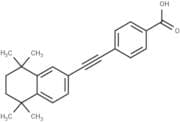
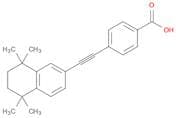
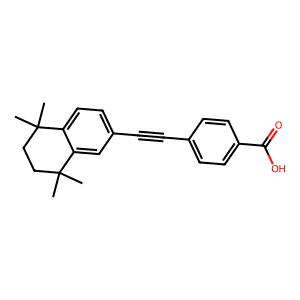
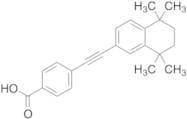
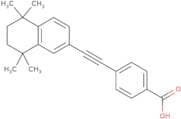
![Benzoic acid,4-[2-(5,6,7,8-tetrahydro-5,5,8,8-tetramethyl-2-naphthalenyl)ethynyl]-](/_next/image/?url=https%3A%2Fstatic.cymitquimica.com%2Fcas-image%2Fthumb-webp%2F325776-benzoic-acid-4-2-5678-tetrahydro-5588-tetramethyl-2-naphthalenyl-ethynyl.webp&w=3840&q=75)
CAS 104561-41-3
:Acide benzoïque, 4-[2-(5,6,7,8-tétrahydro-5,5,8,8-tétraméthyl-2-naphtalényle)éthynyl]-
Description :
L'acide benzoïque, 4-[2-(5,6,7,8-tétrahydro-5,5,8,8-tétraméthyl-2-naphtyl)éthyne]- est un composé organique caractérisé par sa structure complexe, qui comprend un groupe acide benzoïque et un groupe éthyne tétrahydro-tétraméthyl-2-naphtyle. Ce composé présente un groupe fonctionnel acide carboxylique, qui confère des propriétés acides, et un groupe éthyne qui contribue à sa réactivité et à ses applications potentielles en synthèse organique. La présence du groupe tétrahydro-tétraméthyl-2-naphtyle suggère que le composé pourrait présenter des propriétés stériques et électroniques uniques, influençant potentiellement sa solubilité et son interaction avec les systèmes biologiques. Il pourrait également posséder des propriétés photophysiques intéressantes en raison du dérivé de naphtalène, ce qui en fait un candidat pour des études en science des matériaux ou en chimie médicinale. Le numéro CAS du composé, 104561-41-3, permet une identification précise dans les bases de données chimiques, facilitant la recherche et l'application dans divers domaines, y compris les produits pharmaceutiques et la synthèse organique. Dans l'ensemble, ses caractéristiques structurelles suggèrent une utilité potentielle dans diverses applications chimiques.
Formule :C23H24O2
Synonymes :- Benzoicacid, 4-[(5,6,7,8-tetrahydro-5,5,8,8-tetramethyl-2-naphthalenyl)ethynyl]-(9CI)
- Agn 190205
- Basf 46928
Trier par
Degré de pureté (%)
0
100
|
0
|
50
|
90
|
95
|
100
5 produits concernés.
EC23
CAS :EC23 (AGN 190205) is a stable synthetic retinoid analogue. It is also induces neuronal differentiation.Formule :C23H24O2Degré de pureté :99.64%Couleur et forme :SolidMasse moléculaire :332.44Ref: TM-T15196
5mg65,00€10mg96,00€25mg180,00€50mg329,00€100mg527,00€200mg725,00€500mg1.121,00€1mL*10mM (DMSO)72,00€EC 23
CAS :EC 23 is a synthetic retinoid that belongs to the class of chemical compounds called retinoids. Retinoids are natural or synthetic substances that have a high affinity for binding to receptors on the cell surface and activating them. EC 23 has been shown to induce bacterial enzymes that break down long-chain fatty acids, which are toxic to bacteria. It also has been shown to be potent inducers of cellular differentiation in certain animal models, including the mouse embryo eye. EC 23 binds with high affinity to bacterial enzyme and inhibits its activity. It also has been shown to inhibit the growth of certain types of cancer cells in culture, but not others.
Formule :C23H24O2Degré de pureté :Min. 95%Masse moléculaire :332.44 g/molRef: 3D-EEA56141
Produit arrêté