CAS 104594-70-9
:Ester phénéthylique de l'acide caféique
Description :
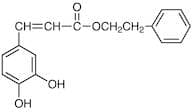
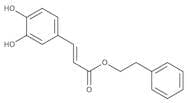
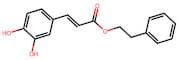
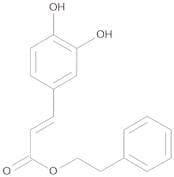
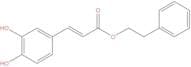
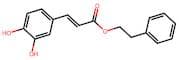
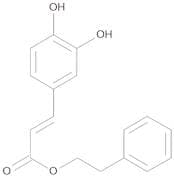
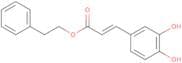
Ester phénéthylique de l'acide caféique (CAPE) est un composé phénolique dérivé de l'acide caféique, connu pour ses potentielles propriétés antioxydantes, anti-inflammatoires et anticancéreuses. C'est un solide brun jaunâtre à température ambiante et il est soluble dans des solvants organiques tels que l'éthanol et le diméthylsulfoxyde, mais a une solubilité limitée dans l'eau. Le CAPE présente une formule moléculaire qui reflète sa structure, qui comprend un groupe phényléthyle attaché à la colonne vertébrale de l'acide caféique. Ce composé est souvent étudié pour ses activités biologiques, y compris sa capacité à inhiber diverses enzymes et à moduler les voies de signalisation, ce qui le rend intéressant dans la recherche pharmacologique. Le CAPE a été étudié pour ses effets protecteurs contre le stress oxydatif et son rôle potentiel dans la prévention des maladies chroniques. De plus, il est reconnu pour sa capacité à interagir avec des composants cellulaires, influençant des processus tels que l'apoptose et la prolifération cellulaire. Dans l'ensemble, Ester phénéthylique de l'acide caféique est un composé significatif dans le domaine des produits naturels et de la chimie médicinale, avec des recherches en cours sur ses applications thérapeutiques.
Formule :C17H16O4
InChI :InChI=1S/C17H16O4/c18-15-8-6-14(12-16(15)19)7-9-17(20)21-11-10-13-4-2-1-3-5-13/h1-9,12,18-19H,10-11H2
Code InChI :InChIKey=SWUARLUWKZWEBQ-UHFFFAOYSA-N
SMILES :C(=CC(OCCC1=CC=CC=C1)=O)C2=CC(O)=C(O)C=C2
Synonymes :- 2-Phenylethyl 3-(3,4-Dihydroxyphenyl)-2-Propenoate
- 2-Phenylethyl 3-(3,4-Dihydroxyphenyl)Prop-2-Enoate
- 2-Phenylethyl caffeate
- 2-Propenoic acid, 3-(3,4-dihydroxyphenyl)-, 2-phenylethyl ester
- 2-phenylethyl (2E)-3-(3,4-dihydroxyphenyl)prop-2-enoate
- Caffeic acid phenethylester
- Phenethyl Caffeate
- β-Phenylethyl caffeate
- Caffeic acid phenethyl ester
- CAPE
Trier par
Degré de pureté (%)
0
100
|
0
|
50
|
90
|
95
|
100
14 produits concernés.
Phenethyl Caffeate
CAS :Formule :C17H16O4Degré de pureté :>98.0%(HPLC)Couleur et forme :White to Orange to Green powder to crystalMasse moléculaire :284.31Phenylethyl 3,4-dihydroxycinnamate, 98+%
CAS :Inhibitor of protein tyrosine kinase, and is cytotoxic to cancer cell linesFormule :C17H16O4Degré de pureté :98+%Masse moléculaire :284.31Caffeic acid-phenethyl ester
CAS :CAPE is known to have antimitogenic, anticarcinogenic, antiinflammatory, and immunomodulating properties. The molecular basis for these properties seems to be its ability to specifically and potently inhibit the activation of the nuclear transcription factor NF-kappaB.Formule :C17H16O4Degré de pureté :99.4%Couleur et forme :White PowderMasse moléculaire :284.312-phenylethyl (2E)-3-(3,4-dihydroxyphenyl)prop-2-enoate
CAS :Formule :C17H16O4Degré de pureté :97%Couleur et forme :SolidMasse moléculaire :284.3065Caffeic acid phenethyl ester
CAS :Formule :C17H16O4Degré de pureté :≥ 98.0%Couleur et forme :White to yellow crystalline powderMasse moléculaire :284.31Caffeic Acid Phenethyl Ester
CAS :Caffeic Acid Phenethyl EsterDegré de pureté :≥98%Masse moléculaire :284.31g/molCaffeic acid phenethyl ester
CAS :Formule :C17H16O4Degré de pureté :95%~99%Masse moléculaire :284.311Caffeic Acid Phenethyl Ester
CAS :CAPE, in propolis, blocks NF-kappa B, suppresses p70S6K/Akt pathways, and inhibits PDGF, aiding in cancer protection and immune modulation.Formule :C17H16O4Degré de pureté :99.18% - 99.35%Couleur et forme :Less Transparent Liquid Colorless Transparent LiquidMasse moléculaire :284.31Caffeic acid phenethyl ester
CAS :Caffeic acid phenethyl esterFormule :C17H16O4Degré de pureté :98% (nmr) (Typical Value in Batch COA)Couleur et forme : off-white solidMasse moléculaire :284.31g/molCaffeic Acid Phenethyl Ester
CAS :Applications Cytotoxic agent against cancer cell lines. Inhibitor of ornithine decarboxylase and protein tyrosine kinase. Found to be a specific inhibitor of the nuclear transcription factor, NF-kB. It has also been shown to significantly suppress the lipoxygenase pathway of arachidonic acid metabolism during inflammation.
References Grunberger, D., et al.: Experientia, 44, 230 (1988), Fesen, M.R., et al.: Biochem. Pharmacol., 48, 595 (1994), Su, Z.Z., et al.: Cancer Res., 54, 1865 (1994), Zheng, Z.S., et al.: Oncol. Res., 7, 445 (1995), Mirzoeva, O.K. and Calder, P.C.: Essent. Fatty Acids, 55, 441 (1996)Formule :C17H16O4Couleur et forme :NeatMasse moléculaire :284.31Caffeic acid phenethyl ester
CAS :Caffeic acid phenethyl ester (CAPE) is an active phenolic compound found in honeybee propolis that has the potential to downregulate inflammation in mammals. Studies demonstrated that CAPE specifically inhibits the protein complex NF-κB - a key player in inflammation, associated with the pathogenesis of chronic inflammatory diseases. Moreover, CAPE inhibits the activity of the enzyme cyclooxygenase and the production of nitric oxide by macrophages, also responsible for inflammation. By acting on T cells, CAPE can reduce the production of pro-inflammatory cytokines and increase the production of anti-inflammatory ones, leading to a less overwhelming immune response to allergens.Formule :C17H16O4Degré de pureté :Min. 98.0 Area-%Masse moléculaire :284.31 g/molPhenethyl 3-(3,4-dihydroxyphenyl)acrylate
CAS :Formule :C17H16O4Degré de pureté :95.0%Couleur et forme :No data available.Masse moléculaire :284.311