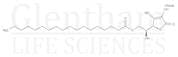
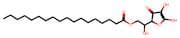
CAS 10605-09-1
:6-stéarate d'acide ascorbique
- 2-(3,4-Dihydroxy-5-Oxo-2,5-Dihydrofuran-2-Yl)-2-Hydroxyethyl Octadecanoate (Non-Preferred Name)
- 6-O-Stearylascorbic acid
- 6-O-octadecanoylhex-1-enofuranos-3-ulose
- <span class="text-smallcaps">L</span>-Ascorbic acid monostearate
- <span class="text-smallcaps">L</span>-Ascorbic acid, 6-octadecanoate
- <span class="text-smallcaps">L</span>-Ascorbic acid, 6-stearate
- <span class="text-smallcaps">L</span>-Ascorbyl 6-octadecanoate
- Ascorbic acid 6-stearate
- Ascorbyl 6-stearate
- Ascorbyl stearate
- E 305
- L-Ascorbic acid 6-octadecanoate
- Stearic acid, 6-ester with <span class="text-smallcaps">L</span>-ascorbic acid
- Vitamin C stearate
- L-Ascorbic acid monostearate
- Stearic acid, 6-ester with L-ascorbic acid
- Voir plus de synonymes
6-O-Stearoyl-L-ascorbic Acid
CAS :Formule :C24H42O7Degré de pureté :>95.0%(T)Couleur et forme :White to Light yellow powder to crystalMasse moléculaire :442.59Ascorbyl Stearate
CAS :Vitamin c (ascorbic acid) and its derivativesFormule :C24H42O7Couleur et forme :PowderMasse moléculaire :442.29305(2S)-2-[(2R)-3,4-dihydroxy-5-oxo-2,5-dihydrofuran-2-yl]-2-hydroxyethyl octadecanoate
CAS :Formule :C24H42O7Degré de pureté :98%Couleur et forme :SolidMasse moléculaire :442.5861L-Ascorbic Acid 6-stearate
CAS :L-Ascorbic acid 6-stearate, a compound derived from L-ascorbic acid and stearic acid identified in K.Formule :C24H42O7Couleur et forme :SolidMasse moléculaire :442.60Ascorbyl stearate
CAS :Formule :C24H42O7Degré de pureté :≥ 95.0%Couleur et forme :White crystalline powderMasse moléculaire :442.59L-Ascorbic acid 6-stearate
CAS :L-Ascorbic acid 6-stearateDegré de pureté :98%Masse moléculaire :442.59g/molL-Ascorbic Acid 6-Stearate
CAS :Applications L-Ascorbic Acid 6-Stearate is used to specifically target anti-tumoral dehydrocrotonin nanoparticles.
References Frungillo, L., et al.: J. Pharm. Sci., 98, 4796-4807 (2009)Formule :C24H42O7Couleur et forme :NeatMasse moléculaire :442.596-O-Stearoyl-l-ascorbic acid
CAS :6-O-Stearoyl-l-ascorbic acid is a derivative of ascorbic acid that has been shown to induce apoptosis in cervical cancer cells. The mechanism by which 6-O-stearoyl-l-ascorbic acid induces the death of cancer cells is still unclear. It may be associated with the formation of reactive oxygen species and lipid peroxidation, or the depletion of mitochondrial membrane potential, or the inhibition of glutamate pyruvate transaminase. 6-O-Stearoyl-l-ascorbic acid also has effects on skin tumor formation and radiation response in mice. This compound has been found to have physiological effects as well; it inhibits fetal bovine serum fatty acid synthesis and causes cellular transformation in vitro.
Formule :C24H42O7Degré de pureté :Min. 95%Couleur et forme :PowderMasse moléculaire :442.59 g/mol
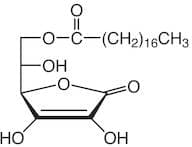

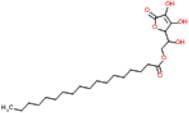

![(2S)-2-[(2R)-3,4-dihydroxy-5-oxo-2,5-dihydrofuran-2-yl]-2-hydroxyethyl octadecanoate](/_next/image/?url=https%3A%2Fstatic.cymitquimica.com%2Fproducts%2FIN%2Fthumb%2FDA003R7X.jpg&w=3840&q=75)