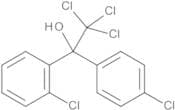
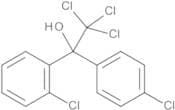
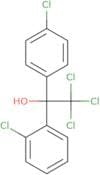
CAS 10606-46-9
:o,p′-Dicofol
- 2,2,2-Trichloro-1-(2-Chlorophenyl)-1-(4-Chlorophenyl)Ethanol
- 2-Chloro-α-(4-chlorophenyl)-α-(trichloromethyl)benzenemethanol
- Benzenemethanol, 2-chloro-α-(4-chlorophenyl)-α-(trichloromethyl)-
- Benzhydrol, 2,4′-dichloro-α-(trichloromethyl)-
- Dicofol O,P'-Isomer
- o,p′-Dicofol
2,4'-Dicofol 10 µg/mL in Cyclohexane
CAS :Formule :C14H9Cl5OCouleur et forme :Single SolutionMasse moléculaire :370.49Chinese pharmacopoeia Pesticides Mixture 353 40-100 µg/mL in Acetonitrile
CAS :- 1031-07-8
- 10606-46-9
- 115-32-2
- 120067-83-6
- 120068-36-2
- 120068-37-3
- 13071-79-9
- 13194-48-4
- 1836-75-5
- 205650-65-3
- 22224-92-6
- 24353-61-5
- 298-00-0
- 298-02-2
- 309-00-2
- 319-84-6
- 319-85-7
- 319-86-8
- 33213-65-9
- 3689-24-5
- 50-29-3
- 5120-23-0
- 56-38-2
- 56-72-4
- 58-89-9
- 60-57-1
- 6164-98-3
- 6923-22-4
- 72-54-8
- 72-55-9
- 789-02-6
- 8065-48-3
- 959-98-8
- 99675-03-3
Couleur et forme :MixturePesticide-Mix 323 20-40 µg/mL in Isooctane
CAS :Produit contrôlé- 1024-57-3
- 1031-07-8
- 10606-46-9
- 115-32-2
- 118-74-1
- 1897-45-6
- 27304-13-8
- 309-00-2
- 319-84-6
- 319-85-7
- 319-86-8
- 33213-65-9
- 3424-82-6
- 50-29-3
- 5103-71-9
- 5103-74-2
- 53-19-0
- 58-89-9
- 60-57-1
- 72-20-8
- 72-54-8
- 72-55-9
- 76-44-8
- 789-02-6
- 959-98-8
Formule :C14H10Cl4Couleur et forme :MixtureMasse moléculaire :320.04o,p’-Dicofol
CAS :Produit contrôléStability Light Sensitive
Applications The o,p'-substituted isomer of Dicofol (D436700) is chiral and may have enantiomer-specific activity; however, the stereospecific activity of o,p'-dicofol has not been reported. An acaricide.
Not a dangerous good if item is equal to or less than 1g/ml and there is less than 100g/ml in the package
References Arnold, S., et al.: Science, 272, 1489 (1996), Gaido, K., et al.: Toxicol. Appl. Pharmacol., 143, 205 (1997), Hoekstra, P., et al.: Toxicol. Lett., 125, 75 (2001),Formule :C14H9Cl5OCouleur et forme :NeatMasse moléculaire :370.49O,P’-Dicofol
CAS :Dicofol is a chlorinated phenyl ether. O, P’-Dicofol is an insecticide, which is used for the control of ticks, chiggers, mites and other insects. Dicofol has a high degree of environmental persistence. It is not readily biodegradable and it can be found in soil and water for up to two years after application. Recrystallization of dicofol is required for purification due to its low solubility in water or organic solvents. Dicofol may be hydrolyzed by alkaline agents such as sodium hydroxide or potassium hydroxide to form dichloro-2,2-difluoroethane and 2,2-dichlorovinyl fluoride. Impurities may include hexane, heptane, alkanes and acaricides.
Formule :C14H9Cl5ODegré de pureté :Min. 95%Masse moléculaire :370.5 g/mol