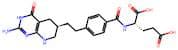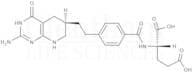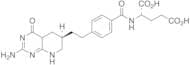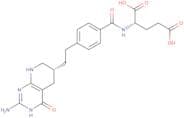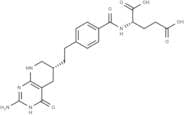
CAS 106400-81-1
:Lometrexol
Description :
Lometrexol est un composé chimique classé comme antifolate, principalement connu pour son rôle dans le traitement du cancer, en particulier dans le contexte de la leucémie et d'autres malignités. Il agit en inhibant la dihydrofolate réductase (DHFR), une enzyme essentielle à la synthèse de l'ADN et à la prolifération cellulaire, entravant ainsi la croissance des cellules cancéreuses à division rapide. Lometrexol se caractérise par sa similitude structurelle avec le folate, ce qui lui permet de rivaliser efficacement avec les substrats naturels pour se lier à la DHFR. Ce composé est généralement administré dans un cadre clinique et a été étudié pour son potentiel dans les thérapies combinées afin d'améliorer l'efficacité d'autres agents anticancéreux. Sa pharmacocinétique, y compris l'absorption, la distribution, le métabolisme et l'excrétion, est essentielle pour déterminer des schémas posologiques appropriés. De plus, comme de nombreux agents chimiothérapeutiques, Lometrexol peut présenter des effets secondaires, nécessitant une surveillance attentive des patients pendant le traitement. Dans l'ensemble, Lometrexol représente une avancée significative dans la thérapie ciblée contre le cancer, contribuant au domaine plus large de la pharmacologie oncologique.
Formule :C21H25N5O6
InChI :InChI=1/C21H25N5O6/c22-21-25-17-14(19(30)26-21)9-12(10-23-17)2-1-11-3-5-13(6-4-11)18(29)24-15(20(31)32)7-8-16(27)28/h3-6,12,15H,1-2,7-10H2,(H,24,29)(H,27,28)(H,31,32)(H4,22,23,25,26,30)/t12-,15+/m1/s1
Synonymes :- Lometrexolum
- Lometrexolum [INN-Latin]
- Unii-6P3Avy8A7Q
- L-Glutamic acid, N-(4-(2-((6R)-2-amino-1,4,5,6,7,8-hexahydro-4-oxopyrido(2,3-d)pyrimidin-6-yl)ethyl)benzoyl)-
- L-Glutamic acid, N-(4-(2-(2-amino-1,4,5,6,7,8-hexahydro-4-oxopyrido(2,3-d)pyrimidin-6-yl)ethyl)benzoyl)-, (R)-
- N-(4-{2-[(6R)-2-amino-4-oxo-1,4,5,6,7,8-hexahydropyrido[2,3-d]pyrimidin-6-yl]ethyl}benzoyl)-L-glutamic acid
Trier par
Degré de pureté (%)
0
100
|
0
|
50
|
90
|
95
|
100
5 produits concernés.
Lometrexol Hydrate
CAS :Produit contrôléApplications It is an antifolate which inhibits glycinamide ribonucleotide formyltransferase (GARFT), an enzyme essential for de novo purine synthesis. Lometrexol has activity against tumors which are refractory to other drugs, notably Methotrexate.
Not a dangerous good if item is equal to or less than 1g/ml and there is less than 100g/ml in the package
References Gibbs, D., et al.: Cancer Res., 65, 11721 (2005), Gangjee, A., et al.: J. Med. Chem., 48, 5329 (2005), Hilgenbrink, A., et al.: J. Pharm. Sci., 94, 2135 (2005),Formule :C21H25N5O6·xH2OCouleur et forme :NeatMasse moléculaire :443.45 + x(18.02)Lometrexol Hydrate
CAS :Lometrexol is an anti-cancer drug that belongs to the class of polymerase chain inhibitors. It inhibits the proliferation of cancer cells by binding to intracellular targets and interfering with DNA synthesis. Lometrexol is used to treat bowel disease, such as ulcerative colitis and Crohn's disease, which are caused by inflammation in the colon. Lometrexol has also been shown to have anti-inflammatory properties. The compound has been shown to inhibit transfer reactions in vitro, and low potency against infectious diseases. Lometrexol Hydrate is a prodrug that is hydrolyzed in vivo to lometrexol.Formule :C21H25N5O6·xH2ODegré de pureté :Min. 95%Masse moléculaire :443.45 g/molLometrexol
CAS :Lometrexol (LY 264618) is an antifolate that inhibits GARFT, blocks purine synthesis, induces apoptosis, and has anticancer properties.
Formule :C21H25N5O6Degré de pureté :97.76% - 99.56%Couleur et forme :SolidMasse moléculaire :443.45