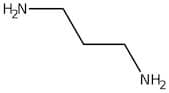
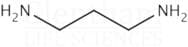
CAS 109-76-2
:1,3-Propanediamine
Description :
1,3-Propanediamine, également connu sous le nom de triméthylènediamine, est un composé organique caractérisé par sa structure d'amines aliphatiques, avec deux groupes amines (-NH2) attachés à une chaîne de trois atomes de carbone. C'est un liquide incolore à jaune pâle avec une forte odeur d'amines et il est hygroscopique, ce qui signifie qu'il absorbe facilement l'humidité de l'air. Ce composé est soluble dans l'eau et dans des solvants organiques polaires, ce qui le rend polyvalent dans diverses applications chimiques. 1,3-Propanediamine est principalement utilisé dans la synthèse de polyamides, de tensioactifs et comme agent de durcissement dans les résines époxy. Il présente des propriétés basiques en raison de la présence de groupes amines, ce qui lui permet de participer à diverses réactions chimiques, y compris des substitutions nucléophiles et des réactions de condensation. De plus, il peut agir comme un ligand en chimie de coordination. Cependant, il est important de manipuler ce composé avec précaution, car il peut être irritant pour la peau, les yeux et le système respiratoire. Des mesures de sécurité appropriées doivent être prises lors de la manipulation de 1,3-Propanediamine dans des environnements de laboratoire ou industriels.
Formule :C3H10N2
InChI :InChI=1S/C3H10N2/c4-2-1-3-5/h1-5H2
Code InChI :InChIKey=XFNJVJPLKCPIBV-UHFFFAOYSA-N
SMILES :C(CN)CN
Synonymes :- 1,3-Diamino-n-propane
- 1,3-Diaminopropan
- 1,3-Propandiamine
- 1,3-Propane Diamine
- 1,3-Propanediamine
- 1,3-Propylenediamine
- 1,3-Trimethylenediamine
- 3-Aminopropylamine
- DAP
- Nsc 8154
- Propane, 1,3-Diamino-
- Propane-1,3-Diaminium
- Tmeda
- Trimethylendiamin
- Trimethylenediamine
- Trimetilendiamina
- α,ω-Propanediamine
- Voir plus de synonymes
Trier par
Degré de pureté (%)
0
100
|
0
|
50
|
90
|
95
|
100
7 produits concernés.
1,3-Diaminopropane
CAS :Formule :C3H10N2Degré de pureté :>98.0%(GC)Couleur et forme :Colorless to Almost colorless clear liquidMasse moléculaire :74.131,3-Diaminopropane, 98%
CAS :1,3-Diaminopropane is commonly used in the preparation of cholinesterase inhibitors and thrombosis inhibitors. It is also used as a polymer cross linkage agent, polyurethane extender and spray coatings. It is involved in the preparation of agrochemicals and pharmaceutical intermediates. Further, itFormule :C3H10N2Degré de pureté :98%Couleur et forme :Liquid, Clear colorlessMasse moléculaire :74.131,3-Diaminopropane
CAS :Produit contrôléApplications 1,3-Diaminopropane is a common chemical reagent, used in the synthesis of 7-methoxytacrine-adamantylamine heterodimers as cholinesterase inhibitors applied in the treatment of Alzheimer’s disease. Also used in the synthesis of thrombosis inhibitors.
Not a dangerous good if item is equal to or less than 1g/ml and there is less than 100g/ml in the package
References Spilovska, K. et al.: Molecules, 18, 2397 (2013); Smith, S. et al.: Blood, 120, 5103 (2012);Formule :C3H10N2Couleur et forme :NeatMasse moléculaire :74.121,3-Diaminopropane
CAS :1,3-Diaminopropane is a molecule that belongs to the group of organic compounds known as diamine. It is a colorless liquid with an unpleasant odor. 1,3-Diaminopropane has inhibitory properties and can be used in the treatment of squamous cell carcinoma and galleria mellonella. The mechanism of action for this compound has been determined by x-ray crystal structures. 1,3-Diaminopropane reacts with picolinic acid (PA) to form an intramolecular hydrogen bond, which inhibits PA's ability to react with other molecules. This results in PA being unable to form reactive intermediates that normally lead to cancerous changes in cells.Formule :C3H10N2Degré de pureté :Min. 95%Couleur et forme :Clear LiquidMasse moléculaire :74.12 g/mol1,3-Diaminopropane
CAS :Formule :C3H10N2Degré de pureté :99.0%Couleur et forme :LiquidMasse moléculaire :74.127