CAS 110042-95-0
:Acemannan
Description :
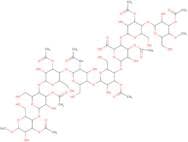
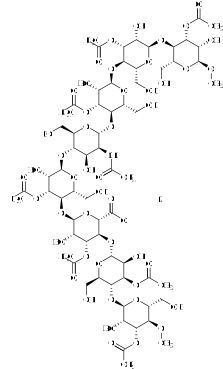
Acemannan est un polysaccharide dérivé du gel de la feuille interne de la plante d'aloe vera, connu pour ses diverses propriétés biologiques. Il est principalement composé de mannose et possède une structure complexe qui comprend une chaîne principale d'unités de mannose liées par des liaisons β-(1→4), avec divers groupes acétyles et chaînes latérales. Acemannan présente des propriétés immunomodulatrices, anti-inflammatoires et de cicatrisation des plaies, ce qui en fait un ingrédient populaire dans les formulations cosmétiques et pharmaceutiques. Sa capacité à améliorer l'hydratation de la peau et à favoriser la réparation des tissus est attribuée à sa capacité à stimuler l'activité des fibroblastes et la synthèse du collagène. De plus, Acemannan a été étudié pour ses effets antiviraux et antibactériens potentiels, contribuant à son utilisation en médecine alternative. La substance est généralement reconnue comme sûre pour une application topique, bien que son efficacité puisse varier en fonction de la formulation et de la concentration. Dans l'ensemble, Acemannan est apprécié pour son potentiel thérapeutique et est largement utilisé dans les produits de santé et de bien-être.
Formule :C64H97NO49
InChI :InChI=1/C66H101NO49/c1-18(75)67-33-34(83)42(26(11-68)102-59(33)110-44-29(14-71)106-63(38(87)51(44)97-21(4)78)113-46-30(15-72)107-64(39(88)53(46)99-23(6)80)111-45-28(13-70)103-60(94-10)35(84)50(45)96-20(3)77)109-61-37(86)52(98-22(5)79)48(32(17-74)105-61)114-66-41(90)55(101-25(8)82)56(57(116-66)58(91)92)115-65-40(89)54(100-24(7)81)47(31(16-73)108-65)112-62-36(85)49(95-19(2)76)43(93-9)27(12-69)104-62/h26-57,59-66,68-74,83-90H,11-17H2,1-10H3,(H,67,75)(H,91,92)/p-1/t26-,27-,28-,29-,30-,31-,32-,33+,34-,35+,36+,37+,38+,39+,40+,41+,42-,43-,44-,45-,46-,47-,48-,49-,50-,51-,52-,53-,54-,55-,56+,57+,59-,60+,61-,62-,63-,64-,65-,66+/m1/s1
Synonymes :- (2S,3S,4R,5S,6S)-6-{[(2R,3R,4R,5S,6R)-6-{[(2R,3S,4R,5S,6R)-5-(acetylamino)-6-{[(2R,3R,4R,5S,6R)-4-(acetyloxy)-6-{[(2R,3R,4R,5S,6R)-4-(acetyloxy)-6-{[(2R,3R,4R,5S,6S)-4-(acetyloxy)-5-hydroxy-2-(hydroxymethyl)-6-methoxytetrahydro-2H-pyran-3-yl]oxy}-5-hydroxy-2-(hydroxymethyl)tetrahydro-2H-pyran-3-yl]oxy}-5-hydroxy-2-(hydroxymethyl)tetrahydro-2H-pyran-3-yl]oxy}-4-hydroxy-2-(hydroxymethyl)tetrahydro-2H-pyran-3-yl]oxy}-4-(acetyloxy)-5-hydroxy-2-(hydroxymethyl)tetrahydro-2H-pyran-3-yl]oxy}-4-(acetyloxy)-3-{[(2R,3S,4R,5R,6R)-4-(acetyloxy)-5-{[(2R,3S,4R,5R,6R)-4-(acetyloxy)-3-hydroxy-6-(hydroxymethyl)-5-methoxytetrahydro-2H-pyran-2-yl]oxy}-3-hydroxy-6-(hydroxymethyl)tetrahydro-2H-pyran-2-yl]oxy}-5-hydroxytetrahydro-2H-pyran-2-carboxylate (non-preferred name)
- Acemananan
- Acemananan [INN-Spanish]
- Acemannan [USAN:INN]
- Acemannan hydrogel
- Acemannan is a highly acetylated, polydispersed, linear mannan obtained from the mucilage of Aloe barbadensis, Miller (aloe vera)
- Acemannan is a highly acetylated, polydispersed, linear mannan obtained from the mucilage of Aloe barbadensis, Miller (aloe vera). Molecular weight is 1-2 million daltons
- Acemannanan
- Acemannanum
- Acemannanum [INN-Latin]
- Aloe Vera Mucilage
- Carraklenz Wound & Skin Cleanser
- Carrisyn
- Snow & Sun Sports Gel
- alpha-D-Galacto-beta-D-mannan, (1-4),(1-6)-, acetate
- α-<span class="text-smallcaps">D</smallcap>-Galacto-β-<smallcap>D</span>-mannan, (1→4),(1→6)-, acetate
- α-D-Galacto-β-D-mannan, (1→4),(1→6)-, acetate
- Acemannan
- Ace-m
- Acemannan Q: What is the storage condition of
- Polymannoacetate
- Aids-000120
- Acemannan (Technical Grade)
- Acemannan Q: What is the CAS Number of
- Aids000120
- Voir plus de synonymes
Trier par
Degré de pureté (%)
0
100
|
0
|
50
|
90
|
95
|
100
3 produits concernés.
Acemannan
CAS :Acemannan is a natural compound found in the Aloe vera plant and has been used in traditional Chinese medicine for its various health benefits. It has been shown to have anticancer properties by inhibiting cancer cell growth and inducing apoptosis. Acemannan works by targeting various kinases and proteins involved in tumor development, making it an effective inhibitor of cancer progression. This compound has also been found to have angiotensin-converting enzyme (ACE) inhibitory activity, which can help regulate blood pressure. Acemannan analogs have been developed and tested for their potential as anticancer agents, showing promising results in human urine cancer cell lines. Overall, acemannan is a powerful natural compound with many potential health benefits.Formule :C66H101NO49Degré de pureté :Min. 95%Masse moléculaire :1,692.5 g/mol