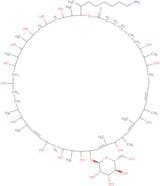
CAS 11006-31-8
:Monazomycine A
Description :
Monazomycine A est un composé antibiotique d'origine naturelle appartenant à la classe des macrolides. Il est produit par certaines souches d'actinobactéries, en particulier celles du genre Streptomyces. Ce composé présente une structure moléculaire complexe caractérisée par un grand anneau de lactone, typique des antibiotiques macrolides. Monazomycine A a démontré une activité antibactérienne, en particulier contre les bactéries Gram-positives, ce qui le rend intéressant dans le domaine de la chimie médicinale et de la recherche sur les antibiotiques. Son mécanisme d'action implique l'inhibition de la synthèse des protéines, qui est une caractéristique commune aux antibiotiques macrolides. De plus, Monazomycine A a été étudié pour ses applications potentielles dans le traitement de diverses infections, bien que son utilisation clinique puisse être limitée en raison de facteurs tels que le développement de résistance et la toxicité. Les caractéristiques structurelles uniques du composé et son activité biologique continuent d'être un sujet de recherche, en particulier dans la recherche de nouveaux agents antimicrobiens face à l'augmentation de la résistance aux antibiotiques.
Formule :C72H133NO22
InChI :InChI=1S/C72H133NO22/c1-39-22-19-20-25-55(79)46(8)54(78)24-17-15-18-26-62(84)95-71(42(4)23-16-13-14-21-31-73)50(12)59(83)37-53(77)36-58(82)48(10)66(88)47(9)56(80)34-51(75)29-27-40(2)63(85)41(3)28-30-52(76)35-57(81)49(11)67(89)60(33-45(7)65(87)44(6)32-43(5)64(39)86)93-72-70(92)69(91)68(90)61(38-74)94-72/h19,22,28,30,32-33,39-42,44,46-61,63-72,74-83,85-92H,13-18,20-21,23-27,29,31,34-38,73H2,1-12H3
Code InChI :InChIKey=BTUZNIQVZBANAX-UHFFFAOYSA-N
SMILES :O(C1OC(CO)C(O)C(O)C1O)C2C(O)C(C)C(O)CC(O)C=CC(C)C(O)C(C)CCC(O)CC(O)C(C)C(O)C(C)C(O)CC(O)CC(O)C(C)C(C(CCCCCCN)C)OC(=O)CCCCCC(O)C(C)C(O)CCC=CC(C)C(O)C(C)=CC(C)C(O)C(C)=C2
Synonymes :- 48-(7-Amino-1-methylheptyl)-8,10,16,20,24,26,28,32,36,38,40,42,44,46-tetradecahydroxy-23-(α-<span class="text-smallcaps">D</span>-mannopyranosyloxy)-9,15,17,19,21,25,31,33,39,41,47-undecamethyloxacyclooctatetraconta-13,17,21,29-tetraen-2-one
- 48-(7-amino-1-methylheptyl)-8,10,16,20,24,26,28,32,36,38,40,42,44,46-tetradecahydroxy-9,15,17,19,21,25,31,33,39,41,47-undecamethyl-2-oxooxacyclooctatetraconta-13,17,21,29-tetraen-23-yl α-D-mannopyranoside
- Brn 4648585
- Monazomycin A
- Oxacyclooctatetraconta-13,17,21,29-tetraen-2-one, 48-(7-amino-1-methylheptyl)-8,10,16,20,24,26,28,32,36,38,40,42,44,46-tetradecahydroxy-23-(α-<span class="text-smallcaps">D</span>-mannopyranosyloxy)-9,15,17,19,21,25,31,33,39,41,47-undecamethyl-
- Oxacyclooctatetracontane, monazomycin A deriv.
- Stereoisomer of 48-(7-amino-1-methylheptyl)-8,10,16,20,24,26,28,32,36,38,40,42,44,46-tetradecahydroxy-23-(α-<span class="text-smallcaps">D</span>-mannopyranosyloxy)-9,15,17,19,21,25,31,33,39,41,47-undecamethyloxacyclooctatetraconta-13,17,21,29-tetraen-2-one
- Takacidin
- U 0142
- Stereoisomer of 48-(7-amino-1-methylheptyl)-8,10,16,20,24,26,28,32,36,38,40,42,44,46-tetradecahydroxy-23-(α-D-mannopyranosyloxy)-9,15,17,19,21,25,31,33,39,41,47-undecamethyloxacyclooctatetraconta-13,17,21,29-tetraen-2-one
- Oxacyclooctatetraconta-13,17,21,29-tetraen-2-one, 48-(7-amino-1-methylheptyl)-8,10,16,20,24,26,28,32,36,38,40,42,44,46-tetradecahydroxy-23-(α-D-mannopyranosyloxy)-9,15,17,19,21,25,31,33,39,41,47-undecamethyl-
- Monazomycin
- Voir plus de synonymes
Trier par
Degré de pureté (%)
0
100
|
0
|
50
|
90
|
95
|
100
1 produits concernés.
monazomycin
CAS :Monazomycin is an antimicrobial agent that inhibits mitochondrial functions and cell division by binding to the mitochondria. It is found in galleria mellonella larvae, which are used as a model for studying the effects of antimicrobial agents on insects. Monazomycin is effective against Saccharomyces cerevisiae strain, but not S. cerevisiae cells with high levels of mitochondrial DNA mutations. Monazomycin binds to the mitochondria and inhibits electron transfer, thereby inhibiting oxidative phosphorylation and ATP production. This inhibition leads to cell death by apoptosis or necrosis, depending on the dose administered.Degré de pureté :Min. 95%