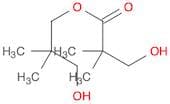
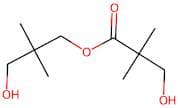
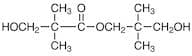
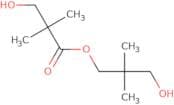
CAS 1115-20-4
:Hydroxypivalyl hydroxypivalate
Description :
Hydroxypivalyl hydroxypivalate, avec le numéro CAS 1115-20-4, est un composé organique qui appartient à la classe des esters. Il est dérivé de l'acide pivalique et se caractérise par la présence de groupes hydroxyles, qui contribuent à sa solubilité et à sa réactivité. Ce composé apparaît généralement sous forme de liquide incolore à jaune pâle et a une volatilité relativement faible. Hydroxypivalyl hydroxypivalate est connu pour son utilisation en tant que plastifiant et comme intermédiaire dans la synthèse de divers produits chimiques. Sa structure moléculaire comprend plusieurs unités de pivalate, qui améliorent sa stabilité et sa compatibilité avec d'autres matériaux. Le composé présente une toxicité modérée et doit être manipulé avec précaution dans les environnements de laboratoire et industriels. De plus, il est important de considérer son impact environnemental, comme c'est le cas pour de nombreux composés organiques, lors de l'évaluation de son utilisation dans diverses applications. Dans l'ensemble, Hydroxypivalyl hydroxypivalate est apprécié pour ses propriétés fonctionnelles dans les formulations chimiques et la science des matériaux.
Formule :C10H20O4
InChI :InChI=1S/C10H20O4/c1-9(2,5-11)7-14-8(13)10(3,4)6-12/h11-12H,5-7H2,1-4H3
Code InChI :InChIKey=SZCWBURCISJFEZ-UHFFFAOYSA-N
SMILES :C(OCC(CO)(C)C)(C(CO)(C)C)=O
Synonymes :- 1,3-Propanediol, 2,2-dimethyl-, mono(2,2-dimethylhydracrylate)
- 2,2-Dimethyl-1,3-propanediol mono(hydroxypivalate)
- 2,2-Dimethyl-3-hydroxypropyl 2,2-dimethyl-3-hydroxypropionate
- 2,2-Dimethyl-3-hydroxypropyl α,α-dimethyl-β-hydroxypropionate
- 3-(Hydroxypivaloyloxy)-2,2-dimethylpropanol
- 3-Hydroxy-2,2-Dimethylpropanoic Anhydride
- 3-Hydroxy-2,2-Dimethylpropyl 3-Hydroxy-2,2-Dimethylpropanoate
- 3-Hydroxy-2,2-dimethylpropyl 2,2-dimethylhydracrylate
- 3-Hydroxy-2,2-dimethylpropyl hydroxypivalate
- Ester Diol 204
- Hphp
- Hydracrylic acid, 2,2-dimethyl-, 3-hydroxy-2,2-dimethylpropyl ester
- Hydroxyneopentyl hydroxypivalate
- Hydroxypivalic acid neopentyl glycol ester
- Hydroxypivalic acid neopentylglycol ester
- Hydroxypivalyl hydroxypivalate
- Neopentyl glycol hydroxypivalate monoester
- Neopentyl glycol mono(hydroxypivalate)
- Neopentyl glycol monoester hydropivalicate
- Neopentyl glycol monohydroxypivalate
- Voir plus de synonymes
Trier par
Degré de pureté (%)
0
100
|
0
|
50
|
90
|
95
|
100
5 produits concernés.
3-Hydroxy-2,2-dimethylpropyl 3-hydroxy-2,2-dimethylpropanoate
CAS :Formule :C10H20O4Degré de pureté :98%Couleur et forme :SolidMasse moléculaire :204.26343-Hydroxy-2,2-Dimethylpropyl 3-Hydroxy-2,2-Dimethylpropanoate
CAS :3-Hydroxy-2,2-Dimethylpropyl 3-Hydroxy-2,2-DimethylpropanoateDegré de pureté :98%Masse moléculaire :204.26g/molNeopentyl Glycol Mono(hydroxypivalate)
CAS :Formule :C10H20O4Degré de pureté :>97.0%(GC)Couleur et forme :White to Almost white powder to crystalMasse moléculaire :204.273-Hydroxy-2,2-dimethylpropyl 3-hydroxy-2,2-dimethylpropanoate
CAS :Degré de pureté :98%Masse moléculaire :204.2660065Neopentyl Glycol Mono(hydroxypivalate)
CAS :Neopentyl Glycol Mono(hydroxypivalate) (NPGMP) is an organic solvent that is used as a reactive diluent for coatings and adhesives. It is synthesized by reacting isobutyraldehyde with glycerol, which results in the formation of an alkynyl group and a hydroxyl group. The alkynyl group reacts with the copper chromite to form an organic molecule containing a functional copolymer. NPGMP is then reacted with calcium carbonate to form a functional copolymer containing hydroxyl groups. This copolymer can be used as a substrate for coatings, such as polarizers or optical filters, due to its specific chemical properties.
Formule :C10H20O4Degré de pureté :Min. 95%Masse moléculaire :204.27 g/mol