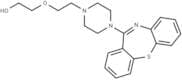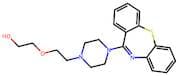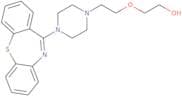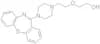
CAS 111974-69-7
:Quétiapine
Description :
Quétiapine est un médicament antipsychotique atypique principalement utilisé pour traiter la schizophrénie, le trouble bipolaire et le trouble dépressif majeur. Il fonctionne en modulant divers systèmes de neurotransmetteurs dans le cerveau, en particulier en antagonisant les récepteurs de la dopamine D2 et de la sérotonine 5-HT2A, ce qui aide à atténuer les symptômes de psychose et de troubles de l'humeur. Quétiapine se caractérise par sa relativement faible affinité pour les récepteurs muscariniques, ce qui contribue à son profil d'effets secondaires favorable par rapport aux antipsychotiques plus anciens. La substance est généralement administrée sous forme de comprimé et est connue pour ses propriétés sédatives, ce qui la rend utile dans la gestion de l'agitation aiguë. Quétiapine a une demi-vie qui permet une posologie une ou deux fois par jour, et elle subit un métabolisme hépatique étendu, principalement via le système du cytochrome P450. Les effets secondaires courants peuvent inclure somnolence, vertiges et changements métaboliques, tels que la prise de poids. Comme pour tout médicament, il est essentiel que les patients soient surveillés pour d'éventuels effets indésirables et qu'ils discutent de toute préoccupation avec leur fournisseur de soins de santé.
Formule :C21H25N3O2S
InChI :InChI=1S/C21H25N3O2S/c25-14-16-26-15-13-23-9-11-24(12-10-23)21-17-5-1-3-7-19(17)27-20-8-4-2-6-18(20)22-21/h1-8,25H,9-16H2
Code InChI :InChIKey=URKOMYMAXPYINW-UHFFFAOYSA-N
SMILES :C(COCCO)N1CCN(C=2C=3C(SC=4C(N2)=CC=CC4)=CC=CC3)CC1
Synonymes :- 11-[4-[2-(2-Hydroxyethoxy)Ethyl]-1-Piperazinyl]Dibenzo[B,F][1,4]Thiazepine
- 2-(2-(4-Dibenzo(b,f)(1,4)thiazepine-11-yl-1-piperazinyl)ethoxy)ethanol
- 2-[2-(4-dibenzo[b,f][1,4]thiazepin-11-ylpiperazin-1-yl)ethoxy]ethanol (2E)-but-2-enedioate (2:1) (salt)
- 2-{2-4-(Dibenzob,F1,4Thiazepin-11-Yl)Piperazin-1-Ylethoxy}Ethanol
- 2-{2-[4-(Dibenzo[b,f][1,4]thiazepin-11-yl)-1-piperazinyl]ethoxy}ethanol
- 2-{2-[4-(Dibenzo[b,f][1,4]thiazepin-11-yl)piperazin-1-yl]ethoxy}ethanol
- 2-{[2-(4-Dibenzo[B,F][1,4]Thiazepin-11-Ylpiperazin-1-Yl)Ethyl]Oxy}Ethanol
- Dibenzo[b,f][1,4]thiazepine, ethanol deriv.
- Ethanol, 2-2-(4-Dibenzob,F1,4Thiazepin-11-Yl-1-Piperazinyl)Ethoxy-
- Ethanol, 2-[2-(4-Dibenzo[B,F][1,4]Thiazepin-11-Yl-1-Piperazinyl)Ethoxy]-
- Ketipinor
- Seronia
- Voir plus de synonymes
Trier par
Degré de pureté (%)
0
100
|
0
|
50
|
90
|
95
|
100
8 produits concernés.
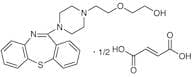
Quetiapine Hemifumarate
CAS :Formule :C21H25N3O2SC4H4O4Degré de pureté :>98.0%(T)(HPLC)Couleur et forme :White to Almost white powder to crystalMasse moléculaire :441.552-[2-(4-Dibenzo[b,f][1,4]thiazepin-11-yl-1-piperazinyl)ethoxy]ethanol
CAS :Formule :C21H25N3O2SDegré de pureté :98%Couleur et forme :SolidMasse moléculaire :383.5071Quetiapine
CAS :Quetiapine treats schizophrenia and bipolar I, targeting serotonin, dopamine, and adrenoreceptor subtypes, plus H1 histamine receptor.Formule :C21H25N3O2SDegré de pureté :99.14% - 99.63%Couleur et forme :White To Off-White Crystalline PowderMasse moléculaire :383.51Quetiapine
CAS :Produit contrôléStability Very Very Hygroscopic
Applications Quetiapine is a dibenzothiazepine antipsychotic commonly used as monotherapy for patients with major depressive disorder and schizophrenia.
Not a dangerous good if item is equal to or less than 1g/ml and there is less than 100g/ml in the package
References Cutler, A., et al.: J. Clin. Psych., 70, 526 (2009); Kapur, S., et al.: Arch. Gen. Psych., 57, 553 (2000); Peuskens, J. & Link, C.: Acta. Psych. Scand., 96, 265 (1997)Formule :C21H25N3O2SCouleur et forme :Off-White To YellowMasse moléculaire :383.51Quetiapine
CAS :Produit contrôléQuetiapine is a psychotropic drug that belongs to the class of atypical antipsychotics. It is used in the treatment of schizophrenia and bipolar disorder. Quetiapine has been shown to have a potent inhibitory effect on prolactin levels, which may be due to its ability to induce fumarate reductase and increase blood flow to the hypothalamus. Quetiapine also interacts with a number of other drugs and can lead to adverse reactions when taken with them. The clinical efficacy of quetiapine for schizophrenia was demonstrated by a double-blind, randomized, placebo-controlled trial involving over 400 patients. The therapeutic efficacy of quetiapine has also been demonstrated in treatment trials involving patients with acute mania associated with bipolar disorder and schizoaffective disorder.Formule :C21H25N3O2SDegré de pureté :Min. 95%Couleur et forme :PowderMasse moléculaire :383.51 g/molQuetiapine
CAS :Formule :C21H25N3O2SDegré de pureté :95.0%Couleur et forme :SolidMasse moléculaire :383.167

![2-[2-(4-Dibenzo[b,f][1,4]thiazepin-11-yl-1-piperazinyl)ethoxy]ethanol](/_next/image/?url=https%3A%2Fstatic.cymitquimica.com%2Fproducts%2FIN%2Fthumb%2FDA003EQ0.jpg&w=3840&q=75)