CAS 1126-58-5
:Girard's
Description :
Le réactif Girard's T, également connu sous le nom de 2,4-dinitrophénylhydrazine (DNPH), est un composé chimique couramment utilisé en chimie organique pour l'identification et la caractérisation des composés carbonyles, tels que les aldéhydes et les cétones. Il se caractérise par sa capacité à former des dérivés d'hydrazone stables lors de la réaction avec des groupes carbonyles, qui peuvent être facilement isolés et analysés. Le réactif est généralement un solide cristallin de couleur jaune à orange, et ses dérivés présentent souvent des points de fusion distincts, facilitant l'identification du composé carbonyle d'origine. Le réactif Girard's T est également remarquable pour sa sensibilité et sa spécificité, ce qui en fait un outil précieux tant dans les applications de laboratoire qu'industrielles, y compris l'analyse de produits pharmaceutiques et d'échantillons environnementaux. De plus, il est important de manipuler ce réactif avec précaution en raison de sa toxicité potentielle et de la nécessité de mesures de sécurité appropriées lors de son utilisation. Dans l'ensemble, le réactif Girard's T joue un rôle significatif dans la synthèse organique et la chimie analytique.
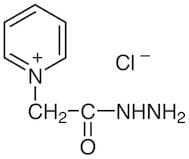
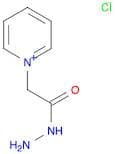
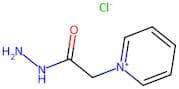
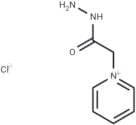
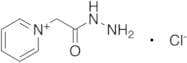
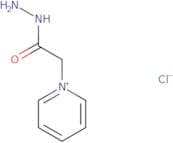
Formule :C7H10N3O·Cl
InChI :InChI=1S/C7H9N3O.ClH/c8-9-7(11)6-10-4-2-1-3-5-10;/h1-5H,6,8H2;1H
Code InChI :InChIKey=NDXLVXDHVHWYFR-UHFFFAOYSA-N
SMILES :C(C(NN)=O)[N+]=1C=CC=CC1.[Cl-]
Synonymes :- 1-(2-Hydrazino-2-oxoethyl)pyridinium chloride
- 1-(2-Hydrazinyl-2-Oxoethyl)Pyridinium Chloride
- 1-(2-Hydrazinyl-2-oxoethyl)pyridin-1-iumchloride
- 1-(Carboxymethyl)pyridinium chloride, hydrazide
- 1-[(Hydrazinecarbonyl)methyl]pyridin-1-ium chloride
- 1126-58-5
- Girard's P reagent
- Girard-P reagent
- Pyridinioacetohydrazide chloride
- Pyridinium, 1- (2-hydrazino-2-oxoethyl)-, chloride
- Pyridinium, 1-(2-Hydrazinyl-2-Oxoethyl)-, Chloride (1:1)
- Pyridinium, 1-(carboxymethyl)-, chloride, hydrazide
- Voir plus de synonymes
Trier par
Degré de pureté (%)
0
100
|
0
|
50
|
90
|
95
|
100
9 produits concernés.
Girard's Reagent P
CAS :Formule :C7H10ClN3ODegré de pureté :>95.0%(T)Couleur et forme :White to Light yellow to Light orange powder to crystalMasse moléculaire :187.631-(2-Hydrazinyl-2-oxoethyl)pyridin-1-ium chloride
CAS :Formule :C7H10ClN3ODegré de pureté :97%Couleur et forme :SolidMasse moléculaire :187.62681-(2-Hydrazinyl-2-oxoethyl)pyridin-1-ium chloride
CAS :1-(2-Hydrazinyl-2-oxoethyl)pyridin-1-ium chlorideDegré de pureté :97%Masse moléculaire :187.63g/molGirard's reagent P
CAS :Formule :C7H10ClN3ODegré de pureté :≥ 95.0%Couleur et forme :White to light yellow or light orange crystalline powderMasse moléculaire :187.63Girard's Reagent P
CAS :Girard's Reagent P, a cationic hydrazine compound, serves as a derivatization agent for the quantification of glycans, oxysterols, and 5-methylcytosineFormule :C7H10N3O·ClCouleur et forme :SolidMasse moléculaire :187.63Girard's Reagent P
CAS :Produit contrôléApplications Girard’s reagent used in the identification and quantification of protein carbonylation as well as in the modification of nucleosides and nucleotides. Used in the preparation of potent photoactive agents.
References Mirzaei, H., et al.: J. Chrom. A, 1134, 122 (2007); Kanofsky, J.R., et al.: Photochem. Photobiol., 73, 349 (2001);Formule :C7H10N3O•ClCouleur et forme :NeatMasse moléculaire :152.183545Girard's reagent P
CAS :Girard's reagent P is a mixture of phenylhydrazine and p-chloro-phenylhydrazine. It is used as a chemical test for the detection of carbonyl groups in organic compounds. This test has been shown to be sensitive to carotenoids, which are found in human serum or urine samples. Girard's reagent P can be used to identify cancer tissues by detecting the presence of hydroxyl groups that are found in the amino acids methionine and cysteine. The hydroxyl group reacts with the phenylhydrazine component of Girard's reagent P, giving off a purple color. Additionally, Girard's reagent P can be used in conjunction with other chemicals to identify specific types of cancer cells such as cerebrotendinous xanthomatosis and neuroblastoma, which have chemical structures that contain hydroxyl groups.Formule :C7H10ClN3ODegré de pureté :Min. 95%Couleur et forme :White PowderMasse moléculaire :187.63 g/mol1-(2-Hydrazinyl-2-oxoethyl)pyridin-1-ium chloride
CAS :Formule :C7H10ClN3ODegré de pureté :97%Couleur et forme :SolidMasse moléculaire :187.63