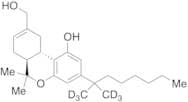
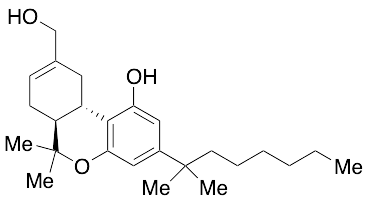
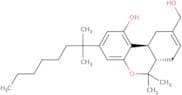
CAS 112924-45-5
:1,1-Diméthylheptyl-11-hydroxytétrahydrocannabinol
Description :
1,1-Diméthylheptyl-11-hydroxytétrahydrocannabinol, communément appelé cannabinoïde synthétique, est un composé qui imite les effets des cannabinoïdes naturels présents dans la plante de cannabis. Cette substance se caractérise par sa structure moléculaire complexe, qui comprend un squelette de tétrahydrocannabinol (THC) modifié avec une chaîne latérale de diméthylheptyle et un groupe hydroxyle en position 11. Sa formule chimique contribue à sa lipophilie, lui permettant d'interagir efficacement avec les récepteurs cannabinoïdes dans le corps, en particulier les récepteurs CB1 et CB2, qui sont impliqués dans divers processus physiologiques tels que la sensation de douleur, la régulation de l'humeur et le contrôle de l'appétit. Le composé est généralement étudié pour ses effets thérapeutiques potentiels, y compris des propriétés analgésiques et anti-inflammatoires, mais il peut également présenter des effets psychoactifs similaires à ceux du THC. En raison de sa nature synthétique, il peut présenter des profils pharmacocinétiques et pharmacodynamiques différents de ceux des cannabinoïdes naturels, soulevant des préoccupations concernant la sécurité, la légalité et le potentiel d'abus.
Formule :C25H38O3
InChI :InChI=1/C25H38O3/c1-6-7-8-9-12-24(2,3)18-14-21(27)23-19-13-17(16-26)10-11-20(19)25(4,5)28-22(23)15-18/h10,14-15,19-20,26-27H,6-9,11-13,16H2,1-5H3/t19-,20-/m0/s1
Code InChI :InChIKey=SSQJFGMEZBFMNV-PMACEKPBSA-N
SMILES :OC1=C2[C@@]3([C@@](C(C)(C)OC2=CC(C(CCCCCC)(C)C)=C1)(CC=C(CO)C3)[H])[H]
Synonymes :- (+)-Hu-210
- (6aS,10aS)-3-(1,1-Dimethylheptyl)-6a,7,10,10a-tetrahydro-1-hydroxy-6,6-dimethyl-6H-dibenzo[b,d]pyran-9-methanol
- (6aS,10aS)-9-(hydroxymethyl)-6,6-dimethyl-3-(2-methyloctan-2-yl)-6a,7,10,10a-tetrahydro-6H-benzo[c]chromen-1-ol
- 6H-Dibenzo[b,d]pyran-9-methanol, 3-(1,1-dimethylheptyl)-6a,7,10,10a-tetrahydro-1-hydroxy-6,6-dimethyl-, (6aS,10aS)-
- 6H-Dibenzo[b,d]pyran-9-methanol, 3-(1,1-dimethylheptyl)-6a,7,10,10a-tetrahydro-1-hydroxy-6,6-dimethyl-, (6aS-trans)-
- Dexanabinol
- Hu 211
- Prs 211007-000
- Sinnabidiol
- 1,1-Dimethylheptyl-11-hydroxytetrahydrocannabinol
- [6aS,(+)]-6a,7,10,10aβ-Tetrahydro-1-hydroxy-6,6-dimethyl-3-(1,1-dimethylheptyl)-6H-dibenzo[b,d]pyran-9-methanol
- (6aS,10aS)-3-(1,1-Dimethylheptyl)-6a,77,10,10a-tetrahydro-1-hydroxy-6,6-dimethyl-6H-dibenzo[b,d]pyran-9-methanol
- (6AR)-TRANS-3-(1,1-DIMETHYLHEPTYL)-6A,7,10,10A-TETRAHYDRO-1-HYDROXY-6,6-DIMETHYL-6H-DIBENZO[B,D]PYRAN-9-METHANOL
- (6AR,10AR)-3-(1,1'-DIMETHYLHEPTYL)-6A,7,10,10A-TETRAHYDRO-1-HYDROXY-6,6-DIMETHYL-6H-DIBENZO[B,D]PYRAN-9-METHANOL
- (6aS,10aS)-9-(hydroxymethyl)-6,6-dimethyl-3-(2-methyloctan-2-yl)-6a,7,10,10a-tetrahydrobenzo[c]chromen-1-ol
- (6aS,10aS)-3-(1,1-dimethylheptyl)-6,6-dimethyl-9-methylol-6a,7,10,10a-tetrahydrobenzo[c]chromen-1-ol
- (6aS)-6aα,7,10,10aβ-Tetrahydro-6,6-dimethyl-1-hydroxy-3-(1,1-dimethylheptyl)-6H-dibenzo[b,d]pyran-9-methanol
- Voir plus de synonymes
Trier par
Degré de pureté (%)
0
100
|
0
|
50
|
90
|
95
|
100
3 produits concernés.
HU 211
CAS :Produit contrôléApplications HU-211 is a synthetic cannabinoid derivative that inhibits TNFα and interleukin-6 (1,2,3). HU-211 exhibits neuroprotective, antioxidant, and anti-inflammatory properties. It might be a useful agent for the treatment of stroke patients, by protecting neuronal lysosomes from nitric oxide (NO)-mediated toxicity.
References (1) Shohami, E., et al.: J. Neuroimmunol., 72, 169 (1997)(2) Ramazan, D., et al.: Neuochemical Res., 33, 1683 (2008) (3) Leker, R., et al.: J. Neurol. Sci., 162, 114 (1999)Formule :C25H38O3Couleur et forme :NeatMasse moléculaire :386.57HU 211
CAS :Produit contrôléHU 211 is a novel synthetic cannabinoid that has been shown to have a number of pharmacological activities. It has been shown to induce neuronal death by causing mitochondrial membrane potential depolarization, which leads to the release of cytochrome c and other apoptotic factors from the mitochondria. HU 211 has also been shown to inhibit tumor growth in animal models when administered alone or in combination with cytotoxic agents like paclitaxel. The synergistic effect between HU 211 and paclitaxel is due to their ability to decrease the expression of anti-apoptotic molecules. HU 211 also inhibits transcriptional regulation, leading to inhibition of protein synthesis and cell proliferation. HU 211's antitumor activity has been demonstrated in animal models for breast, colon, lung, liver, and prostate cancers as well as bowel disease (including colitis), Parkinson's disease, and dopamine-related disorders.Formule :C25H38O3Degré de pureté :Min. 95%Masse moléculaire :386.57 g/mol